About Catocala sponsa Linnaeus, 1767
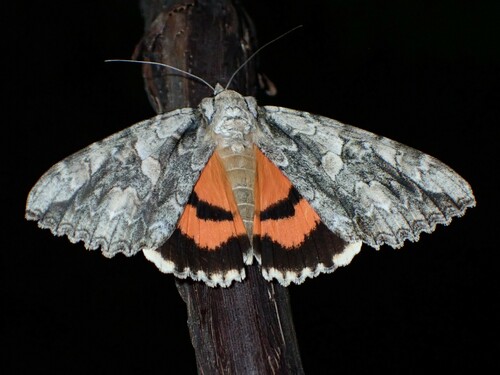
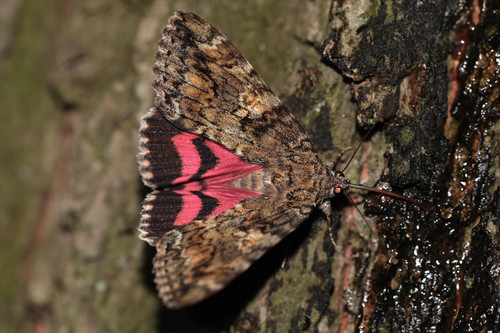
Technical description and variation for M. sponsa L. It is somewhat smaller and paler than Catocala dilecta. There is generally a pale fulvous tint below the middle in the space between the outer and submarginal lines. The lunule between veins 3 and 4 is nearly always paler. The pale outline of the reniform stigma, the whitish spot preceding it, and the white spot beneath it are often conspicuous; however, both of these spots may match the ground color, or be yellowish as well as white. The inner margin of the hindwing is not darkened, and the red ground color is not as deep. The form rejecta Fisch.-Wald. is smaller in size, and has the basal area of the hindwing clouded with fuscous; its median band is thickened, and the red band following it is much narrower than is typical; its terminal border is brownish black, and the red ground is dull pink. Judging only by appearance, this could easily be a distinct species. Specimens where the median space between the inner and outer lines is noticeably paler grey than the other areas are separated by Spuler as the aberration fasciata. In aberration desponsa Schultz, the red of the hindwing is either wholly yellow or partially changed to yellow; however, examples of this change in this species are much rarer than in Catocala nupta and Catocala elocata. In aberration florida Schultz, which must be very similar to fasciata Spul., the median area and the terminal area beyond the subterminal line are whitish grey, while the basal area and the space between the outer line and subterminal line are pale brown. Aberration grisea ab. nov. (a female specimen of which is held in the Tring Museum from Uralsk, sent by M. Bartel) is entirely dark grey grizzled with pale grey, without any brown or fulvous tints, and has black lines. The subspecies laeta Oberth., from Algeria, is brighter than specimens from Southern Europe; its median area is dusted with whitish at each end, its subterminal line is whitish, and the annulus of the reniform stigma, and the spots before and below it, are white. The larva is grey brown or red brown, with fine dark dots; it has reddish dorsal tubercles. The hump on segment 9 is prominent, and bears an oval yellow transverse marking edged with black. The hump on segment 12 is also strong, with the two hind tubercles on it developed into brown points. The larval head is grey with black streaks.