About Catocala junctura Walker
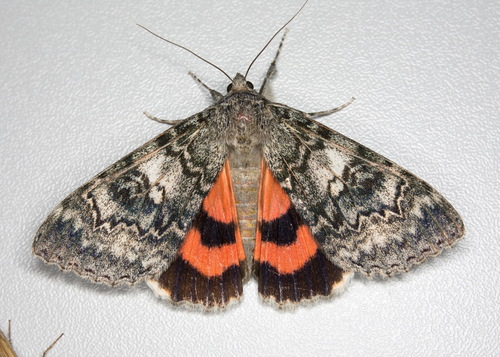
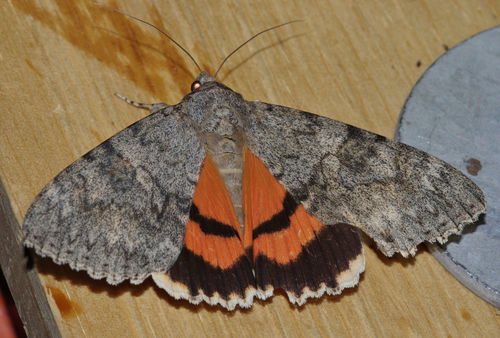
Catocala junctura Walker has a wingspan of 70–75 mm or larger. Its forewings range from grayish to brownish, marked with prominent black bands on the upper surface and whitish on the lower surface. The upperside of each hindwing is orange red, with two roughly concentric blackish bands, and no hairs at the wing base. The outer black band divides the upper hindwing, creating a margin that is lighter in color than the rest of the wing surface. The inner black band does not reach the hindwing’s trailing edge; its hindward tip forms a hook that points back toward, or almost back toward, the wing base. On the underside of the hindwings, the area along the leading edge is whitish, while the trailing three-quarters of the wing are orange red. The inner black band is also visible on the underside of the hindwings. Like many of its close relatives, this species has no spines on the foreleg tibia, while the tarsi bear three rows of spines. Adult Catocala junctura are active from June to September, with timing varying by location. There is most likely one generation produced each year. Caterpillars of this species feed on willow species (Salix), and on Fremont cottonwood (Populus fremontii) in the western portion of the species’ range.