About Catherpes mexicanus (Swainson, 1829)
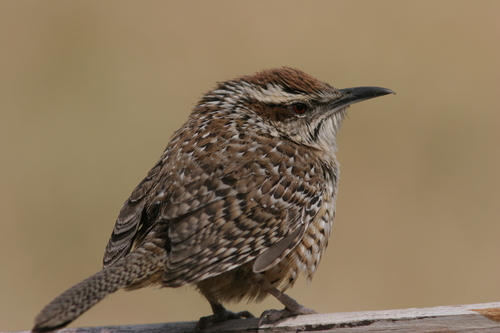
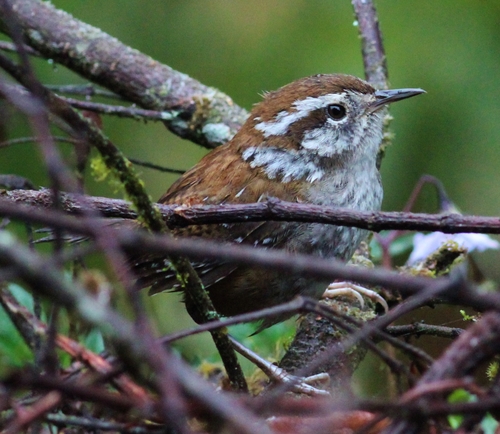
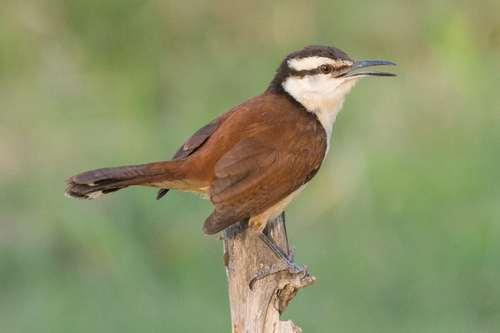
Description: The canyon wren (Catherpes mexicanus) measures 5 1/2 to 6 inches (14 to 15 cm) long, with a long thin beak and a square-tipped tail. It has speckled chestnut coloration that fades to gray on the head, with a contrasting white throat patch. Its coloration and small size let it camouflage perfectly against its rocky environment. The canyon wren has a loud, distinctive call made up of a series of cascading notes. It sings most often in spring, though mated pairs may sing at any time of year. When defending its territory, its song is harsher and lower in frequency. Distribution: Canyon wrens do not migrate, but individual birds may make short seasonal movements. Their typical range stretches from southern British Columbia's Okanagan Valley, through most of the western United States, and into Mexico. Disjunct populations live in the Black Hills of southwest South Dakota, northeast Wyoming, and southeast Montana. Habitat: Like the closely related rock wren, the canyon wren prefers steep, rocky environments, especially in arid landscapes, though it may also forage near rivers. Canyon wrens live year-round in large, widely spaced territories where they forage, breed, and nest. In Colorado, canyon wrens often associate with cliff swallows; the cliff swallows' nests give canyon wrens foraging opportunities, and are sometimes taken over by canyon wrens to use as their own nesting sites.