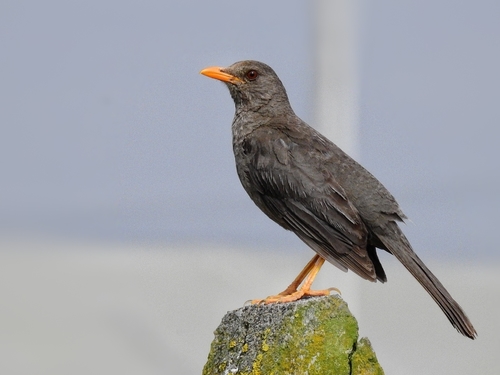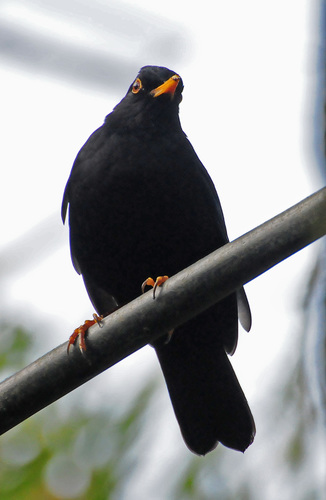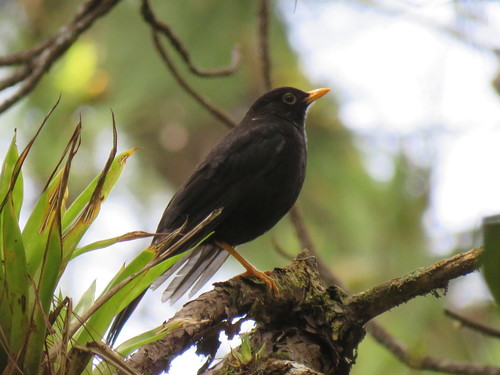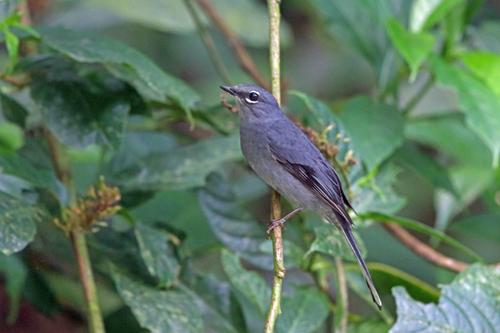
About Catharus minimus (Lafresnaye, 1848)
The gray-cheeked thrush, scientific name Catharus minimus (Lafresnaye, 1848), is slightly larger than other thrushes in the Catharus genus. It measures about 16 to 17 cm (6.7 in) in length, weighs between 26 and 30 g, and has a wingspan ranging from 32 to 34 cm (12.6 to 13.4 in).
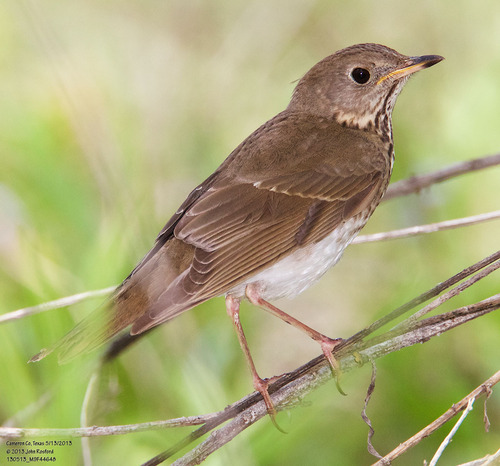
This species can be identified by its grayish face, partial pale eyering, drab gray-brown upperside, and extensively dusky flanks. The area between its eye and beak is also grayish, while the stripe running from the beak to above the eye is grayish white. The gray-cheeked thrush is nearly identical in appearance to Bicknell's Thrush.
There are two recognized subspecies: the northern gray-cheeked thrush (Catharus minimus aliciae), and the nominate subspecies, the Newfoundland gray-cheeked thrush (C. m. minimus). C. m. minimus can be distinguished by its overall browner overall coloration and a buff wash on the breast, compared to C. m. aliciae. C. m. minimus also has an extensive brighter yellow area at the base of the lower mandible. C. m. aliciae has grayish olive upperparts and flanks, a lightly cream-washed breast, and a duller lower mandible, while C. m. minimus has brownish olive upperparts.
The gray-cheeked thrush is a long-distance migratory species, with an average migration distance of 300 km. It is believed to spend the winter in the Amazon basin, and crosses the Caribbean Sea and Gulf of Mexico during its spring migration. The species is present on its breeding grounds from May to August. Its breeding range includes northern boreal forests from Newfoundland to Alaska in North America, and across the Bering Sea to Eastern Siberia, where it is associated with dense conifer and broadleaf shrub thickets. The breeding range extends north of the treeline into low Arctic willow and alder beds.
Gray-cheeked thrushes prefer low coniferous woods, including young regenerating forests, open-canopy old-growth forests that have dense growth of shrubs and small conifers in the understory, and dense, stunted spruce and fir on windblown sites and near the tree line. C. minimus remains uncommon to rare across most regions of North America, but can be spotted in any wooded habitat. The two subspecies have separate breeding ranges: C. m. aliciae breeds from Labrador west to Siberia, while C. m. minimus breeds on the island of Newfoundland and possibly adjacent portions of southern coastal Labrador.
During breeding season, C. minimus exhibits secretive behavior. Nesting pairs are rarely found at high densities, as their territories are well-spaced. The species builds nests on the ground or in low shrubs, typically less than 2 meters above ground. Females construct the nest from dried grasses, mixed with a supporting layer of mud. Gray-cheeked thrushes produce only one brood per season, although they will lay a second brood if the first nest fails early in the season. The average clutch size is 4 eggs per nest, but clutch size can vary between 3 and 5 eggs. The eggs are greenish blue, marked with light brown dots, and are oval to short oval in shape. Females incubate the eggs for 13 to 14 days. Nestlings fledge 11 to 13 days after hatching, and the young are cared for by both parents. Individuals begin breeding at one year of age, and the species is presumed to be monogamous.