About Cathartes melambrotus Wetmore, 1964
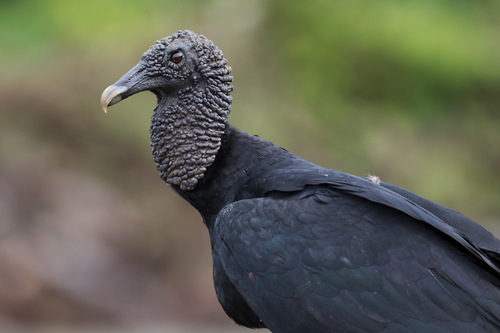
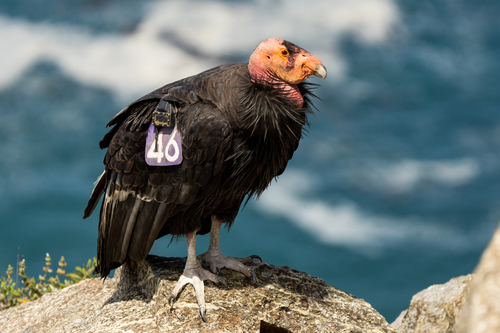
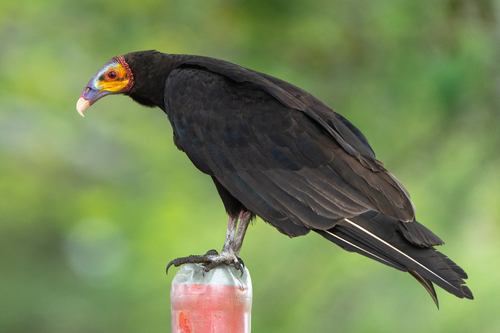
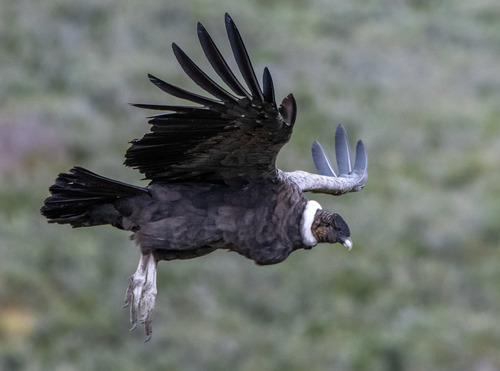
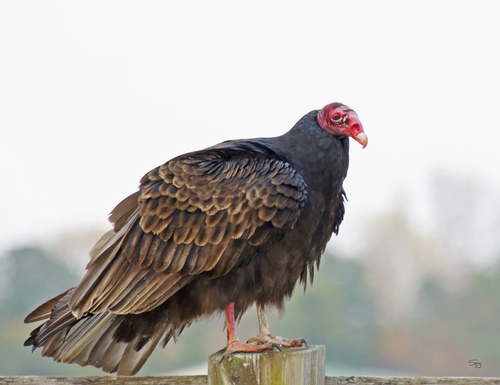
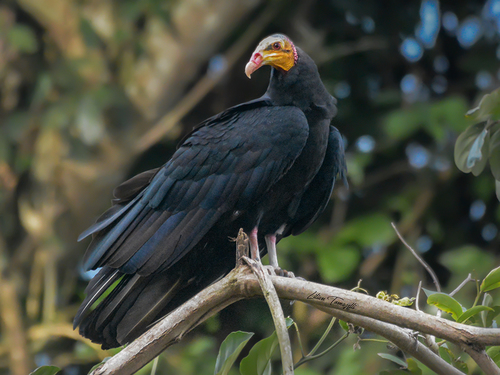
The greater yellow-headed vulture (scientific name: Cathartes melambrotus Wetmore, 1964) measures 64–75 centimetres (25–30 in) in body length, with a 166–178 centimetre (65–70 in) wingspan, a 25–29 centimetre (9.8–11.4 in) tail, and an average weight of 1.65 kilograms (3.6 lb). Its plumage is black with a green or purple sheen. The throat and sides of the head are featherless; the head skin ranges from deep yellow to pale orange, with a blue crown, and the nape and area near the nostrils are pale pinkish. The undersides of the wings are black, while the flight feathers are a lighter shade. When viewed from above, the quills of its eleven primary feathers appear white. The tail is rounded and long for a vulture, extending to or slightly beyond the tip of the closed wing. The two sexes are outwardly identical. Juveniles have dull greyish heads, but are otherwise identical to adults. This vulture has red irises, black feet, a flesh-colored beak that is thick, rounded, and hooked at the tip. It has a single incomplete row of eyelashes on the upper eyelid and two rows on the lower eyelid. Because it practices urohidrosis, the scaly portions of its legs are often streaked white with uric acid. Its front toes are long, with small webs at their bases, and are not adapted for grasping. The nostril opening is longitudinal, set in a soft cere, and the nostrils lack a septum. Like all New World vultures, the greater yellow-headed vulture has no syrinx, so it can only produce grunts or a low hiss, and cannot make other sounds. It differs in appearance and habits from the closely related lesser yellow-headed vulture in multiple ways: it is larger, more heavily built, with a longer, broader tail, darker glossy black plumage (compared to the lesser yellow-headed vulture's browner plumage), darker legs, a head that is more yellow and less orange or pink, broader wings, and steadier flight. Unlike the lesser yellow-headed vulture which prefers savannas, the greater yellow-headed vulture prefers forest habitats. Unlike other members of the genus Cathartes, it has relatively dark inner primary feathers that contrast slightly with its paler secondaries and outer primaries. It is also somewhat larger than the turkey vulture. The two species can only be distinguished at relatively close range by their different head coloration. While their underwing coloration is similar, the greater yellow-headed vulture usually has a faint, broad, dark band running vertically down the middle of its wings. The greater yellow-headed vulture is native to the Amazon Basin of tropical South America, where it occurs specifically in southeastern Colombia, southern and eastern Venezuela, Guyana, French Guiana, Suriname, northern and western Brazil, northern Bolivia, eastern Peru, and eastern Ecuador. It is not found in the Andes, in the lowlands west or north of the Andes, in the relatively open regions of northern or eastern South America, or in southern subtropical South America. It has a large range, with an estimated global extent of occurrence of 6,700,000 square kilometers (2,586,884.5 sq mi). Its natural habitat is tropical moist lowland forests, and it is generally not found in high-altitude regions. It is common in heavily forested areas. It may wander over grasslands, but rarely travels far from forested areas that provide it with shelter and nesting sites. In terms of ecology and behavior, the greater yellow-headed vulture roosts on tall, exposed dead trees to observe the surrounding area. When flying, it travels alone or in pairs, and is rarely found in groups. Its flight is heavy and steady. It holds its wings flat or very slightly above horizontal in the dihedral position. It uses static soaring flight, which relies on thermals to maintain altitude without flapping its wings. Like storks and other New World vultures, the greater yellow-headed vulture exhibits the unusual behavior of urohidrosis, in which it urinates or defecates on its legs to cool them through evaporation.