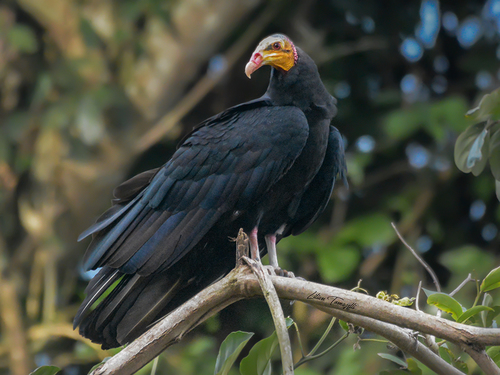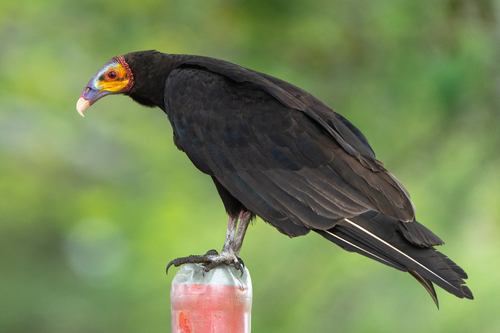
About Cathartes aura (Linnaeus, 1758)
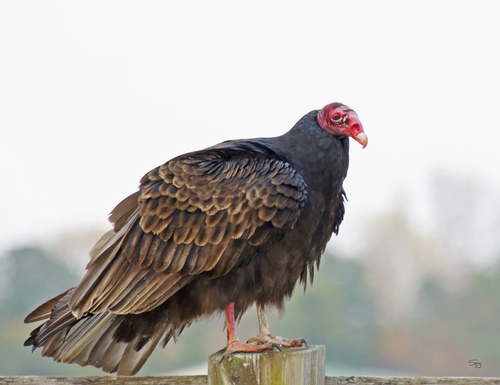
This large bird, scientifically named Cathartes aura (Linnaeus, 1758), measures 62–81 cm (24–32 in) in length, has a wingspan of 160–183 cm (63–72 in), and weighs 0.8 to 2.41 kg (1.8 to 5.3 lb). Individuals from the northern edge of the species' range are on average larger than those from the neotropics; 124 birds from Florida had an average weight of 2 kg (4.4 lb), while samples of 65 and 130 birds from Venezuela had average weights of 1.22 kg (2.7 lb) and 1.45 kg (3.2 lb) respectively. The species shows minimal sexual dimorphism: males and females have identical plumage and coloration, and are similar in size. Most body feathers are brownish-black, while the undersides of the wing flight feathers are silvery-gray, which contrasts with the darker wing linings. Adult turkey vultures have a small head, relative to their body size, that is red and has very few to no feathers. They also have a relatively short, hooked, ivory-colored beak. Their eye irises are gray-brown, and their legs and feet have pink skin that is typically stained white. The upper eyelid has a single incomplete row of eyelashes, while the lower eyelid has two rows. The two front toes on each foot are long, with small webs at their bases, and the toes follow the classic anisodactyl arrangement. Foot tracks are large, measuring 9.5 to 14 cm (3.7 to 5.5 in) in length and 8.2 to 10.2 cm (3.2 to 4.0 in) in width, with both measurements including claw marks. The feet are flat, relatively weak, and poorly suited to grasping, and the talons are also not built for grasping, as they are fairly blunt. In flight, the tail is long and slim. In comparison, the related black vulture has a shorter tail and shorter wings, so it appears smaller in flight than the turkey vulture even though the two species have roughly similar body masses. The nostrils of the turkey vulture are perforate rather than divided by a septum, meaning it is possible to see through the beak from the side. The turkey vulture molts gradually from late winter to early spring, with the molt continuing until early autumn. Immature birds have a gray head and a black beak tip; these colors change to match adult coloration as the bird matures. Captive longevity for the species is not well documented. As of 2025, the oldest known captive individual is a 51-year-old male named Lord Richard, housed at the Lindsay Wildlife Experience in Walnut Creek, California. Lord Richard hatched in 1974 at the Randall Museum in San Francisco and moved to Lindsay Wildlife later the same year. Another captive turkey vulture named Nero lived to 47 years old. Nero also hatched in 1974; he was taken from his nest for research at the University of Wisconsin, later became an education ambassador at the Carpenter Nature Center in Hastings, Minnesota, and joined the education department of the University of Minnesota's Raptor Center in 1993. He remained the center's only educational vulture until his death in 2022. The oldest recorded wild banded turkey vulture was 16 years old. Leucistic turkey vultures, which are sometimes mistakenly called albino, are occasionally observed. Like most other vultures, the turkey vulture has very limited ability to produce vocalizations. Since it lacks a syrinx, it can only make hisses and grunts. The turkey vulture has a very large range, with an estimated global distribution covering 28,000,000 km² (11,000,000 sq mi). It is the most widely distributed vulture in the Americas, and matches its cousin the black vulture as one of the most abundant raptorial birds worldwide. Its global population is estimated at 18,000,000 individuals. It occurs in open and semi-open areas across the Americas, ranging from southern Canada to Cape Horn. It is a permanent resident in the southern United States, though birds from northern populations may migrate as far south as South America. It is widespread across nearly all American habitats, but has specific habitat preferences. It is most common in relatively open areas adjacent to woodland, which provides important sites for nesting and roosting. In North America, turkey vultures generally avoid dense closed forests that can interfere with taking flight, and often prefer hills or low mountainous areas that make catching flight easier with less effort. The species can be seen flying over open country including grasslands, but is usually absent from completely treeless areas such as parts of the prairies or Great Plains. It can also adapt to live in tropical and subtropical forests, shrublands, deserts and semi-deserts, wetlands, and foothills. Evidence shows agricultural land is an important habitat for turkey vultures, primarily pastureland or other low-input farmland for foraging and roosting, but the species only visits row-crop agricultural areas temporarily as flyovers. It also uses other manmade habitats, and is regularly seen over urban areas throughout its range, though it tends to use these areas more when not breeding because it cannot nest without appropriate natural habitats. It does not live as a regular urban bird as commonly as black vultures do in the tropics and subtropics. The bird's crow-like appearance inspired the name of Uruguay's Quebrada de los Cuervos (Crows Ravine), where turkey vultures live alongside the lesser yellow-headed vulture and the black vulture. The turkey vulture is gregarious, and roosts in large community groups, leaving the roost to forage independently during the day. Several hundred vultures may roost together in groups, which sometimes include black vultures. They often roost on dead, leafless trees and low-density conifers, and will also roost on manmade structures such as water or microwave towers. While they nest in caves, they do not enter caves except during the breeding season. At night, the turkey vulture lowers its body temperature by approximately 6 °C (11 °F) to 34 °C (93 °F), becoming slightly hypothermic. This vulture is frequently seen standing with its wings spread, in a posture called horaltic. This stance is thought to serve multiple functions: drying the wings, warming the body, and killing bacteria that accumulate on the bird. It is done more often after damp or rainy nights. This same behavior is seen in other New World vultures, Old World vultures, and storks. Like storks, the turkey vulture often defecates on its own legs, using evaporation of water from the feces and/or urine to cool itself, a process called urohidrosis. This cools the blood vessels in the unfeathered tarsi and feet, and leaves streaks of white uric acid on the legs. The turkey vulture has very few natural predators, and recorded predation events are quite infrequent. Fledglings, immature birds, and adult vultures are preyed on, in order from most to least frequent, by great horned owls, golden eagles, bald eagles, and potentially red-tailed hawks. Eggs and nestlings may be preyed on by mammals such as raccoons and opossums. Foxes can occasionally ambush adult turkey vultures, but climbing species are more likely to access and predate nests than adults, and dogs may sometimes kill a turkey vulture as well. The turkey vulture's primary defense is regurgitating semi-digested meat, a foul-smelling substance that deters most creatures from attacking a vulture nest. If a predator is close enough, the vomit will also sting if it gets in the predator's face or eyes. In some cases, the vulture must empty its crop of a heavy, undigested meal to take flight and escape from a potential predator. Life expectancy in the wild can reach at least 16 years, and captive lifespans of over 45 years are possible. On the ground, the turkey vulture is awkward and moves with an ungainly hopping walk. It requires a great deal of effort to take flight, flapping its wings while pushing off the ground and hopping with its feet. When soaring, the turkey vulture holds its wings in a shallow V-shape and often tips from side to side, which frequently makes the gray flight feathers look silvery as they catch the light. Its flight is a form of static soaring: it flaps its wings very infrequently, and uses rising thermals to stay aloft.