About Catananche caerulea L.
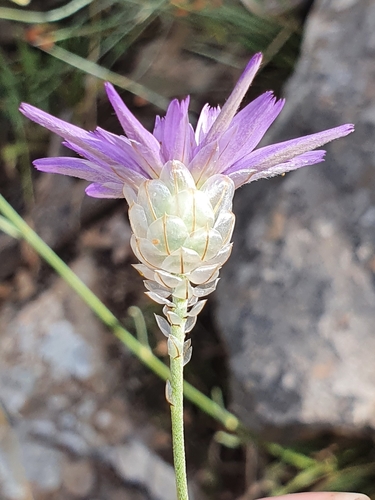
Catananche caerulea L., commonly called Cupid's dart, is a short-lived herbaceous perennial plant that grows 20–90 cm (8–36 in) tall, and has a chromosome count of 2n=18. In the wild, this species is native to western North Africa, specifically Morocco, Algeria, Tunisia and Libya, and south-western Europe, specifically Portugal, Spain including the Balearic Islands, Andorra, France, and Italy. It has become naturalized in Czechoslovakia, and may appear temporarily in other locations when it escapes from cultivation. In its natural habitat, Catananche caerulea grows on disturbed, young or eroded carbonaceous soils, in plant communities made up of dwarf shrubs and perennials. It is frequently found associated with a range of other species: multiple Cistaceae including Fumana laevipes, Helianthemum apenninum, H. cinereum, H. marifolium, H. croceum; several Lamiaceae including Lavandula latifolia, Rosmarinus palaui, Teucrium capitulatum, and T. haenseleri; several Asteraceae including Rhaponticum coniferum, Scorzonera hispanica, Serratula flavescens and S. pinnatifida; a small number of Fabaceae including Astragalus glaux and Ononis pusilla; parasitic plants including Cytinus ruber and Orobanche latisquama; and additional species including Aristolochia pistolochia, Euphorbia nicaeensis, Globularia vulgaris, Ruta chalepensis, and Viola arborescens. Catananche caerulea is cultivated as an ornamental short-lived perennial for garden use, and it can self-seed spontaneously. It grows best in full sun with well-draining soil, and is drought tolerant. Several cultivated selections are grown, including 'Amor Blue', 'Major' which produces larger flowers, 'Alba', and 'Amor White' which has white petals with purple floret tubes. The cultivar C. caerulea 'Major' has received the Royal Horticultural Society's Award of Garden Merit, a confirmation that was made in 2017.