About Catalpa ovata G.Don
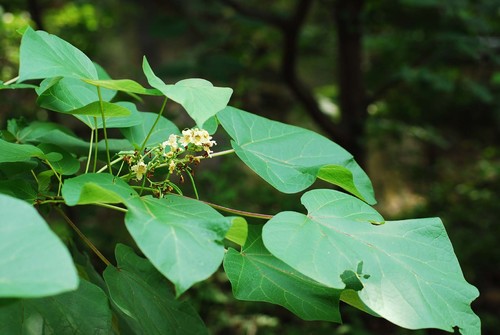
Catalpa ovata, commonly known as yellow catalpa or Chinese catalpa (Chinese: 梓; pinyin: zǐ), is a pod-bearing tree native to China. In comparison to Catalpa speciosa, it is much smaller, typically growing to heights between 20 and 30 feet (6 and 9 m). Its inflorescences grow as 4–10-inch (100–250 mm) long bunches of creamy white flowers with distinct yellow tinging; individual flowers are around 1 inch (25 mm) wide. This species blooms in July and August. Its leaves are very similar in shape to the leaves of Paulownia tomentosa, with three lobes: two lobes are abruptly truncated on either edge, and a third central, slightly acute, pointed lobe forms the leaf apex; the leaves are dark green. Its fruits are very narrow pods that reach one foot in length. While it is native to temperate provinces of China, specifically Anhui, Gansu, Hebei, Heilongjiang, Henan, Hubei, Jiangsu, Jilin, Liaoning, Nei Monggol, Ningxia, Qinghai, Shaanxi, Shandong, Shanxi, Sichuan, and Xinjiang, Catalpa ovata is also cultivated in North America and Europe. It has become one of the parent species of the hybrid Catalpa × erubescens, crossed with the American species Catalpa bignonioides. It is commonly used to make the undersides of qin.