About Catalpa bignonioides Walter
Catalpa bignonioides Walter is a deciduous tree that grows 7.6–12.2 meters (25–40 feet) tall, with a spread equal to or greater than its height. Its trunk can reach up to 1 meter (3 ft 3 in) in diameter, and is covered in brown to gray bark that matures into hard plates or ridges. The short, thick trunk supports long, straggling branches that form a broad, irregular crown. Its roots are fibrous, branches are brittle, and its watery juices have a bitter taste.
The leaves are large, bright green, heart-shaped, measuring 20–30 cm (8–12 in) long and 15–20 cm (6–8 in) broad. Leaves emerge late in the season, and reach full size before flower clusters open, adding to the tree’s beauty when in bloom. An unusual characteristic for leaves, they secrete nectar via clusters of tiny glands in the axils of primary veins. Nectar secretion begins one week before the tree’s flowers bloom, and continues up to ten days after blooming ends, as recorded in the July 1938 issue of American Bee Journal (Vol 78, Iss 7, Page 319). Leaves are arranged opposite each other or in groups of three, are simple, broadly ovate with a cordate base, have smooth or wavy edges, and come to an acute or acuminate tip. They unfold involute from buds with a purplish tint; when fully grown, they are bright green and smooth on the upper surface, pale green and downy on the lower surface. Bruised leaves give off a disagreeable odor, and they turn dark and fall after the first severe frost. Leaf stalks (petioles) are stout, terete, and long. Clusters of dark nectar-secreting glands are consistently found in the axils of the primary leaf veins.
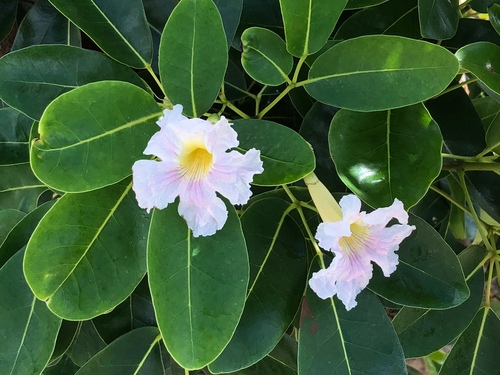
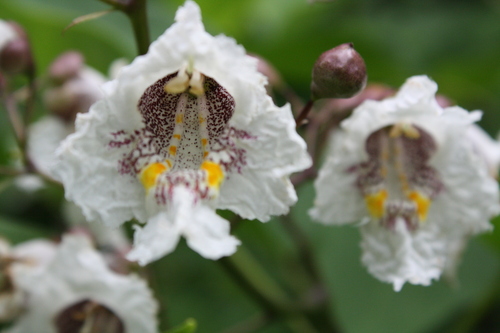
Flowers measure 2.5–4 cm across, are trumpet-shaped, white with yellow spots on the inside, and grow in panicles holding 20–40 flowers each. In the northern United States, this tree is a late bloomer, producing large panicles of white flowers in June or early July, when most other trees have finished blooming. The flowers are so dense they almost completely cover the tree’s full-grown leaves. While whole flower clusters appear pure white, individual corollas are marked with purple and gold spots; some of these spots are arranged in lines along a ridge that lead directly to the flower’s internal nectar. A fully expanded single flower is 5 cm (2 in) long and 40 mm (1+1⁄2 in) wide. It is two-lipped with lobed lips: two lobes on the upper lip and three on the lower, a common structure for this corolla shape. Flowers are perfect, bearing both stamens and pistils, but of the five expected stamens, three have aborted, lost their anthers, and become simple filaments. This species cannot self-fertilize: the stigma lobes remain closed until the flower’s own anthers have opened and released all their pollen. After the anthers wither and become non-functional, the stigma opens to receive pollen from visiting bees. This reproductive strategy is also seen in the entire Pink family. Flowers are produced from June to July, are perfect and white, and borne in many-flowered thyrsoid panicles 200–250 mm (8–10 in) long. Flower stalks (pedicels) are slender and downy. The calyx is globular and pointed in bud, and eventually splits into two broadly ovate, smooth-edged lobes that are green or light purple. The corolla is bell-shaped (campanulate), with a swollen, slightly oblique tube, is two-lipped and five-lobed, with the two upper lobes smaller than the three lower lobes. It is imbricate in bud, with a spreading, undulate flower limb; when fully expanded it is 40 mm (1+1⁄2 in) wide and nearly 50 mm (2 in) long. It is white, marked on the inner surface with two rows of yellow blotches, and marked with purple spots on the lower lobes in the flower throat. Only two (rarely four) stamens are fertile; they are inserted near the base of the corolla, are introrse and slightly exserted, with oblong two-celled anthers that open longitudinally, and flattened thread-like filaments. Three sterile filaments, often rudimentary, are inserted near the base of the corolla. The pistil has a superior two-celled ovary, a long thread-like style, and a two-lipped stigma, with numerous ovules.
The fruit is a long, thin seed pod 20–40 cm long and 8–10 mm in diameter, which often stays attached to the tree through winter. The capsule holds numerous flat light brown seeds, each with two papery wings. Despite its bean-like pod shape, it is not closely related to true beans. Botanically, it is more accurately described as a long slender nearly cylindrical two-celled capsule, with a partition positioned at right angles to the capsule valves. It ranges from 150–500 mm (6–20 in) long, is brown, hangs on the tree all winter, and splits open before falling. Seeds are 25 mm (1 in) long and 5 mm (1⁄4 in) wide, silvery gray, with a wing on each side and fringed wing edges.
C. bignonioides is closely related to Northern Catalpa (C. speciosa), and can be distinguished by its flowering panicles, which hold a larger number of smaller flowers, and its slightly more slender seed capsules. Bark is light brown with a red tinge. Young branchlets fork regularly in pairs; they are initially green, shaded purple, and slightly hairy, turning gray or yellowish brown with age, and finally becoming reddish brown. Bark contains tannin. The wood is light brown, with nearly white sapwood; it is light, soft, coarse-grained, and durable when in contact with soil. Winter buds have no terminal bud; the uppermost bud is axillary, minute, globular, and sits deep in the bark. Outer bud scales fall when spring growth begins, while inner scales enlarge with the growing shoot, becoming green, hairy, and sometimes reaching 50 mm (2 in) long.
In terms of distribution, C. bignonioides is definitely native to the southern United States, and Europeans first recorded it growing in the cultivated fields of the Cherokee Native American tribe. Its original native range is somewhat uncertain, however, because it also grows successfully in the northern United States. Despite its southern origins, it can grow well almost anywhere in the United States and the southernmost part of Canada, and has become widely naturalized outside its original restricted native range.
In cultivation and uses, C. bignonioides is a fast-growing tree widely planted as an ornamental. It bears some of the showiest flowers of any native American tree, a valued trait that has long been recognized, so it has an established place in parks and gardens across all temperate countries. It, along with its gold-leafed cultivar C. bignonioides 'Aurea', has received the Royal Horticultural Society's Award of Garden Merit. The purple-leaved hybrid Catalpa × erubescens 'Purpurea' (synonym C. bignonioides 'Purpurea') has also received this award, with confirmation in 2017. It prefers moist soil and full sun. It is easily grown from seed, which germinate early in their first growing season, and can also be propagated readily from cuttings. The tree is fairly resistant to fungal diseases and has few insect pests. Its wood is brittle and hard, but resists rotting, so it is used for fence posts and railroad ties.
C. bignonioides contains varying levels of iridoid glycosides that deter most generalist herbivores, but these compounds are tolerated and concentrated in Ceratomia catalpae caterpillars. These caterpillars share a long-term ecological relationship with the tree, and may defoliate a tree three or more times in a single summer without killing it. Fishing enthusiasts value these caterpillars highly as bait, particularly for catfish, and often collect them in spring to freeze for use over months. C. bignonioides is one of the parent species of the intergeneric hybrid tree × Chitalpa tashkentensis; the other parent is Chilopsis linearis. This cross was made by a Russian scientist in Tashkent, Uzbekistan. The hybrid is sterile, and at least two cultivars exist: 'White Cloud' and 'Pink Dawn'.