About Catagonus wagneri (Rusconi, 1930)
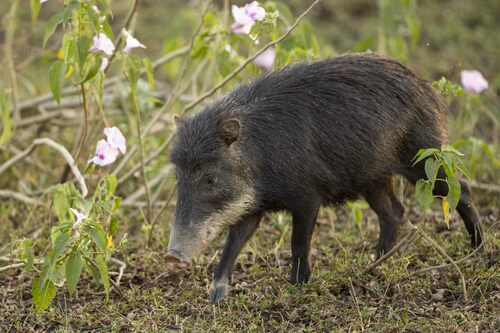
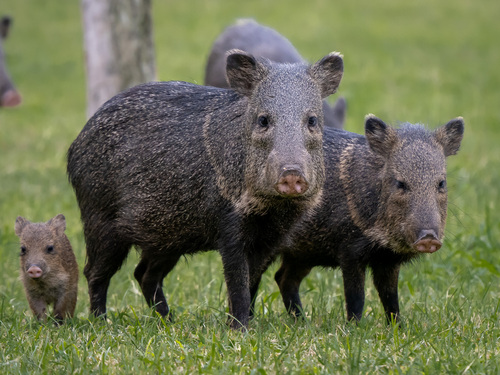
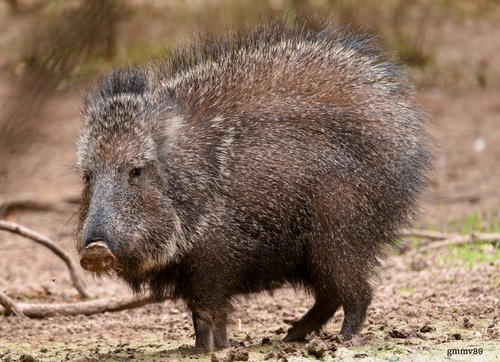
Catagonus wagneri, commonly known as the Chacoan peccary, is the largest of the three generally accepted peccary species. It is an ungulate with many pig-like features, including a well-formed rostrum ending in a tough, leathery snout. Its bristle-like hair ranges in color from brown to nearly gray; a dark stripe runs across its back, and its shoulders are covered in white fur. Compared to other peccary species, Chacoan peccaries have longer ears, longer snouts, and longer tails. Unlike other peccaries, they have white hairs around the mouth, and they retain a third hind toe, while other peccaries only have two. They have hypsodont teeth following the dental formula 2/3, 1/1, 3/3, 3/3. Like all peccaries, their upper canines point downwards, unlike the outward and upward pointing canines of pigs; this downward orientation may help signal to other peccaries to keep the group together while moving through dense bush. The Chacoan peccary is restricted to hot, dry areas, specifically the Gran Chaco, a roughly 140,000 km2 region dominated by low-lying succulents and thorny bushes. While a small number of scattered giant trees grow here, most of the region’s vegetation is thorny scrub. Chacoan peccaries have evolved specific adaptations for dry, dusty conditions, including well-developed sinuses. Their small feet improve their ability to maneuver among spiny plants. For Chacoan peccaries, most young are born between September and December, though litters have been recorded at almost any time of year. Births coincide with periods of increased food availability and rainfall. The average number of recorded embryos per pregnancy is approximately 2.72. Females typically leave their herd to give birth, then return to the herd afterwards. Newborn Chacoan peccaries are precocial, able to run just a few hours after birth. The young’s fur coat matches that of adults, and there is no sexual dimorphism in the species. The arid Gran Chaco habitat offers only very tough vegetation for Chacoan peccaries to eat. These peccaries feed on various cactus species, including Cleistocactus baumannii and Opuntia discolor. They use their tough snout to roll cacti along the ground to rub off spines; they may also pull spines off with their teeth and spit them out. Their kidneys are specialized to break down acids from cacti, and their two-chambered stomachs are well adapted to digest tough plant foods. Chacoan peccaries occasionally graze on bromeliad roots, and also eat acacia pods and fallen cactus flowers. They will seek out salt licks that form on ant mounds and in areas affected by construction projects like road building and land clearing, to obtain essential minerals including calcium, magnesium, and chlorine.