About Cataclysta lemnata Linnaeus, 1758
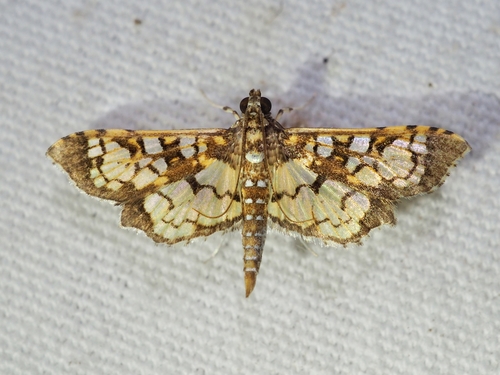
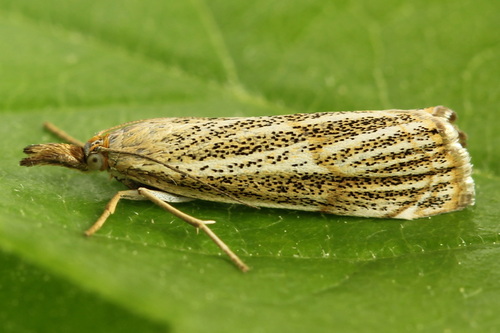
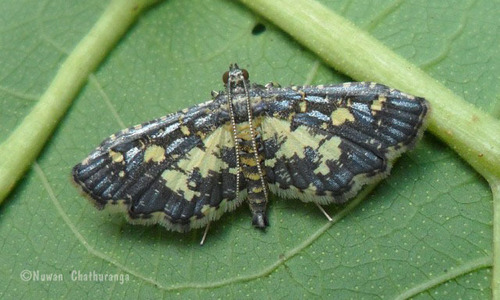
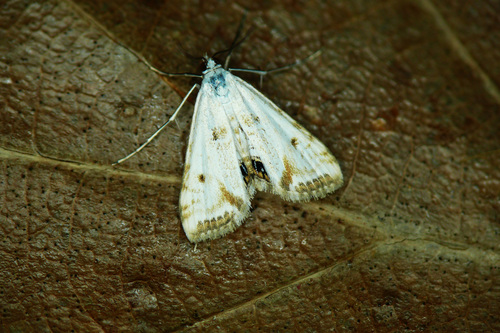
Cataclysta lemnata, commonly known as the small china-mark, is a moth species belonging to the family Crambidae. Its distribution includes Europe, which covers Great Britain and Ireland, as well as Morocco and Iran. Adults of this species display sexual dimorphism. Males have a wingspan of 18–19 mm, while females have a wingspan of 22–24 mm. For the typical wing pattern, the forewings are white, with a fuscous costa, fuscous discal spot, and a series of fuscous terminal spots; the hindwings are white with scattered pale fuscous scales. Meyrick’s more detailed description notes that male forewings are whitish, with a yellowish-fuscous discal dot, faint traces of lines, and a pale brownish terminal streak. Female forewings are pale brownish mixed with ochreous, with a darker discal spot, very indistinct whitish lines edged with darker color, and a whitish subterminal streak. The hindwings are white, with a dark fuscous discal dot; lines are outlined with fuscous, and are sometimes nearly absent; the first line is preceded by a yellow or fuscous spot in the disc; subterminal and terminal ochreous lines enclose a black fascia marked with four bluish-silvery dots. The larva is dark green or blackish, with a black dorsal line and a pale brown head. This account also references the work of Parsons et al. The adult moth flies from May to August, with the timing varying by location. Larvae of Cataclysta lemnata are semiaquatic. They have been recorded feeding on duckweed species, including Lemna species and Spirodela polyrhiza, as well as water ferns of the genus Azolla. This species pupates inside cocoons or shelters constructed from plant material.