About Casuarina pauper F.Muell. ex Miq.
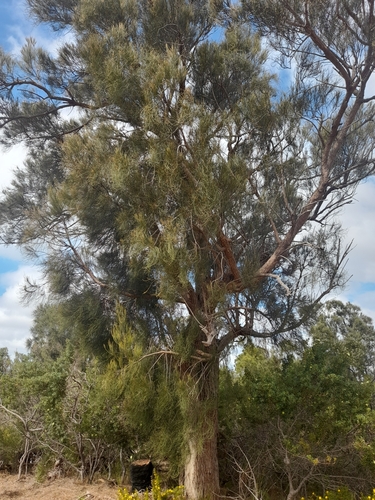
Casuarina pauper F.Muell. ex Miq. is a dioecious tree that is similar to Casuarina cristata. It typically grows to a height of 5 to 15 meters (16 to 49 feet), reaches up to 0.5 meters (1 foot 8 inches) in diameter at breast height, and sometimes produces root suckers.
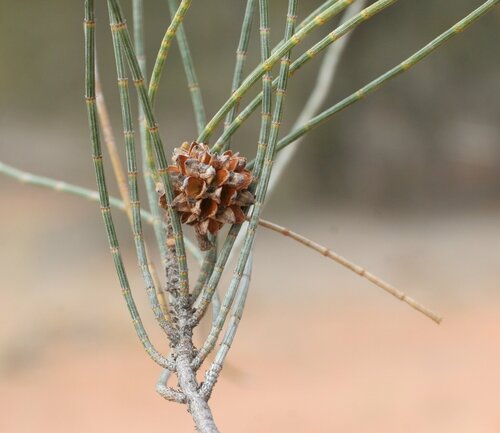
Its branchlets are more or less erect or spreading, and grow up to 250 millimeters (9.8 inches) long. Its true leaves are reduced to small, scale-like teeth 0.8 to 0.9 millimeters (0.031 to 0.035 inches) long, arranged in whorls of 9 to 13 around the branchlets. The sections of branchlet between the leaf whorls, called "articles", are waxy, 8 to 17 millimeters (0.31 to 0.67 inches) long and 1.0 to 1.8 millimeters (0.039 to 0.071 inches) wide.
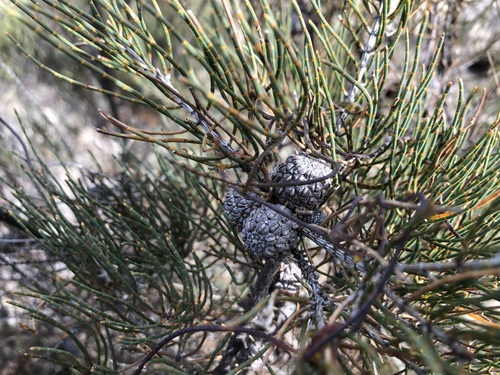
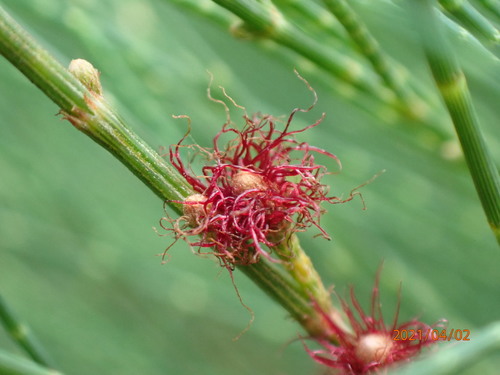
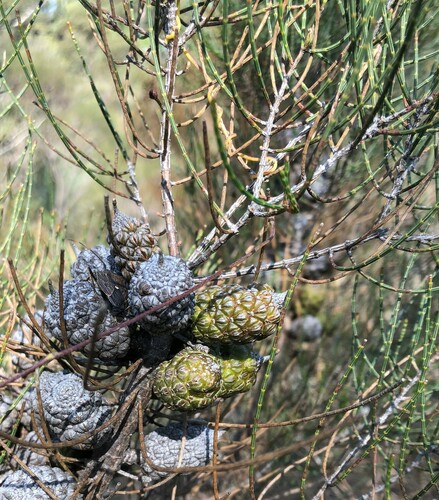
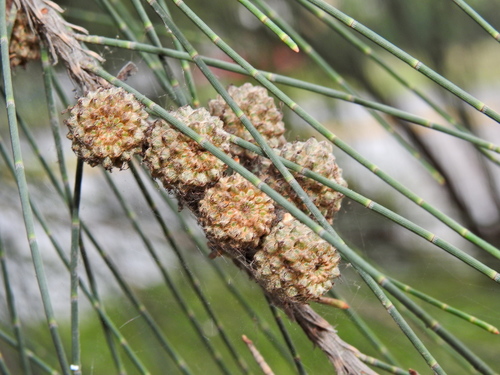
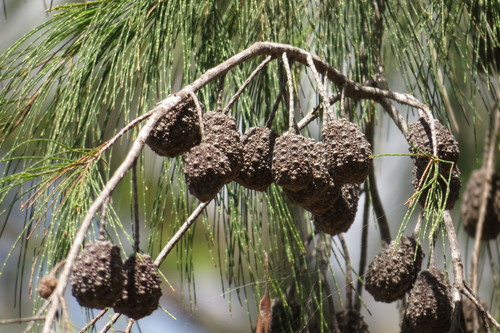
Flowers on male plants are arranged in spikes 10 to 30 millimeters (0.39 to 1.18 inches) long, and the anthers are 0.8 to 1.1 millimeters (0.031 to 0.043 inches) long. Female cones are covered with rust-colored hairs, and grow on a peduncle 1 to 14 millimeters (0.039 to 0.551 inches) long. Mature cones are usually 10 to 22 millimeters (0.39 to 0.87 inches) long and 11 to 15 millimeters (0.43 to 0.59 inches) in diameter, and the winged seeds called samaras are 5.5 to 7.0 millimeters (0.22 to 0.28 inches) long. This species is a poorer, stunted form of C. cristata, and the two species often intergrade where their ranges overlap.
Commonly called black oak, this species grows in red-brown soils in open woodland, sometimes alongside Callitris gracilis. It is widespread across southern Australia, occurring in the far south-west of Queensland, western New South Wales, north-western Victoria, South Australia, and inland Western Australia. It typically grows in groves ranging in area from less than 1 hectare to 10 hectares (2.5 to 24.7 acres), at altitudes between 400 and 500 meters (1,300 to 1,600 feet), in regions where annual temperatures range between 3 and 36 °C (37 and 97 °F).
Casuarina pauper produces abundant viable seed. Successful seed regeneration is likely inhibited during periods when soil moisture is insufficient. When the species occurs at low densities, it tends to reproduce sexually. Established groves mostly extend from their outer edges through growth of root suckers, which increases the local area occupied by individual plants.