About Casuarina equisetifolia L.
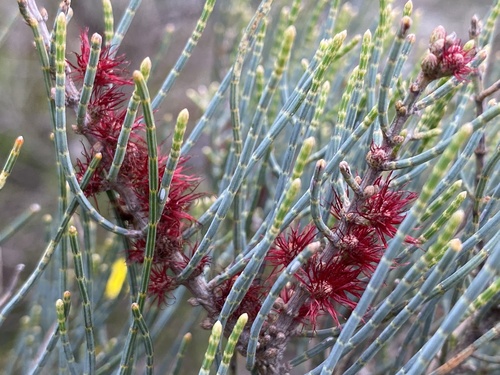
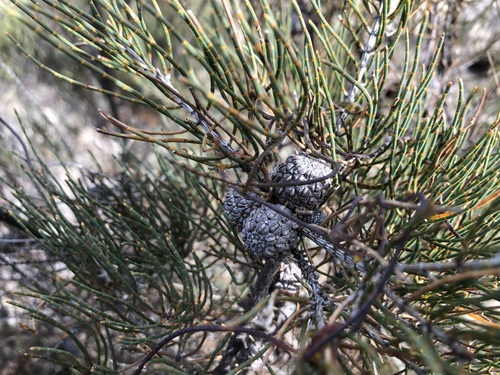
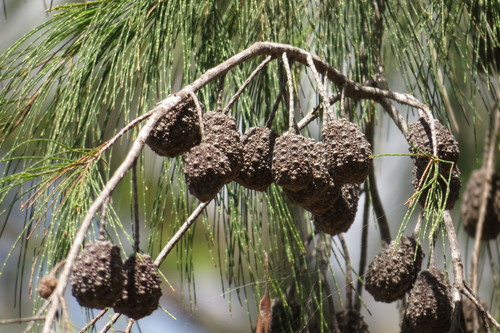
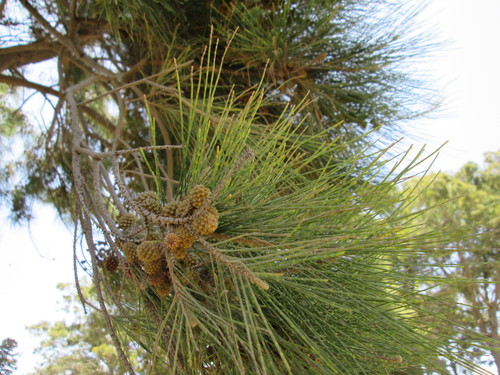
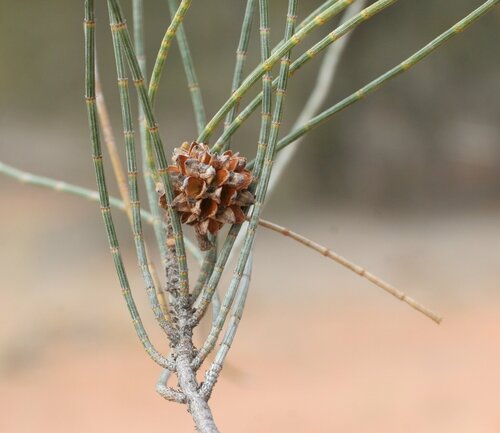
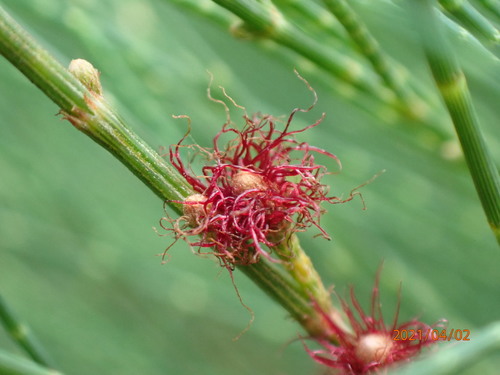
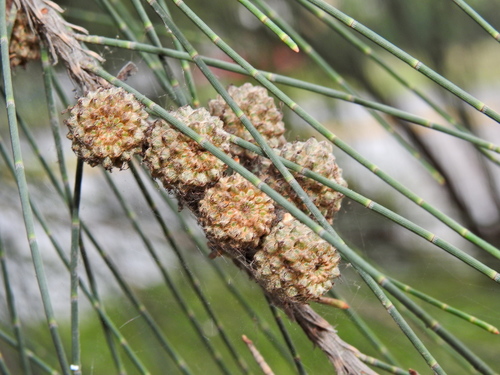
Casuarina equisetifolia L. has a range of common names, including coastal she-oak, horsetail she-oak, ironwood, beach sheoak, beach casuarina, whistling tree, and Australian pine. It is a species of flowering plant in the family Casuarinaceae, native to Australia, New Guinea, Southeast Asia, and India. It is a small to medium-sized, monoecious tree. Older individuals have scaly or furrowed bark, and the tree has drooping branchlets. Its leaves are reduced to small scales arranged in whorls of 7 or 8. The fruit of this species is 10–24 mm (0.4–0.9 in) long, and contains winged seeds called samaras that measure 6–8 mm (0.2–0.3 in) in length. There are two accepted subspecies of Casuarina equisetifolia. Casuarina equisetifolia subsp. equisetifolia grows near the sea, behind beaches, and near estuaries, and sometimes grows on rocky headlands, across its native range of Australia, New Guinea, Southeast Asia, and India. The native range of the species is broken down by region: in South Asia it is native to India and Bangladesh; in Southeast Asia it is native to Myanmar, the Andaman Islands, Nicobar Islands, Vietnam, Thailand, Cambodia, Peninsular Malaysia, the Philippines, Borneo, Java, the Lesser Sunda Islands, islands in the South China Sea, Sulawesi, and Sumatra; in the Pacific Ocean it is native to the Carolines, Fiji, the Marianas, the Marshall Islands, New Caledonia, Samoa, Solomon Islands, Tonga, Tuvalu, and Vanuatu; it is native to New Guinea; and in Australia it is native to New South Wales, the Northern Territory, and Queensland. The subspecies C. equisetifolia subsp. incana grows on rocky headlands near the coasts of eastern Queensland and New South Wales in Australia, ranging as far south as Laurieton. Casuarina equisetifolia has been introduced to many other continents and islands around the world. It is classed as an invasive species in the United States, but biological control using insects including a Selitrichodes wasp, and moths from the families Carposinidae and Gelechiidae, has been effective at managing it. It is also regarded as invasive in South Africa. Casuarina equisetifolia is an actinorhizal plant. It can fix atmospheric nitrogen through a symbiotic relationship with strains of the actinomycete Frankia, which lives in nodules on the tree's roots. In addition to being grown as an ornamental plant, Casuarina equisetifolia has been studied for its potential use in remediating textile dye wastewater. All parts of the plant have been found to work as absorbent material for removing different textile dyes: leaves can remove reactive orange 16, rhodamine B, methylene blue, malachite green, and methyl violet 2B; dried cones can remove rhodamine B and methyl violet 2B; bark can remove methylene blue; and seeds can remove neutral red and malachite green. Carbon produced from the cones of C. equisetifolia has been found to be an effective absorbent for landfill leachate, and one laboratory study also found it has good absorbency for copper ions removed from aqueous solutions. When planted in lines in coastal areas, C. equisetifolia trees are known to help reduce wind force. In countries such as India, the species is recognized as suitable for use in wasteland development.