About Casuarina cunninghamiana Miq.
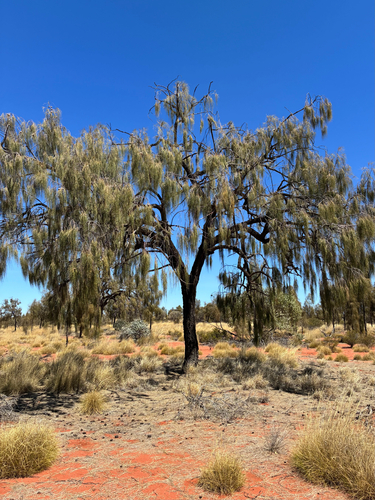
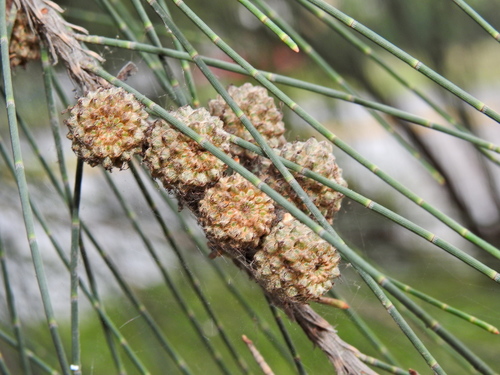
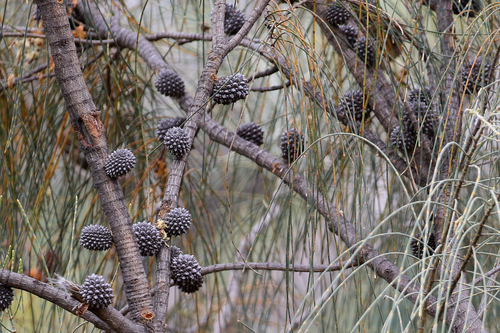
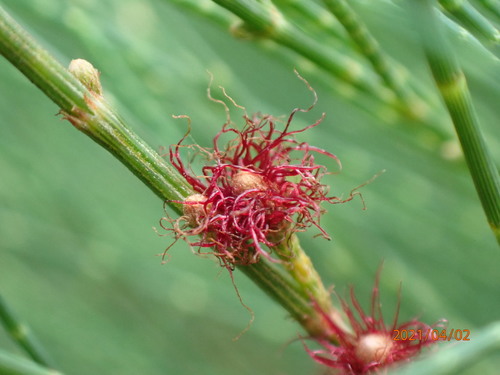
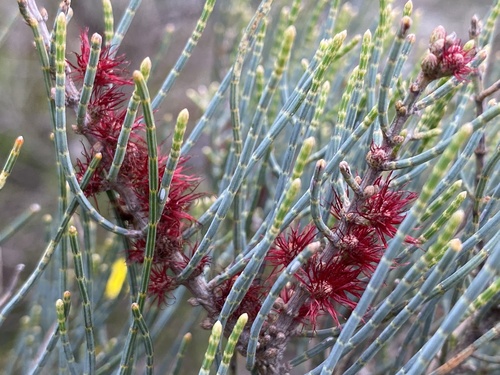
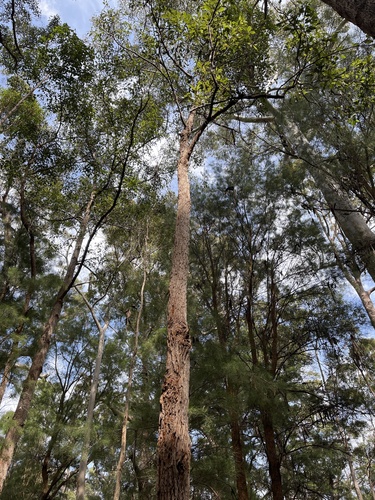
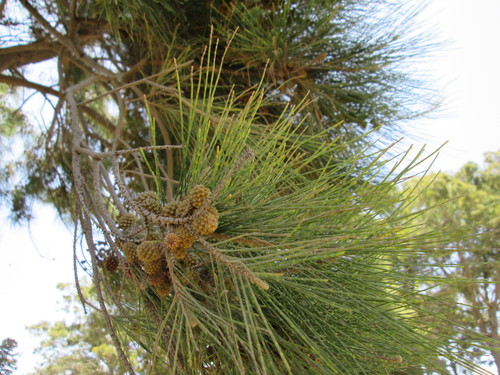
Casuarina cunninghamiana Miq. is a dioecious tree that typically reaches 15 to 35 metres (49 to 115 feet) in height, with a diameter at breast height of 0.5 to 1.5 metres (1 foot 8 inches to 4 feet 11 inches). It has finely fissured, scaly, greyish brown bark, and often produces drooping branchlets that are 100 to 250 millimetres (3.9 to 9.8 inches) long. Its leaves are reduced to scale-like teeth 0.3 to 0.5 millimetres (0.01 to 0.02 inches) long, arranged in whorls of 6 to 10 around the branchlets. The sections of branchlet between the leaf whorls, called "articles", are 4 to 9 millimetres (0.2 to 0.4 inches) long and 0.4 to 0.7 millimetres (0.02 to 0.03 inches) wide. Male trees produce flowers arranged in spikes that are 4 to 40 millimetres (0.2 to 1.6 inches) long, with anthers 0.4 to 0.7 millimetres (0.02 to 0.03 inches) long. Female cones grow on a 2 to 9 millimetre (0.08 to 0.4 inch) long peduncle and are sparsely covered with soft hairs. Mature cones are usually 7 to 14 millimetres (0.3 to 0.6 inches) long and 4 to 6 millimetres (0.16 to 0.24 inches) in diameter, and the samaras they produce are 3 to 4 millimetres (0.12 to 0.16 inches) long. This casuarina grows mainly in pure stands in open forest on the banks of freshwater rivers and streams in Australia and New Guinea. Subspecies cunninghamiana is found from Laura, Chillagoe and Augathella in Queensland to Condobolin and Narrandera in New South Wales, as well as in the Australian Capital Territory. Subspecies miodon occurs in the area between the Daly River in northern Northern Territory to the Gulf of Carpentaria in Queensland. Commonly called river oak, this tree is widely recognized as important for stabilising riverbanks and preventing soil erosion, and tolerates both wet and dry soils. Its foliage is quite palatable to livestock.