About Casuarina cristata Miq.
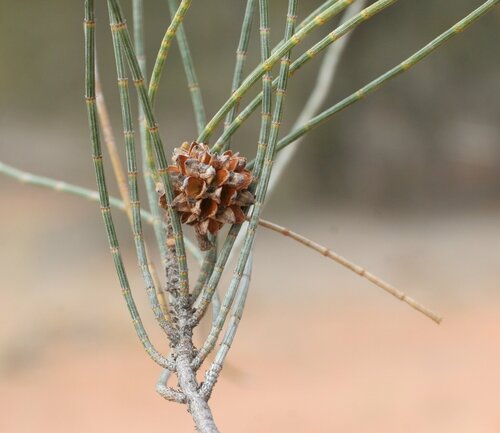
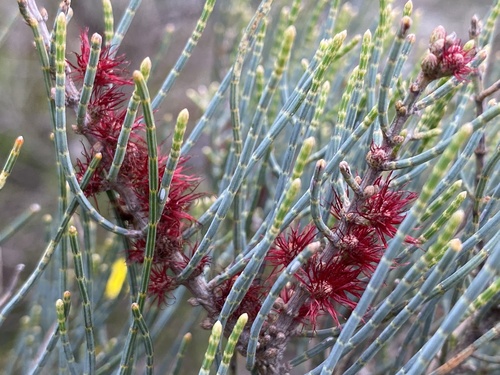
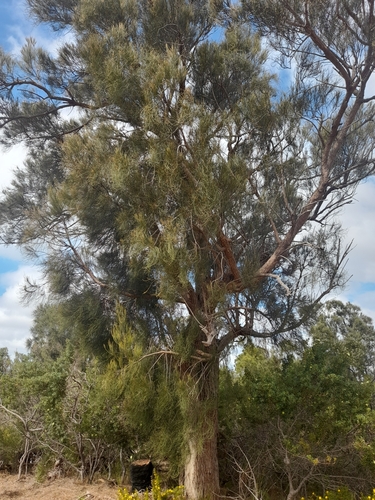
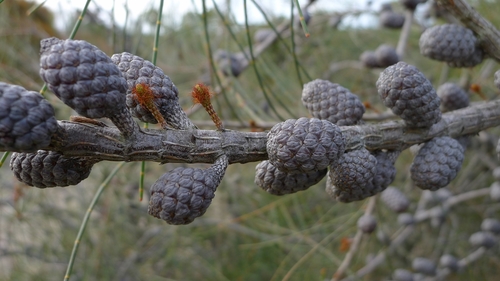
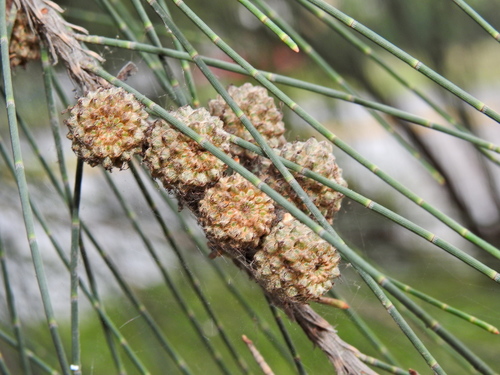
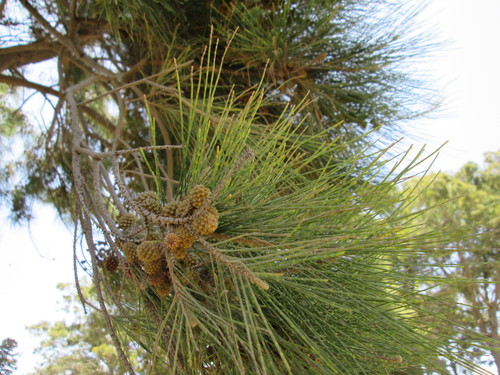
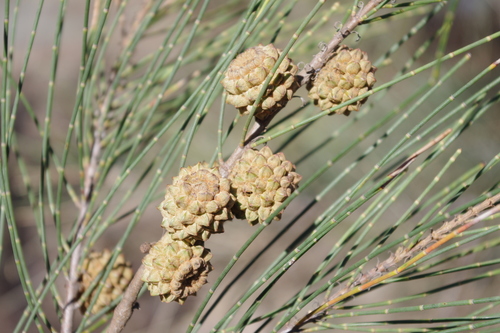
Casuarina cristata Miq., commonly called belah, is a dioecious tree that typically grows 10–20 metres (33–66 feet) tall, reaches up to 1 metre (3 feet 3 inches) in diameter at breast height, and often produces suckers. Its bark is dark greyish brown, with a finely fissured or scaly texture. Branchlets are often drooping, reaching up to 250 millimetres (9.8 inches) in length. Its leaves are reduced to small scale-like teeth 0.5–0.7 millimetres (0.02–0.03 inches) long, arranged in whorls of 8 to 12 around the branchlets. The sections of branchlet between leaf whorls, called "articles", are 8–17 millimetres (0.3–0.7 inches) long and 0.6–0.9 millimetres (0.02–0.04 inches) wide. Male flowers grow in spikes 13–50 millimetres (0.5–2.0 inches) long, and their anthers measure 0.8–1.1 millimetres (0.03–0.04 inches) long. Young female cones are covered in rusty hairs, becoming hairless as they mature, and grow on a peduncle 1–14 millimetres (0.04–0.6 inches) long. Mature cones are typically 13–18 millimetres (0.5–0.7 inches) long and 10–16 millimetres (0.4–0.6 inches) in diameter, and the enclosed samaras are 6.0–10.5 millimetres (0.2–0.4 inches) long. Belah occurs from Clermont in central Queensland, southward to Temora in southern New South Wales. It is an important component of the endangered Brigalow ecological community found in inland New South Wales and Queensland. Within this community, it acts as a dominant tree growing alongside brigalow (Acacia harpophylla), black gidyea (A. argyrodendron), bimble box (Eucalyptus populnea), Dawson River blackbutt (E. cambageana), E. pilligaensis, and smaller trees including wilga (Geijera parviflora) and false sandalwood (Eremophila mitchellii), in open forest that occurs mainly on Cenozoic clay plains. Other associated plant species are boonaree (Alectryon oleifolius), sugarwood (Myoporum platycarpum) and nelia (Acacia loderi). On limestone-derived soils, belah stands may have a dense understory made up of pearl bluebush (Maireana sedifolia) or black bluebush (M. pyramidata). Belah can reproduce via suckering from its root system, and clonal stands of the species have been recorded. Seedlings only emerge following periods of high rainfall.