About Castor canadensis Kuhl, 1820
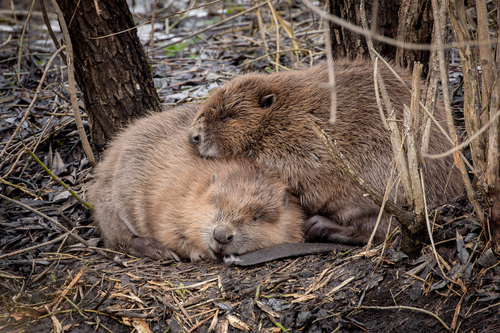
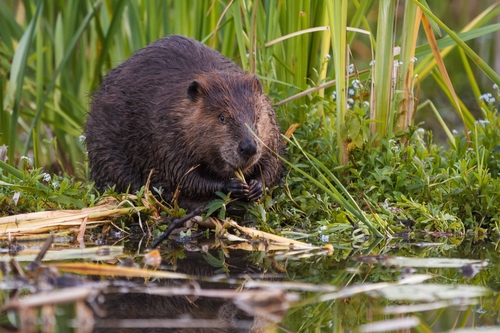
This species, the North American beaver (Castor canadensis Kuhl, 1820), is the largest rodent in North America. It competes with the Eurasian beaver (its European counterpart) for the title of the third-largest rodent in the world, after the South American capybara and lesser capybara. On average, the Eurasian beaver is slightly larger, but the North American beaver has a larger recorded maximum size. Adult North American beavers usually weigh between 11 and 32 kg (24 to 71 lb), with a typical weight of 20 kg (44 lb). Recorded regional averages vary: adult males in New York average 18.9 kg (42 lb), non-native females in Finland average 18.1 kg (40 lb), and adults of both sexes in Ohio average 16.8 kg (37 lb). The species appears to follow Bergmann's rule, with individuals from northern regions being larger; adults in the Northwest Territory have a median weight of 20.5 kg (45 lb). Overall, the North American beaver has a slightly smaller average body mass than the Eurasian beaver. The head-and-body length of adult North American beavers ranges from 74 to 90 cm (29–35 in), with the tail adding an additional 20 to 35 cm (7.9–13.8 in). Very old individuals can exceptionally grow beyond normal size, reaching weights over 40 kg (88 lb) and even up to 50 kg (110 lb), which is higher than the maximum recorded weight for the Eurasian beaver. Like the capybara, the North American beaver is semiaquatic, with many traits adapted to this lifestyle. It has a large, flat, paddle-shaped tail and large webbed hind feet. Its smaller unwebbed front paws have claws, and the forepaws are highly dextrous. They are used for digging, folding individual leaves into the beaver's mouth, and rotating small pencil-sized stems while the beaver gnaws off bark. A nictitating membrane covers the beaver's eyes, allowing it to see underwater. The nostrils and ears seal shut when the beaver is submerged, and its lips can close behind the front teeth so it can continue gnawing underwater. A thick layer of fat under the skin insulates the beaver from its cold water environment. The beaver's fur is a double coat, made up of long coarse outer hairs and short fine inner hairs. Fur color varies, but is most often dark brown. Scent glands near the genitals secrete an oily substance called castoreum, which the beaver uses to waterproof its fur. There is also another set of oil glands that produce unique chemical identifiers in the form of waxy esters and fatty acids. Historically, the beaver's lush, workable fur was used to make many products, most notably hats. Demand for fur for hats drove North American beaver populations nearly to extinction, and the species was saved primarily by a sudden change in fashion style. Like all rodents, the North American beaver has continuously growing incisors, and is a hindgut fermenter with a cecum populated by symbiotic bacteria that help digest plant-based material. Even so, the beaver is remarkably specialized for efficiently digesting its lignocellulose-heavy diet. The brain anatomy of the beaver is not particularly specialized for its semiaquatic life history. A 11.7 kg beaver has a brain mass of 41 g, while a 17 kg beaver has a 45 g brain. C. canadensis has an encephalization quotient of 0.9 among rodents, which is intermediate between similar terrestrial rodents and arboreal squirrels, and higher than similar semi-aquatic rodents, muskrats and nutria. The cerebrum is well developed, and the neocortex is comparatively large. Larger areas of the beaver's somatosensory cortex are dedicated to processing stimuli from the lips and hands, rather than the tail and whiskers, which play a relatively minor role. The visual area of the brain is smaller than that of the gray squirrel. Historically, North American beavers were nearly ubiquitous across their range, living from south of the Arctic tundra to the deserts of northern Mexico, and from the Atlantic to the Pacific Oceans. Unregulated trapping across the continent for economic gain and political competition led to regional extirpation in many areas, including the Great Plains. Some areas saw only population decline rather than near-extirpation, partially due to mixed-result conservation measures implemented by the Hudson's Bay Company. By the 1900s and 1910s, beavers survived mostly in isolated pockets, though the exact locations of these pockets were not well documented. Later, reintroduction efforts and natural spread have restored the species to most of its original range. Improved management innovations now allow sustainable harvest yields that exceed previous record harvests. Beavers are now widely distributed in boreal and temperate ecoregions, with populations rebounding from historic over-exploitation. Recently, beavers have been observed colonizing Arctic tundra, likely due to climate change-induced increases in riparian shrubs. A 1907 report by physician-naturalist Edgar Alexander Mearns of beavers on the Sonora River may be the earliest record of the southernmost range of this North American aquatic mammal. Beyond this, beavers have been recorded both historically and recently in Mexico on the Colorado River, Bavispe River, and San Bernardino River in the Mexican states of Sonora and Chihuahua. North American beavers produce one litter per year. Females enter estrus for only 12 to 24 hours, between late December and May, with the peak occurring in January. Reproduction occurs earlier in warmer southern climates, while beavers in northern ranges may wait until late spring to breed. Litters are typically born between April and June, depending on when breeding occurs. Unlike most other rodents, beaver pairs are monogamous and stay together for multiple breeding seasons. Gestation averages 128 days, and litters contain between three and six kits, most often 4 to 5. Most beavers do not breed until they are three years old, but around 20% of two-year-old females do reproduce. Before giving birth, female beavers prepare a soft bed inside their lodge for the litter. After birth, young beavers stay sheltered in the lodge for up to a month before they start swimming and eating solid food. Juvenile beavers remain with their parents for up to two years before leaving to build their own homes. North American beavers were trapped to near-extirpation in North America because their fur and castoreum were highly sought after. Their furs were used to make clothing and beaver hats. Extensive trapping for the fur trade began in the early 17th century in the United States: between 1620 and 1630, more than 10,000 beavers were taken each year in Connecticut and Massachusetts, and from 1630 to 1640, around 80,000 beavers were taken annually from the Hudson River and western New York. Starting in 1670, the Hudson's Bay Company sent two or three trading ships to Hudson Bay each year to transport furs from Canada to England. Archaeological and historical evidence indicates that beaver ponds created "moth-hole like" open habitats within the deciduous forest that dominated eastern North America. These open habitats attracted Native American and early colonial hunters to the abundant fish, waterfowl, and large game that congregated in the riparian clearings created by the beavers. Early colonial farmers were also drawn to the fertile, flat bottomlands formed by accumulated silt and organic matter in beaver ponds. As eastern beaver populations were depleted, English, French, and American trappers pushed west. Much of the westward expansion and exploration of North America was driven by the search for beaver fur. Before the 1849 California Gold Rush, an earlier 19th-century California Fur Rush drove the first American settlement in that state. During the roughly 30 years of the mountain man era, from 1806 to 1838, the West stretching from Missouri to California and from Canada to Mexico was thoroughly explored, and the beaver was brought to the brink of extinction. After protection was enacted in the late 19th and early 20th centuries, the current beaver population has rebounded to an estimated 10 to 15 million individuals. This is still only a fraction of the original estimated population of 100 to 200 million North American beavers that existed before the large-scale fur trade. In parts of their range, beavers are considered pests because their dams can cause flooding, and their habit of felling trees can pose danger to people, as documented at Park Road Park in Charlotte, North Carolina. Because beavers consistently repair damage to their dams, they were historically relocated or killed. Non-lethal methods for managing beaver-related flooding have since been developed. One such flow control device, called a "beaver deceiver" or leveler, was invented and pioneered by wildlife biologist Skip Lisle, and has been used by both the Canadian and U.S. governments. The beaver is a keystone species, which increases biodiversity in its territory through the creation of ponds and wetlands. As wetlands form and riparian habitats expand, aquatic plants colonize the newly available aquatic habitat, and the diversity of insects, invertebrates, fish, mammals, and birds also increases. The effects of beaver recolonization on native and non-native species in streams where beavers have been historically absent, particularly dryland streams, are not well researched. As a food source, beaver meat has a flavor similar to lean beef or venison, but special care must be taken to avoid contamination from the animal's strong castor musk gland. Like most wild game, beavers can carry diseases including giardiasis, tularemia, and rabies, so taking precautions when preparing beaver and other wild game is required. Beaver meat is usually slow-cooked in a broth, and was a valuable food source for Native Americans. Beavers store large amounts of body fat, which can be rendered down into lard for use as cooking oil. The tail muscle is a popular edible cut; similar to oxtail, it can be cut into sections, and the meat is rich and dense. Early French Canadian Catholics considered beaver to be "four-legged fish" that could be eaten during Lent. Early North American settlers were interested not just in beaver fur, but also in their meat, and beaver stew became a common meal among settlers.