About Castilleja scabrida Eastw.
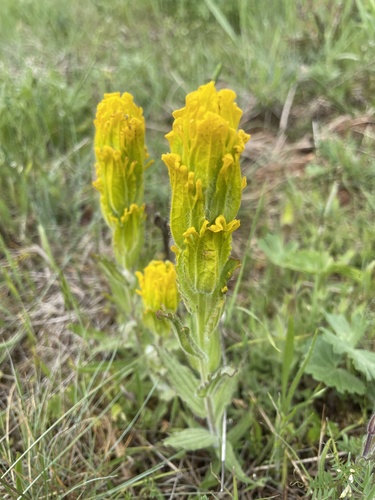
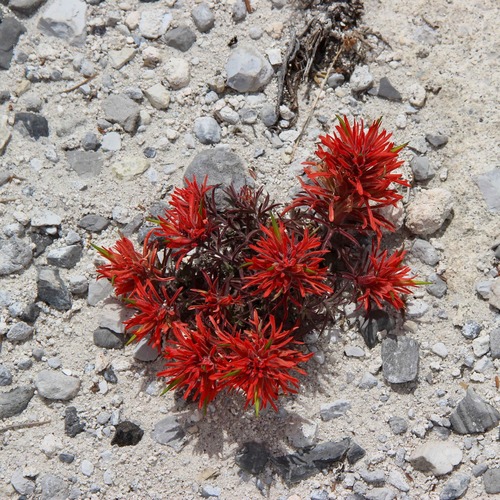
Castilleja scabrida, commonly called rough paintbrush, is a perennial plant that produces herbaceous stems from a woody caudex, growing from either a taproot or thick, branched roots. Stems typically grow 7 to 15 centimeters (2.8 to 5.9 inches) tall, and occasionally reach up to 20 centimeters (7.9 inches). They are decumbent, meaning they grow along the ground with upturned ends, and usually grow in clumps of several unbranched stems. Branching only occurs if the growing stem is injured; while stems do not usually branch, small leafy shoots may occasionally grow at the points where main leaves attach to stems. Stems are covered in short, stiff, non-glandular hairs that are somewhat white in color. Leaves are most often gray-green, but may occasionally be reddish-purple or entirely green. The lowest leaves, which cover the bottom tenth to quarter of the stem, are small, lack chlorophyll, and look similar to scales or bracts. More fully developed leaves are 1.5 to 5 centimeters long, and range from linear to lanceolate in shape, meaning they are narrow and grass-like to spear-head shaped. All leaves may have smooth edges, while the uppermost leaves may grow one, or occasionally two pairs of side lobes, which can either spread outward or curve upward. The inflorescence of rough paintbrush is the most vividly colored among its genus. It is densely packed with flowers and covered in hairs. The bracts surrounding the flowers are green or green-purple toward the base, and usually bright red toward their tips, though they may sometimes be brick-red or orange-red. The bracts are linear to lanceolate, and usually have three or five lobes, occasionally growing seven lobes. They measure 2.5 to 10 centimeters long and 2.5 to 5 centimeters wide; they are more leaf-like near the bottom of the inflorescence, and become shorter and wider toward the top. The calyx, made up of the flower's sepals, is 19 to 30 millimeters long and divided into lobes. This species is native to five western U.S. states: Arizona, Colorado, New Mexico, Nevada, and Utah. It is only rarely found in Apache County, Arizona and San Juan County, New Mexico, and is much more common in Utah and southwestern Colorado. It grows at elevations between 1,200 and 2,800 meters (3,900 to 9,200 feet), and is most often found on slopes and rock outcrops in open pinyon-juniper woodlands. The seeds of Castilleja scabrida require cold stratification before they can germinate. One study found that germination rates increase with the length of prechill treatment up to 16 weeks. Temperatures of 3 °C (37 °F) or lower are required for good germination. Ideal germination temperatures are 21 to 25 °C (70 to 77 °F) during the day, and 10 to 16 °C (50 to 61 °F) at night. In controlled experiments, C. scabrida—like orange paintbrush (Castilleja integra) and desert paintbrush (Castilleja chromosa)—was able to tolerate growing without a host plant for short periods of time. Rough paintbrush has high potential for use as a garden species. In experiments, it was relatively tolerant of common garden practices such as transplantation, and its seeds have a moderate germination rate when grown in greenhouse flats.