About Castilleja puberula Rydb.
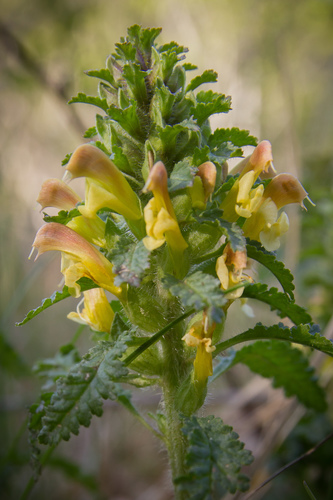
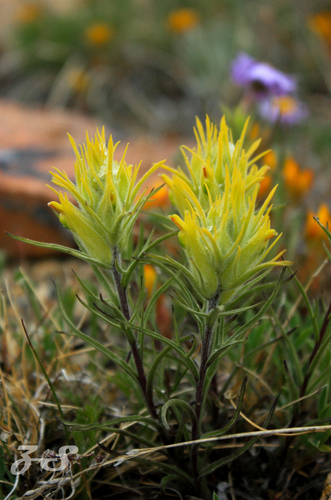
Castilleja puberula Rydb., commonly called the alpine paintbrush, reaches a mature height of 8 to 15 centimeters (3–6 inches). It grows from a taproot topped by a woody caudex, which produces multiple stems that grow upright or outward from the plant’s crown; these stems are typically unbranched. All above-ground parts of the plant are covered in small, soft hairs. Its leaves are small and narrow, measuring 2–3.3 cm long, ranging in shape from grass-blade-like to linear-lanceolate, which resembles a very narrow spear head with the widest portion below the midpoint. Leaves can be unlobed or have up to five lobes, though they usually have no more than three. Lobed leaves have narrow pointed tips that spread widely. Lower stem leaves usually do not have lobes, while leaves higher on the stem are more likely to develop lobes. Leaf color ranges from green to purple, and leaves have a non-fleshy texture. The inflorescence grows at the top of each stem, measuring 4 to 5 cm long and 1.5 to 2.5 cm in diameter. The actual flowers are not very noticeable, while the surrounding bracts are always green at the base; bract upper sections range from yellow to green, and may have yellow-orange tinged tips. Bracts are slightly wider than leaves, and are lanceolate to linear-lanceolate in shape, with up to seven spreading thread-like lobes, though they usually have five or fewer. The flowers are tube-shaped with a beak that extends out from behind the bracts, and measure 1.8–2.1 cm long overall. Flower color ranges from yellow to yellow-green, and blooming usually occurs in July or August, though blooming as early as February occurs rarely. Most of the alpine paintbrush’s known range lies in north-central Colorado near the North American Continental Divide. It has been recorded in six Colorado counties, ordered from south to north: Park, Summit, Clear Creek, Grand, Boulder, and Larimer. The presence of alpine paintbrush on the Montana side of Mount Jefferson was not formally recognized until 2014, even though a botanist had previously collected a specimen there in 2004. There is a nearly 600 kilometer gap between the Colorado and Montana populations, which suggests additional unrecorded populations may exist in Wyoming in similar suitable habitats. Alpine paintbrush grows at elevations of 2,700 to 3,900 meters (8,900–12,800 ft) in subalpine and alpine tundra. It can be found growing in moist meadows, along streams, and on moderately moist rocky slopes, and it prefers limestone-containing soils. While its overall range in Colorado spans 3,529 square kilometers (1,363 sq mi), its total available habitat in the region is only around 143 hectares (354 acres).