About Castilleja flava S.Watson
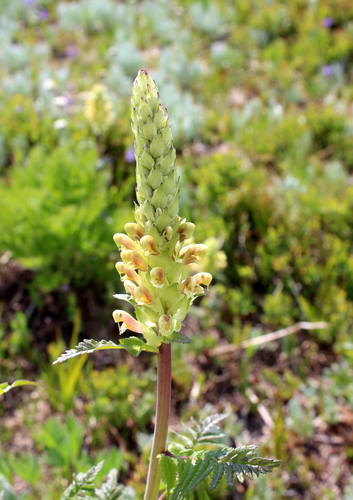
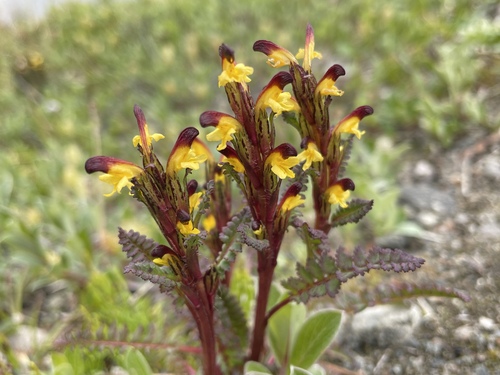
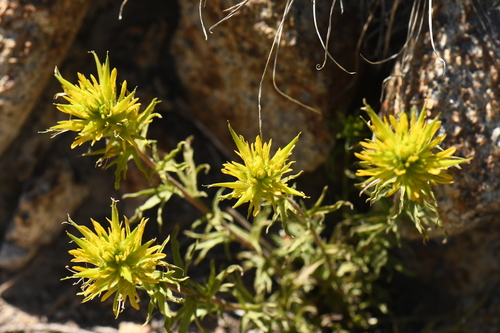
Castilleja flava, commonly called yellow paintbrush, is a perennial herb that produces flowering stems. These stems are typically 15 to 55 centimeters (6–22 inches) tall, and occasionally reach up to 75 centimeters (30 inches) tall. Multiple stems grow in a cluster, growing upright or leaning outward from the plant crown, usually branching in their upper sections, though they may also be unbranched. Stems are rarely hairless, except for populations in northeast Nevada; most stems are covered in backward-pointing hairs that give the plant an ashy color. Stems grow from a woody caudex that sits on top of a taproot. The leaves of this species are narrowly lanceolate to narrowly oblong in shape, ranging from 1 to 6.7 centimeters long. They are typically somewhat purple or gray, with wavy edges or edges that roll inward. Leaves may be unlobed, but more often have three or five deep spreading lobes, and occasionally up to seven lobes. Lower leaves are more likely to be unlobed than upper leaves. The plant’s inflorescence is normally yellow, but may show shades of orange or red. It is covered in long, soft hairs that can be curly or matted, and measures 3.5 to 29 centimeters long, rarely exceeding 20 centimeters. The inflorescence bracts usually have three or five lobes, and are slightly wider than the plant’s leaves. The mostly fused sepals are 1.1 to 2.8 centimeters long, with deeper splits along the front and back than along the sides. The green to yellow flower can extend just slightly or substantially out from the sepals. The fruit of yellow paintbrush is a capsule that measures 0.8 to 1.5 centimeters long. Yellow paintbrush is native to the Intermountain West of North America, ranging northward from Colorado and Utah. According to the Natural Resources Conservation Service, the only recorded population of C. flava variety rustica in Washington state is in Lincoln County, with no other known populations in the state. Variety rustica is also the only variety of this species found in northeastern Oregon. Both varieties of C. flava occur in Idaho: rustica is far more widespread and grows throughout central Idaho, while the nominate variety C. flava var. flava occurs in southeastern Idaho. Both varieties are also present in Montana, where C. flava var. flava is the primary variety, and all known populations of the species in Montana are located in the southwestern end of the state. This species grows throughout the western two-thirds of Wyoming. In Colorado, it grows in the northwest of the state, occurring almost entirely west of the Continental Divide, with only small populations present in Jackson County east of the divide. In Utah, the species grows primarily in the eastern counties, extending as far south as Garfield County, and also occurs in Box Elder County in northwestern Utah. It is also native to the three northernmost counties of Nevada: Elko, Humboldt, and Washoe. It grows at elevations ranging from 300 to 3,000 meters (980–9,840 ft). Yellow paintbrush grows in association with various shrubby sagebrush species in plant communities such as sagebrush steppe. It is found in valleys and the lower slopes of mountains, and only occasionally reaches the subalpine zone.