About Castanopsis fissa (Champ. ex Benth.) Rehder & E.H.Wilson
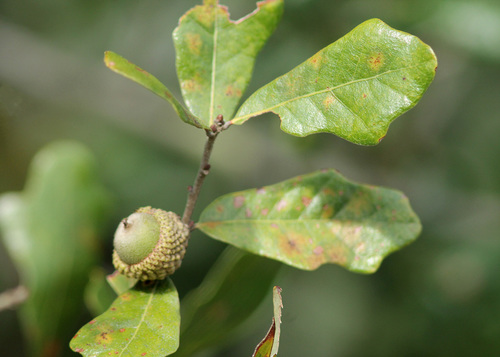
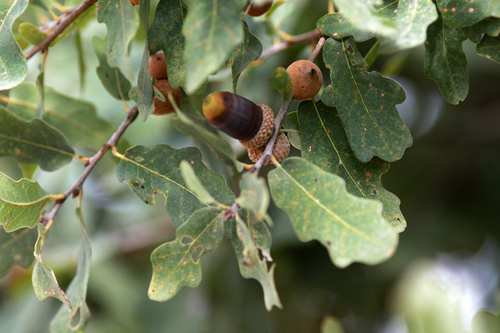
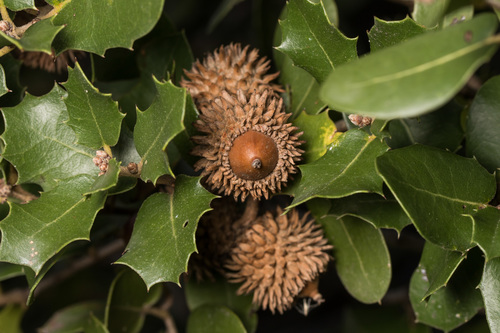
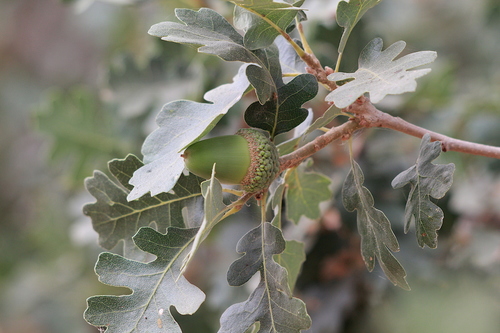
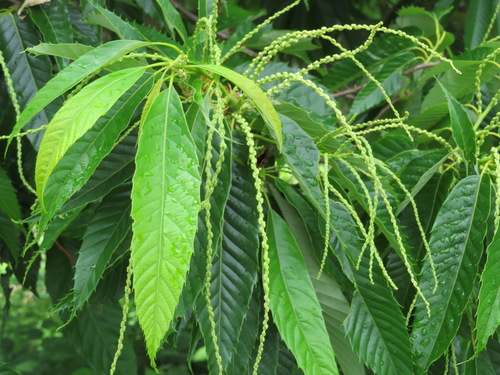
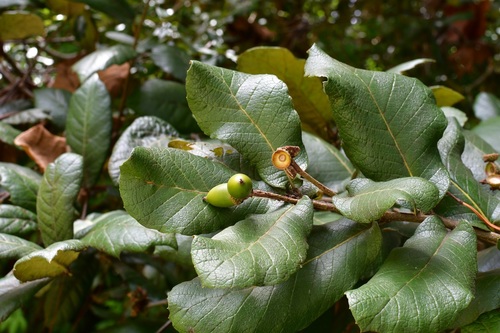
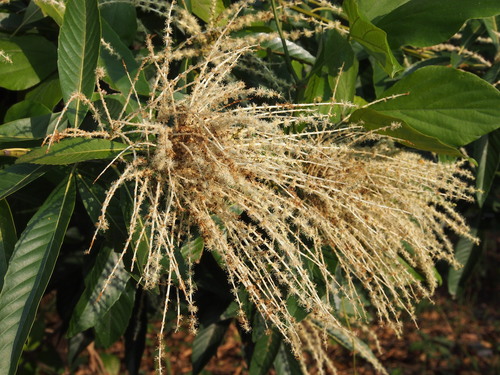
Castanopsis fissa (Champ. ex Benth.) Rehder & E.H.Wilson is a large evergreen tree that can reach up to 20 meters in height. Its bark is greyish-brown and becomes coarse with age, while its branchlets are red-purple with conspicuous ribs. The leaves are alternate, thick, and papery, highly variable in size and shape, ranging from oblong to obovate-elliptic, with a cuneate base. The lower half of the leaf margin has rounded, undulate, crenate teeth. Lateral veins are numerous, typically 15 to 20 pairs, and are raised on the leaf underside; the upper leaf surface is glabrous, while the lower surface is initially yellowish-brown puberulent but becomes glabrescent over time. Flowers are arranged in erect spikes that form firework-like panicles; they are unisexual, monoecious, and many-flowered, with white, clustered stamens. The fruit is an ovoid to ellipsoid cupule that is slightly dark reddish-brown and tomentose; it fully encloses the nut when immature, and splits into 2 to 3 irregular segments when mature. Each cupule contains a single globose to elliptic nut that is reddish-brown in color. This species occurs in Southeast China, Hong Kong, Laos, Thailand and Vietnam, with its range extending closer to the south China coast. It grows primarily in wet tropical lowlands. Castanopsis fissa flowers from April to June, and fruits from October to November. Seed dispersal of C. fissa is strongly constrained by both biological and landscape factors. Its cupules are extremely hard and are primarily consumed by rodents and other scatter-hoarding animals, and the species otherwise relies largely on gravity for dispersal. As a result, seeds typically fall and establish close to the parent tree, usually within about five meters in forest environments. This limited dispersal capacity makes natural migration of Castanopsis species unlikely, especially in areas with low forest connectivity. Expansion into new habitats depends on continuous forest cover, particularly near the northern edge of their historical range. However, primary forests in these regions were cleared centuries ago, and existing forested landscapes now mainly consist of plantations or regenerating secondary forests with reduced species diversity, which further limits their migration. This is a fast-growing evergreen species that is highly tolerant of poor soils. As one of the few native species that thrived during early reforestation efforts in Hong Kong, it has proven highly resilient and adaptable. Thus, it is often selected as a pioneer species to prevent soil erosion. The starchy fruits of this species were cooked into congee, a food that Hong Kong villagers relied on during the Japanese occupation.