About Castanea sativa Mill.
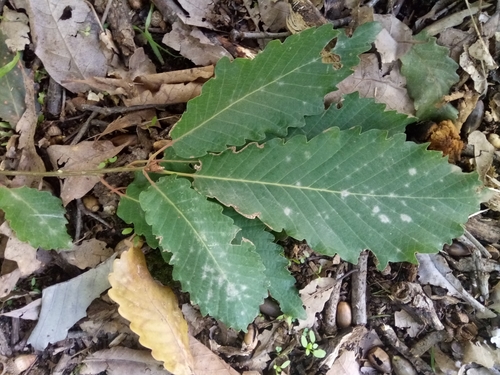
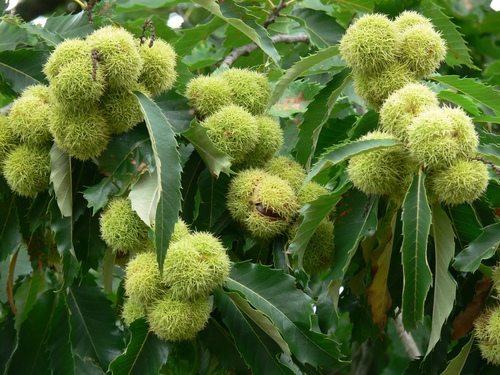
Castanea sativa Mill., commonly known as the sweet chestnut, typically grows to a height of 20–35 metres (66–115 feet), with a trunk that often reaches 2 m (7 ft) in diameter. Around 20 individual trees have been recorded with trunk diameters over 4 m (13 ft), including one measured at 7.5 m (25 ft) in diameter at breast height. A famous ancient specimen called the Hundred Horse Chestnut in Sicily was historically recorded at 18 m (59 ft) in diameter, though it has split into multiple trunks above ground. Its bark often forms a net-shaped (retiform) pattern, with deep furrows or fissures that run spirally in both directions up the trunk. Most trunks are straight, and branching starts at low heights on the tree. Its leaves are oblong-lanceolate with bold teeth, measure 16–28 centimetres (6–11 inches) long and 5–9 cm (2–4 in) broad. Both male and female flowers grow in upright catkins 10–20 cm (4–8 in) long; male flowers occupy the upper part of the catkin, while female flowers grow in the lower part. In the Northern Hemisphere, flowers appear from late June to July. By autumn, female flowers develop into spiny cupules holding 3–7 brownish nuts that are shed during October. The spiky sheath that forms around the seeds deters predators. The sweet chestnut is naturally self-incompatible, meaning it cannot pollinate itself, so cross-pollination is required. Some cultivars produce only one large seed per cupule, while others can produce up to three. Each nut has two skins: an external shiny brown skin, and an internal skin that adheres to the fruit. Inside is an edible, creamy-white portion developed from the cotyledons. Wild sweet chestnut trees usually live 500 to 600 years, and cultivated specimens can live 1,000 years or more; some naturally growing specimens can live over 2,000 years, such as the Hundred Horse Chestnut near Mount Etna in eastern Sicily. This species is native to Southern Europe and Asia Minor. It is found across the Mediterranean region, from the Caspian Sea to the Atlantic Ocean. It is thought to have survived the last ice age in several Southern European refuges, on the southern coast of the Black Sea with a main center on the southern slope of the Caucasus, and in northwestern Syria, possibly extending into Lebanon. It is widely distributed across Europe; in 2004, it was grown on 2,250,000 hectares (5,600,000 acres) of European forest, of which 1,780,000 ha (4,400,000 acres) were primarily cultivated for wood and 430,000 ha (1,100,000 acres) for fruit production. In some European countries such as Slovakia and the Netherlands, this species was only introduced recently. The sweet chestnut requires a mild climate and adequate moisture for good growth and a full nut harvest. Its new annual growth (though not the rest of the tree) is sensitive to late spring and early autumn frosts, and it is intolerant of alkaline lime soil. Under forest conditions, it tolerates moderate shade well. In ecology, sweet chestnut leaves provide food for some animals, including Lepidoptera such as the case-bearer moth Coleophora anatipennella, and the North American rose chafer Macrodactylus subspinosus. Two major fungal pathogens affect the sweet chestnut: chestnut blight caused by Cryphonectria parasitica, and ink disease caused by Phytophthora cambivora and P. cinnamomi. In the 20th century, Cryphonectria parasitica destroyed most of the sweet chestnut population in both North America and Southern Europe. With biological control, sweet chestnut populations are no longer threatened by chestnut blight and are regenerating. Ink disease primarily infects trees growing in humid soils; its mycelium invades the roots, leading to leaf wilting. Failed fruit development causes petal dieback. The disease gets its name from black exudates that appear at the base of the trunk. Today, there are cultivars that are resistant to ink disease. Phytophthora cambivora caused serious damage in Asia and the United States, and it continues to destroy new plantations in Europe. Another serious pest that is difficult to control is the gall wasp Dryocosmus kuriphylus, which originated in Asia and was recently introduced to Southern Europe. Three distinct cultivation systems are used for sweet chestnut: Coppicing, which is primarily for wood extraction, yields an average of 15 m3 of wood per hectare per year under standard conditions. The Selve system is used for fruit production from grafted trees; these trees have a short trunk and a large crown, are planted at high density, and the ground between trees is often used as pasture. High forest cultivation produces both wood and fruit, is less intensive, yields 4–10 decitonnes per hectare, and replaces trees every 50–80 years. Trees in this system grow from seeds and form a dense canopy. Field management depends on the cultivation system. Clearing leaf litter from the soil and pruning are standard practices, while fertilizer, irrigation, and pesticides are used less often and only for more intensive cultivation. The species is widely cultivated for its edible seeds (called nuts) and for its wood. Sweet chestnut is one of the 38 substances used to prepare Bach flower remedies, a type of alternative medicine promoted for its claimed health effects. However, according to Cancer Research UK, "there is no scientific evidence to prove that flower remedies can control, cure or prevent any type of disease, including cancer". The species' large genetic diversity and many cultivars are used for a range of food purposes, including making flour, and cooking by boiling, roasting, or drying, and use in sweets. The skin of raw peeled chestnuts can be removed fairly easily by quickly blanching the nuts after cutting a cross slit at the tufted end. Once cooked, chestnuts have a sweet flavor and a floury texture similar to sweet potato. Cooked chestnuts can be used to stuff poultry, as a vegetable, in nut roasts, confections, puddings, desserts, and cakes. They are also used for flour, bread making, as a cereal substitute, coffee substitute, a thickener in soups and for other cookery uses, as well as for fattening livestock. Sugar can be extracted from chestnuts. The Corsican variety of polenta (called pulenta) is made with sweet chestnut flour, and a local Corsican beer also uses chestnuts. Commercial products made from sweet chestnut include sweetened vanilla chestnut paste called crème de marrons, sweetened or unsweetened chestnut purée, and candied chestnuts called marrons glacés. Roman soldiers were given chestnut porridge before entering battle.