About Castanea dentata (Marshall) Borkh.
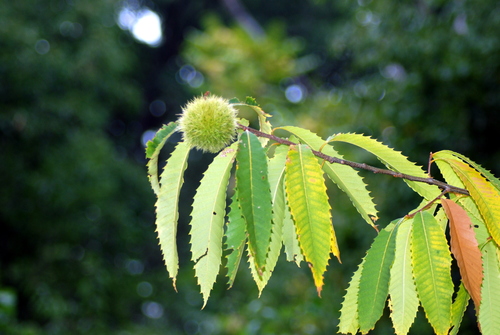
Castanea dentata (Marshall) Borkh., commonly known as American chestnut, is a large, fast-growing deciduous hardwood eudicot tree. One known single specimen growing in Maine has reached a height of 115 feet (35 m). Records from before the chestnut blight epidemic note a maximum height of 100 feet (30 m) and a maximum trunk circumference of 13 feet (4.0 m). Post-blight sources incorrectly report that this species grows to a larger maximum size than pre-blight records indicate. This error is likely caused by nostalgia, misinterpretation of pre-blight circumference measurements as diameter measurements, and the mistaken belief that pre-blight observations of maximum size described average tree size. American chestnut is considerably larger than its close relative, the Allegheny chinquapin (Castanea pumila). There are several other well-known species in the Castanea (chestnut) genus: European sweet chestnut (C. sativa), Chinese chestnut (C. mollissima), and Japanese chestnut (C. crenata). American chestnut can be distinguished from these related species by several key morphological traits, including petiole length, nut size, number of nuts per burr, and leaf shape and size. Its leaves measure 14–20 cm (5.5–8 in) long and 7–10 cm (3–4 in) broad, which is slightly shorter and broader than the leaves of European sweet chestnut. The edges of American chestnut leaves bear larger, more widely spaced saw-like teeth, which is referenced in its scientific species epithet dentata, Latin for 'toothed'. European sweet chestnut was introduced to the United States by Thomas Jefferson in 1773, and has since been the main source of commercial chestnuts sold in the country. Unlike the hairless twigs of American chestnut, European sweet chestnut has hairy twig tips. Japanese chestnut was accidentally introduced to the United States by Thomas Hogg in 1876, and was planted on S. B. Parsons' property in Flushing, New York. It is the most blight-resistant of the introduced chestnut species, and has narrower leaves that are smaller than the leaves of either American chestnut or European sweet chestnut. Its leaves have small, sharply pointed teeth and many hairs on the underside. American chestnut is monoecious, and usually protandrous. It produces many small, pale green (nearly white) male flowers that are tightly arranged along catkins 6 to 8 inches long. Female floral structures are located near the base of the catkins, close to the twig, and flowering occurs from late spring to early summer. Like all members of the Fagaceae family, American chestnut is self-incompatible, meaning it requires a second tree for successful pollination, and the pollinating tree can be any other member of the Castanea genus. Its pollen is classified as a mild allergen. American chestnut is a very productive producer of nuts. Wild trees begin producing inflorescences and nuts when they are 8 to 10 years old. The spiny burrs that enclose the nuts often open while still attached to the tree, around the time of the first autumn frost, after which the nuts fall to the ground. Typically, three nuts are enclosed in each spiny green burr, and the inner surface of the burr is lined with tan velvet. This differs from Allegheny chinquapin, which produces only one nut per burr. Chestnuts belong to the Fagaceae family, along with beech and oak trees. They are not closely related to horse chestnut, which is classified in the Sapindaceae family. Phylogenetic analysis shows that living Castanea species migrated westward from Asia to Europe then to North America. American chestnut is more closely related to Allegheny chinquapin (Castanea pumila v. pumila) than it is to European or Asian Castanea clades. The overall genetic diversity of Castanea roughly follows a clinal pattern divided into northeast, central, and southwest populations. Southwest populations hold the greatest genetic diversity, which reflects an evolutionary bottleneck likely caused by Quaternary glaciation. Two distinct lineages of American chestnut have been identified. One is a hybrid between American chestnut and Allegheny chinquapin that originates from the southern Appalachians. The other lineage shows a gradual reduction in genetic diversity moving northward, which suggests the species expanded its range northward after the most recent glacial maximum during the Wisconsin glaciation. Ozark chinkapin (C. ozarkensis), which is usually treated as either a separate species or a subspecies of Allegheny chinquapin (C. pumila subsp. ozarkensis), may be ancestral to both American chestnut and Allegheny chinquapin. A natural hybrid between C. dentata and C. pumila has been formally named Castanea × neglecta. Chestnut blight reduced the American chestnut population to just 1–10% of its original size, and the species has not recovered. Surviving trees exist as 'frozen in time' stands: new shoots sprout from surviving rootstock, but almost all sprouts die back from blight infection before they can produce nuts. Contrary to expectations, American chestnut has retained a substantial amount of genetic diversity despite this severe population bottleneck. This observation does not align with the very low frequency of blight resistance or tolerance seen in current surviving populations. Before the blight epidemic, American chestnut grew only on moist, well-drained steep slopes with acidic loam soils. Analysis of ancient forest dust data shows the tree was rare or absent in New England before 2500 years before present, but it quickly became established and dominant in these forests. Its historic range stretched from Maine and southern Ontario to Mississippi, and from the Atlantic coast west to the Appalachian Mountains and the Ohio Valley. Within this range, American chestnut was the dominant timber tree on mountain ridges and sandstone soils. Along the Blue Ridge Mountains of North Carolina, it dominated the area above the natural range of Eastern hemlock and below 1,500 meters elevation. In Western Maryland, it made up 50% of ridge timber and 36% of forested slopes. The species became so abundant due to a combination of rapid growth, relative fire resistance, and a large annual nut crop. This compares favorably to oaks, which do not reliably produce large numbers of acorns every year. Historically, the average fire return interval was 20 years or less in chestnut-dominated ecosystems, which produced a more open forest stand structure than what is common today. American chestnut was a critical tree for wildlife, providing large amounts of fall mast food for species including white-tailed deer, wild turkey, Allegheny woodrat, and (before its extinction) the passenger pigeon. Black bears also ate the nuts to build up fat reserves for winter. American chestnut leaves contain more nitrogen, phosphorus, potassium, and magnesium than leaves of other native trees sharing its habitat. When leaves fall and decompose, they return more nutrients to the soil, which supports better growth for other plants, animals, and microorganisms. Some avian seed hoarders prefer American chestnut seeds, and it was a particularly important food source during years when oak mast crops failed. The functional extinction of American chestnut was long assumed to have caused the extinction of its host-specialist insect, the Greater Chestnut Weevil, until the beetle was rediscovered in 2025. Historically, American chestnut nuts were an important economic resource across North America, commonly sold on the streets of towns and cities. This street sale tradition continues in some places during the Christmas season, where nuts are often described as 'roasting on an open fire' because their distinct scent can be detected from many blocks away. The nuts are edible raw or roasted, though most people prefer them roasted. The brown outer skin must be peeled to reach the yellowish-white edible portion. The abundant nuts were eaten by many types of wildlife, and farmers also used them to feed livestock by allowing animals to roam freely through forests dominated by American chestnut. The tree was important to many Native American tribes across North America, as it provided a food source for both the tribes and the wildlife they hunted, and its parts were used in traditional medicine.