About Cassytha pubescens R.Br.
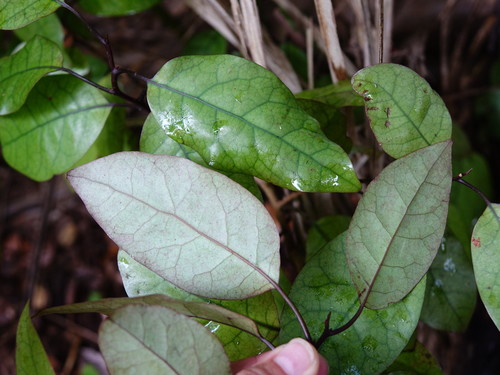
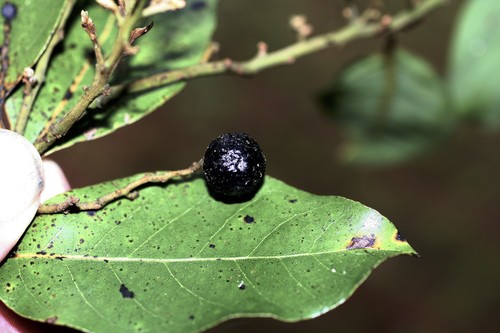
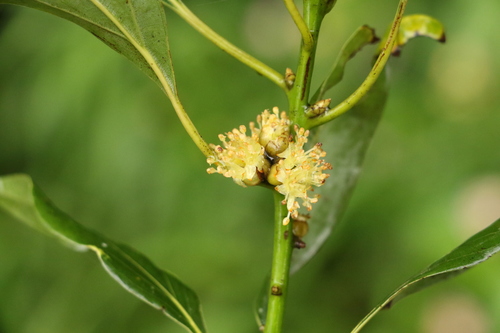
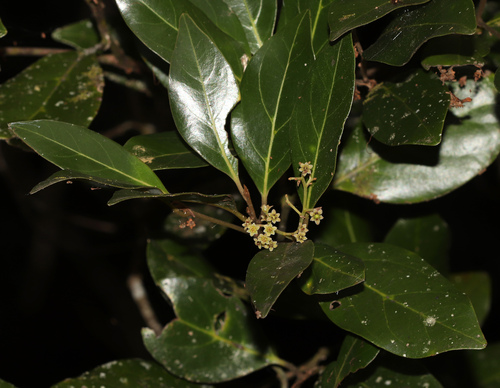
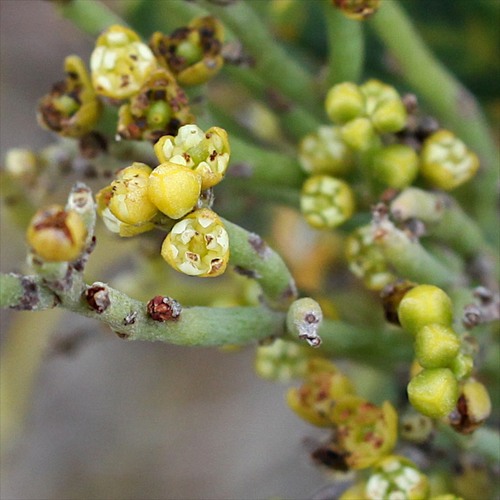
Cassytha pubescens R.Br. grows as a photosynthetic stem that twines around itself and around the branches of its host. Stems are between 0.5 and 1.5 mm thick and can be highly variable in appearance. In darker, more humid conditions, stems are dark green, glabrescent, and have very few pale grey hairs. Overall, stems on a single plant can range from glabrescent to pubescent, smooth to wrinkly, and vary in colour. High variation exists in flowers, fruits, stems and trichomes within individual plants, across individuals in a population, and across entire populations of this species. It is speculated that this variation likely results from a combination of reproductive isolation across populations and, in some cases, phenotypic modification to different environments. Flowers can grow on spikes, racemes or panicles, and are either sessile or almost sessile. Peduncles are 3-20mm long, and may have hairs or be hairless. Peduncles up to 10 cm have been recorded in specimens from northeastern New South Wales and Queensland. Flowers have pubescent petals and 9 stamens, with the outer stamens dorsiventrally flattened. When fleshy, fruit can be green, green-red, or grey to green-red in colour, and ranges from smooth to pubescent. Fruit is globose to obovoid in shape, and measures 6-10mm × 5.5-9mm. It may be covered in dull green to dull reddish-brown bands, and turns grey to black when drying or dry. Flowering occurs in summer, from December to April, and fruit develops from March to April. Cassytha pubescens is widespread along the east coast of Australia, and does not extend into arid regions. Its range runs from southeastern Queensland through the eastern half of New South Wales and into southeastern South Australia. The species is also found across eastern and western regions of Victoria and Tasmania. It is most commonly found in dry forests and woodlands. This species has a very wide host range, but is mostly confined to both native and invasive woody perennial shrubs. It spreads mostly through vegetative growth, using disk-like haustoria that penetrate the host's xylem to fuse to the host stem and extract water and essential nutrients. For survival, host attachment must occur within the first 6 weeks after germination. It has been suggested that Cassytha pubescens could be used as a biological control agent, because it appears to have stronger adverse effects on invasive hosts than on native hosts. One study compared the effects of this hemiparasite on native Leptospermum myrsinoides and invasive legume Cytisus scoparius, and found that Cassytha pubescens had little to no effect on Leptospermum myrsinoides, but significantly decreased the biomass and physiological capabilities of the introduced legume.