About Cassytha glabella R.Br.
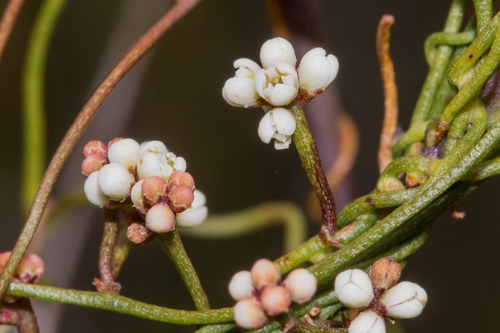
Cassytha glabella R.Br., commonly known as slender devil's twine, is a common twining hemi-parasitic climbing vine in (or sometimes placed in its own separate family Cassythaceae of) the laurel family Lauraceae. It is found in many moister regions of Australia. The specific epithet glabella comes from Latin, and refers to this species' lack of hairs. Alternate common names for this plant include Smooth Cassytha, slender dodder-laurel, and tangled dodder-laurel. This species was first formally published in scientific literature in 1810 by prolific Scottish botanist Robert Brown, in his work Prodromus Florae Novae Hollandiae. Two forms are currently recognized: Cassytha glabella f. dispar, which produces more elongated fruit that is either pear-shaped (pyriform) or spindle-shaped (fusiform), and Cassytha glabella f. glabella, which produces more oval fruit. Cassytha glabella is a small twining vine, with twining stems that reach roughly 0.5 mm in diameter. Its haustoria are less than one millimetre long, and its leaves take the form of tiny scales. Tiny, stalkless yellow or white flowers grow on short spikes 5 to 7 mm long; flowers can form at any time of year, with a peak blooming period from November to March in the Sydney region. The hairless fruit is round, 3 to 6 mm in diameter, and is green or yellow, sometimes with red markings. It is juicy, succulent, and has a sweet, mucousy taste. The plant starts its life when its seed germinates in the ground; the vine grows and moves until it latches onto nearby vegetation, after which its original root dies, and the plant lives by suckering from the stems and branches of its host plants. Although Cassytha glabella resembles dodders of the genus Cuscuta, it is not related to them. Similar related species are Devil's Twine (Cassytha pubescens) and Cassytha melantha; both have thicker stems than C. glabella, and C. pubescens additionally has hairier stems.