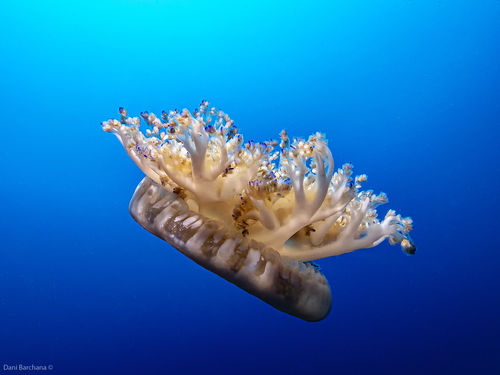
About Cassiopea andromeda (Forskål, 1775)
Cassiopea andromeda (Forskål, 1775) is a cnidarian species commonly known as the upside-down jellyfish. It typically inhabits intertidal sand or mudflats, shallow lagoons, and areas surrounding mangroves. This species is often mistaken for a sea anemone, because it usually holds its mouth facing upward. Its yellow-brown bell, marked with white or pale streaks and spots, pulsates to move water through its arms for respiration and to collect food. As a cnidarian, Cassiopea andromeda uses both asexual and sexual reproduction. In its polyp life stage, it reproduces asexually through budding. In its medusa life stage, it reproduces sexually. Female medusae produce and hold onto their eggs. Males produce sperm and release it into the water, and females use their tentacles to capture this sperm to fertilize their eggs.

