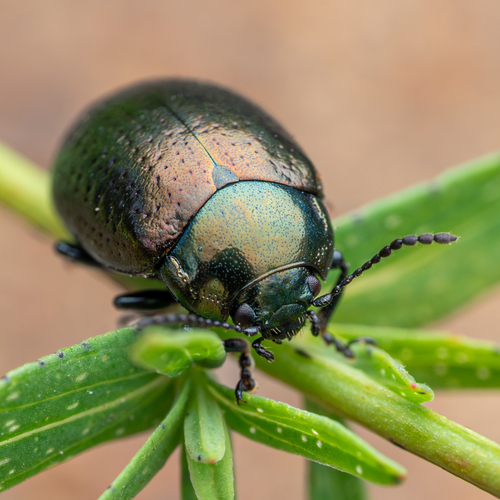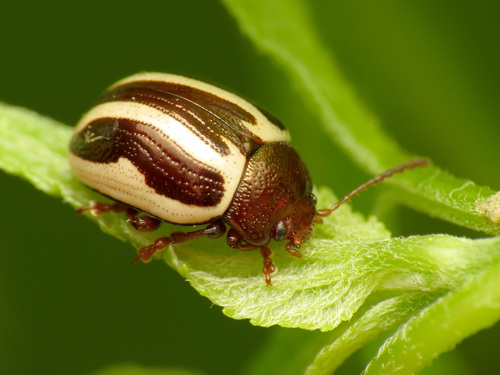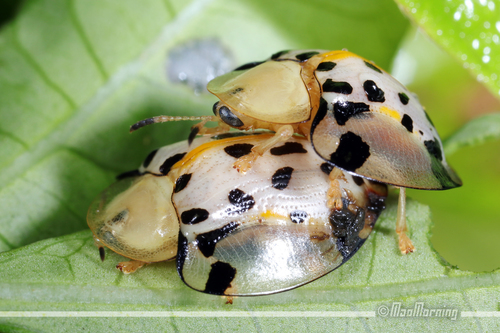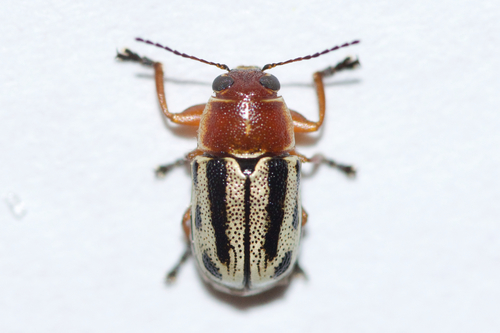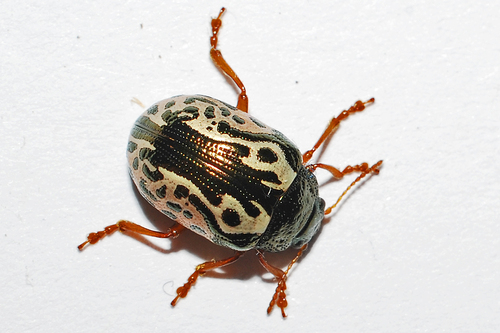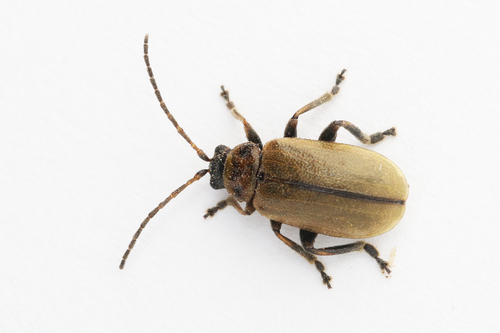
About Cassida rubiginosa Müller, 1776
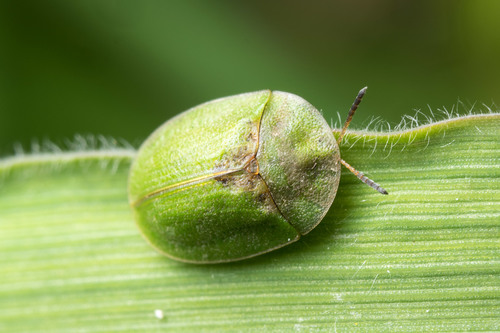
Cassida rubiginosa Müller, 1776, commonly known as the thistle tortoise beetle, has an adult body length of 6.0–8.0 mm. Like all species in the genus Cassida, its head is entirely covered by the pronotum, and its elytra are surrounded by a wide flange. The body of this species is distinctly highly rounded, with green or yellowish-green elytra; sometimes individuals have a small dark triangular spot around the scutellum. The species epithet rubiginosa is Latin for "rusty or rust-coloured", which can make identification confusing for some people. This confusion arises because the bright green color of fresh specimens quickly fades to brown when the beetle is preserved. This species is distributed across North America, Europe, and Siberia. Within the United States, it is common from South Dakota to Virginia. In Canada, it occurs across multiple provinces ranging from Alberta to New Brunswick. In Europe, it can be found from Fennoscandia south to Greece and Spain, and it is also present in Great Britain. In all these regions, it lives in habitats with abundant thistle populations, including fields, pastures, orchards, meadows, and general farmland. It resides on multiple thistle species: Canada thistle, bull thistle, musk thistle, plumeless thistle, and field thistle. The male intromittent organ of this species, called the flagellum, is a long, thin tube-shaped structure. The very tip of the flagellum is extremely thin and curved. As seen in many small beetle species, this flagellum can be longer than the entire male body. When not in use, the flagellum is stored inside the male's abdomen. To extend it, muscles running parallel to the lumen of the ejaculatory duct contract to push the structure outward. Males require this specialized organ shape because the female reproductive tract includes a long coiled duct that must be penetrated via contraction of the male's ejaculatory muscles. The mechanical properties of this thin, flexible organ have been studied for medical research, because penetrating tissue without buckling or rupturing a thin flexible structure is a major mechanical challenge, and insights from the beetle's anatomy may inform the development of modern microscopic medical catheters. The average oviposition period for this species is 12 weeks. Females typically lay around 3 eggs per ootheca, though clutch size can increase to 4–6 eggs in different regions. Egg hatching time is temperature dependent. At lower temperatures such as 18°C, eggs take up to two weeks to hatch. At higher temperatures such as 32°C, eggs can hatch in as little as four days. Larval development occurs across five distinct instar stages. Like hatching time, larval development rate is temperature dependent, with development speeding up as temperature increases. Larvae also develop faster under shorter day lengths compared to longer day lengths. On average, male larvae develop faster than female larvae. Larvae remain on the same thistle leaves where eggs were laid for their entire development period. When larvae are ready to pupate, they move to the thicker central portion of the host leaf to pupate. Pupation duration is also temperature dependent, ranging from approximately 3 days to 10 days. Higher temperatures close to 32°C produce the shortest pupation periods. New adults begin to emerge between July and August.