About Caryophyllia smithii Stokes & Broderip, 1828
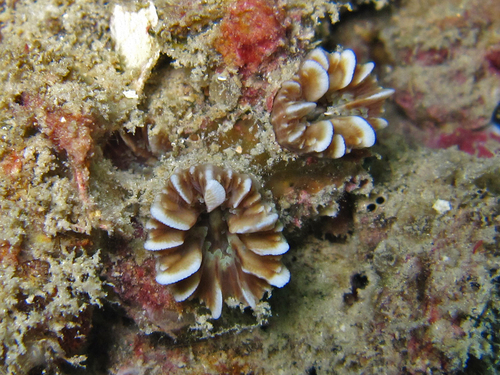
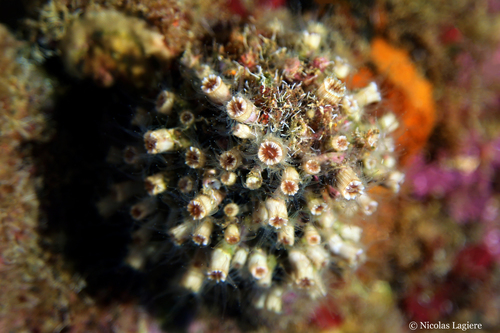
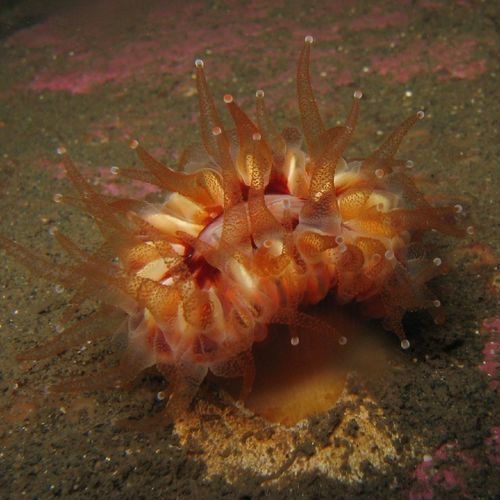
Caryophyllia smithii is a solitary species of stony coral that has a cup-shaped, stony skeleton called a corallum. This corallum has an elliptical base and can reach up to 25 mm (1 inch) in diameter, and it is typically broader than it is tall. The vertical radial calcareous plates, known as septa, are arranged in four to five cycles and have smooth edges. The column of the coral's polyp can extend up to 30 mm (1.2 inches) out from the cup, and the polyp has around 80 tentacles, each with a knob at its end. The polyp is translucent, and its color varies widely: it may be white, pink, orange, red, brown, or bright green. Contrasting color regions sometimes occur, most often forming a zig-zag pattern around the mouth. Except for their white or brown terminal knobs and many tiny warts, the tentacles are colorless. A deep-water form of this species is smaller and more delicate, with an inverted cone shape that is narrowed at the base. In contrast, shallow-water forms are cylindrical and more robust. Caryophyllia smithii is native to the northeastern Atlantic Ocean, ranging as far north as the Shetland Islands, and also occurs in the North Sea and the Mediterranean Sea. The shallow-water form is found from the sublittoral zone down to around 100 m (328 ft). The deep-water form occurs from about 50 m (164 ft) down to around 1,000 m (3,281 ft), and generally lives in less turbulent water than the sturdier shallow-water form. Sometimes, the narrow base of this coral becomes detached from the seabed substrate, and the coral lives freely on the seabed. This coral is abundant around the west coasts of the British Isles below the Laminaria kelp zone, and can occur at densities of over 100 individuals per square meter below the red algae zone. It grows both on flat rock surfaces and in rock crevices. Sponges and bryozoans are often the dominant organisms in the habitats where Caryophyllia smithii lives, and these groups also grow on the coral's own corallum. Larvae of the barnacle Megatrema anglicum often settle near the rim of the corallum, where they appear to be unaffected by the coral's stinging nematocysts. The barnacles become attached to the stony skeleton, and the coral's epithelial tissue grows over them, leaving only the barnacles' operculums exposed. A single C. smithii coral may host multiple barnacles, which tend to cluster in one particular area of the coral. When corals grow on vertical surfaces, this cluster is often on the lower side. The presence of these barnacles is semi-parasitic: the coral's tentacles retract when they touch the barnacles' feeding appendages (called cirri), which interferes with the coral's ability to gather food.