About Caryocar brasiliense A.St.-Hil.
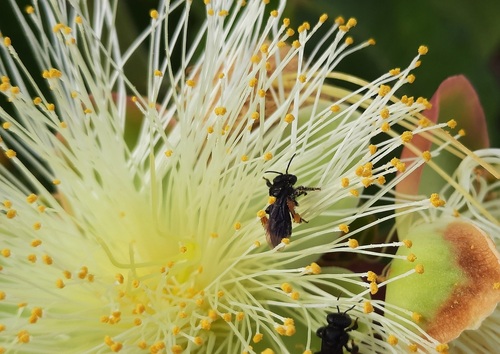
The pequi tree (scientific name Caryocar brasiliense A.St.-Hil.) grows up to 10 m (30 ft) tall. It is common in the central Brazilian cerrado habitat, ranging from southern Pará to Paraná and northern Paraguay, and it is also native to Bolivia. Its leaves are large, tough, hairy, and palmate, with three leaflets per leaf. Unlike most other cerrado trees, it blooms during the dry winter months, approximately from July to September. Its yellowish-white hermaphroditic flowers produce many stamens, and they somewhat resemble a large pale St John's Wort flower; St John's Wort is a distant relative of the pequi tree within the order Malpighiales. An inflorescence often holds two dozen or more flowers.
Pollination of pequi tree flowers is mainly done by bats. As is typical for bat-pollinated plants, the flowers do not have a pleasant scent, but they produce large amounts of thin nectar. Flowers open in the evening and produce nectar throughout the night, stopping production in the early morning. The final batch of nectar produced around dawn is richer in sugars than nectar produced earlier in the night, though it is produced in much smaller quantities. Moths, nocturnal wasps, and ants visit the flowers at night. Moths and nocturnal wasps may carry out some minor pollination, but they are not known to be major pollinators. During the day, bees and wasps visit the flowers to feed on any remaining pollen. From dusk until nectar production stops, hummingbirds may visit the flowers. While most hummingbirds only visit opportunistically, some species — such as the fork-tailed woodnymph (Thalurania furcata), and in particular the glittering-throated emerald (Chionomesa fimbriata) — appear to visit pequi tree flowers regularly. More notably, small tanagers from the Thraupidae and Cardinalidae families have been observed visiting around dusk. Specifically, species like the guira tanager (Hemithraupis guira), white-lined tanager (Tachyphonus rufus), palm tanager (Thraupis palmarum), and sayaca tanager (T. sayaca) seem to favor pequi flower nectar, and spend a large amount of time feeding on it when it is available. Even curl-crested jays (Cyanocorax cristatellus) have been observed around flowering pequi trees at daybreak, though they may not only be seeking nectar, since many insects attracted to the tree earlier in the night may still be present. Since the stigmata dry out by daybreak, it is unclear whether birds, particularly tanagers, contribute to pollination or are just taking advantage of an easy early-morning meal. This uncertainty is heightened because little other food is available during C. brasiliense's flowering season.
Humans use pequi in a variety of ways. Pequi pulp is a very popular food in the Brazilian states of Goiás, Mato Grosso, Mato Grosso do Sul, and Minas Gerais. It can be eaten raw on its own, prepared as a dish, used as a cooking ingredient, or used to flavor drinks. Pequi served with rice and chicken is an especially popular local preparation. Pequi pulp can tarnish silver cutlery, so raw pequi is best eaten by hand. Care must be taken to gently scrape the pulp off the pit with one's teeth: the pit's spines can detach and injure the mouth, causing considerable pain and being difficult to remove. Pits that still have spines and leftover pulp can be left to dry in the sun for around two days. After drying, the spines can be scraped off with a knife or stick, and the pit can be cracked open to remove the seed. Edible pequi oil is commercially extracted from the seeds. The seeds can also be roasted like peanuts and eaten with salt as a rich snack. Nearly every part of the tree can be used for food, medicinal purposes, or construction. The pequi tree holds an important role in the culture of indigenous peoples in Brazil's Cerrado region. Rural Brazilians traditionally plant pequi trees around villages. Because pequi seeds take a long time to germinate, new trees must be planted periodically to maintain a consistent supply. In recent decades, demand for pequi fruit has risen while pequi habitat has been destroyed, putting wild pequi populations under strain. One report notes: "The pequi is the main symbol of this destructuring of the economy. The pequi is habitually consumed by the population in the Cerrado zone and is deeply rooted in the regional culture and cooking. For the Mineiros, the Cerrado inhabitants of Minas Gerais, the pequi does not belong to anyone, because it belongs to all. Therefore, they maintain their ancestral right to take it wherever it is, in public or private land, fenced in land or unfenced land, etc., wherever it is, the pequi was always "accessible" to the regional society."

