About Carychium minimum O.F.Müller, 1774
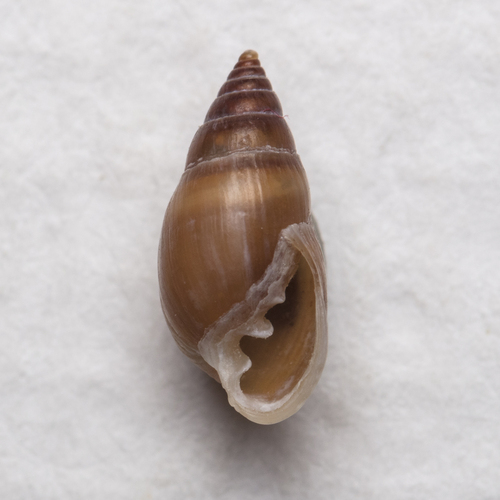
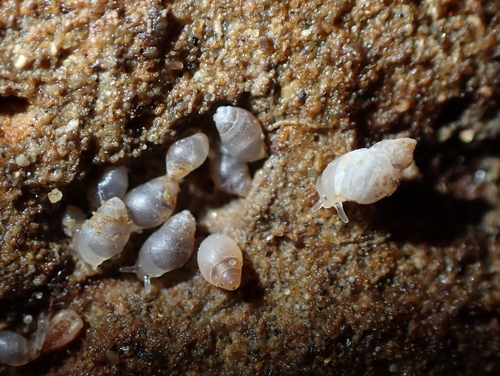
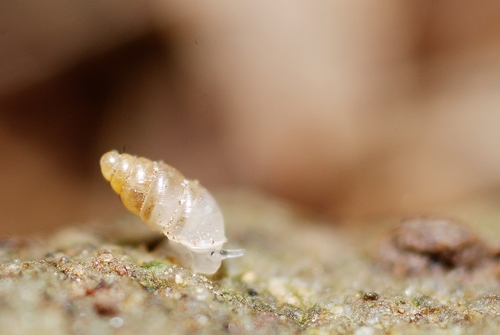
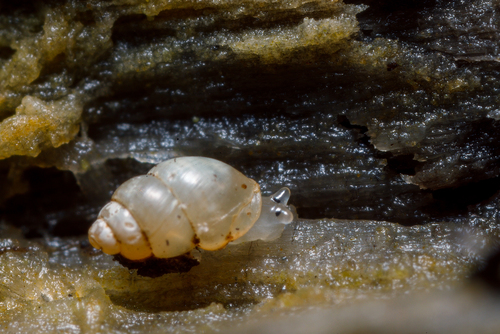
The shell of Carychium minimum O.F.Müller, 1774 measures 0.9–1.1 mm in width and 1.6–2.2 mm in height. This species closely resembles Carychium tridentatum, but its shell is wider than that of C. tridentatum. Like the shell of C. tridentatum, it is dull white, cylindrical, has an oval mouth with two denticles, and a thickened lip. A distinguishing feature appears when the last whorl above the aperture is opened: the plica parietalis, a spiral ridge on the parietal region that projects into the shell's interior, descends straight downwards in a simple pattern.
This species has a Euro-Asiatic native distribution. It occurs in Northern Europe in Denmark, Finland, Norway, and Sweden. In Western Europe it is found in Belgium, France including Corsica, Great Britain and the Channel Islands, Ireland, Luxembourg, the Netherlands, and Switzerland. In Central Europe it is present in Austria, the Czech Republic, Germany, Hungary, Liechtenstein, Poland, Slovakia, and Slovenia. In Southern Europe it occurs in Greece including the North Aegean islands, and Italy. In Southeastern Europe it is found in Albania, Bosnia-Herzegovina, Bulgaria, Croatia, Montenegro, Romania, and Serbia. In Southwestern Europe it occurs in Andorra, Portugal including the Azores and Madeira, and Spain. In Eastern Europe it is present in Belarus, Crimea, Estonia, Kaliningrad, Latvia, Lithuania, Moldova, Ukraine, and European Russia. In Southwestern Asia it is found in Turkey, Armenia, Azerbaijan, and Georgia. It also occurs in Western Siberia. In Central Asia it inhabits northern, central, and eastern Kazakhstan. It has been introduced to North America, specifically Canada (British Columbia, Ontario, New Brunswick) and the United States of America (California, Massachusetts, New York, Pennsylvania).