About Carya ovata (Mill.) K.Koch
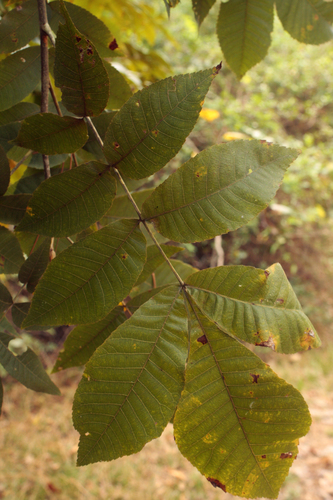
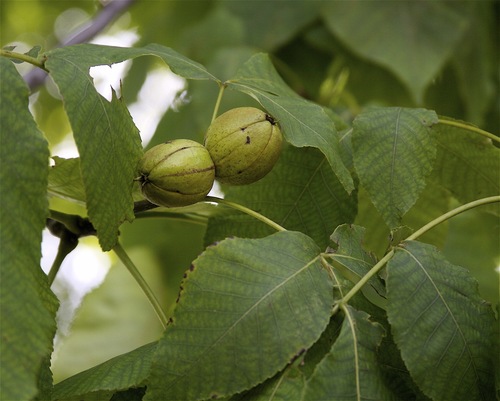
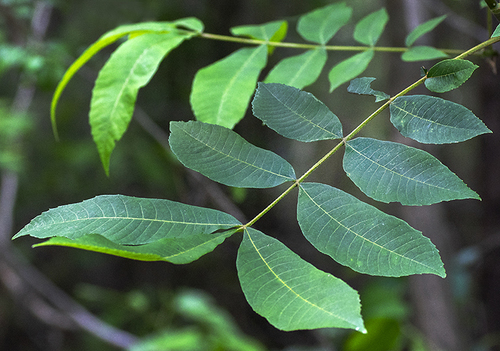
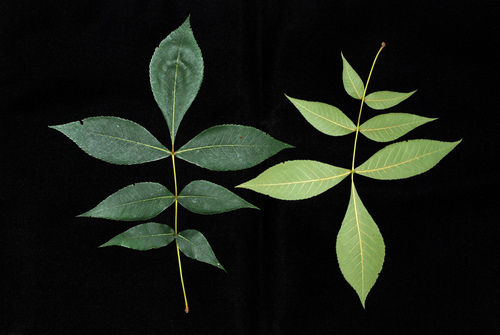
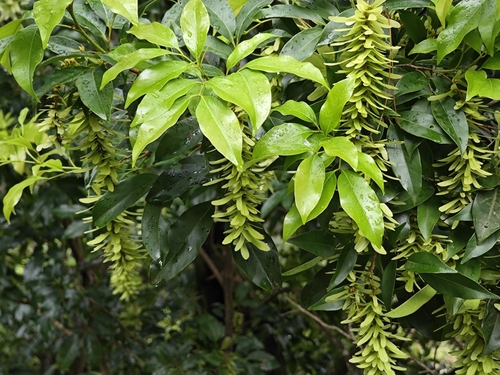
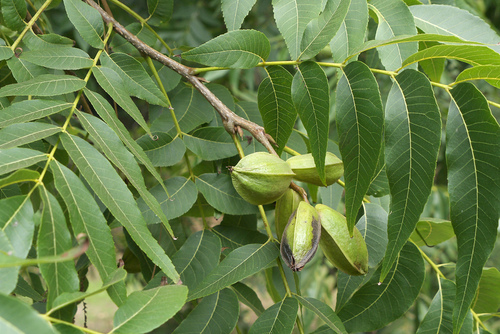
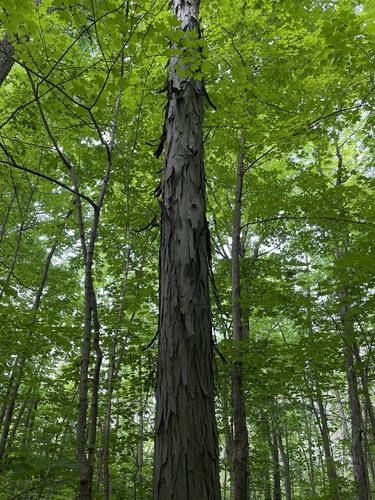
Carya ovata (Mill.) K.Koch, commonly known as shagbark hickory, is a large deciduous tree that grows well over 100 ft (30 m) tall and can live more than 350 years. The tallest recorded shagbark hickory, located in Savage Gulf, Tennessee, stands over 150 ft (46 m) tall. Mature shagbark hickories are easily recognizable by their distinctive shaggy bark, a trait that gives the species its common name; this characteristic only appears on mature trees, while young specimens have smooth bark. Its leaves are 30–60 cm (12–24 in) long and pinnate, most often bearing five leaflets (rarely three or seven), and the terminal three leaflets are much larger than the basal pair. Shagbark hickory is monoecious: staminate flowers grow on long-stalked catkins at the tip of old wood or in the axils of the previous season's leaves, while pistillate flowers form short terminal spikes. The fruit is a drupe 2.5 to 4 cm (1 to 1+1⁄2 in) long, holding an edible nut with a hard, bony shell. The nut is encased in a thick, green four-sectioned husk that darkens and splits off when the fruit matures in the fall. Terminal buds on shagbark hickory are large and covered with loose scales. C. ovata begins producing seeds at approximately 10 years of age, but does not produce large seed crops until it is 40 years old, and will continue producing seeds for at least 100 years after that. Nut production is erratic, with good crops occurring every 3 to 5 years; few or no nuts are produced in between good crops, and entire crops may be lost to animal predation. Shagbark hickory is found across most of the eastern United States, but is largely absent from the southeastern and Gulf Coastal Plains, as well as lower Mississippi Delta areas. An isolated population grows in eastern Canada as far north as Lavant Township, Canadian zone 4b. Scattered populations of shagbark hickory also occur in the Sierra Madre Oriental of eastern Mexico. The species was introduced to Europe in the 17th century, and still occurs as a non-native species in Central Europe. Its native range is one of the widest among all hickory species, though the species is now less prevalent due to selective harvesting for its wood. In its ecology, the nuts of shagbark hickory are consumed by red squirrels, gray squirrels, raccoons, chipmunks, and mice. Additional consumers include black bears, gray foxes, red foxes, rabbits, and bird species including mallards, wood ducks, bobwhites, and wild turkey. The nuts of shagbark hickory are edible with an excellent flavor. They are not suitable for commercial or orchard production, because the tree takes a long time to produce sizable crops and output varies unpredictably from year to year. The nuts can be used as a substitute for pecans in colder climates, and serve nearly the same culinary function as pecans. The bark is also used to add flavor to maple-style syrup. Shagbark hickory nuts were an important staple in the diets of Indigenous peoples. Excavation of an ancient site dated to approximately 4350–4050 cal BP at Victor Mills in Columbia County, Georgia uncovered hickory nuts, processing tools, and other artifacts that indicate large-scale processing and storage of the nuts. Native Americans used nut kernel milk to make corn cakes, kanuchi, and hominy, and the nuts were a significant food source for the Algonquins. Shagbark hickory wood is used for smoking meat, and was used to make bows by Native Americans in northern regions. Air-dried shagbark hickory lumber weighs 63 lb per cubic foot, is heavy, hard, and tough, and has been used to make implements and tools that require strength, including axles, axe handles, ploughs, skis, and drum sticks.