About Carya illinoinensis (Wangenh.) K.Koch
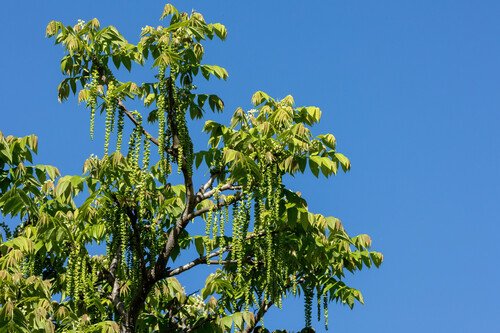
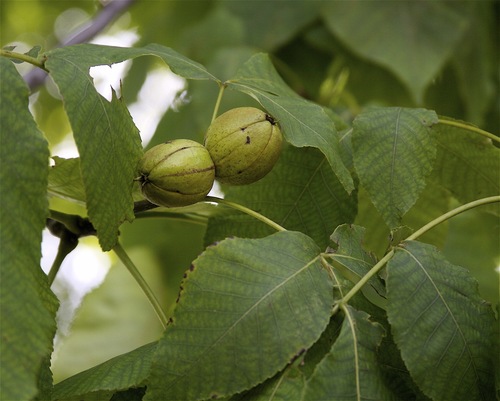
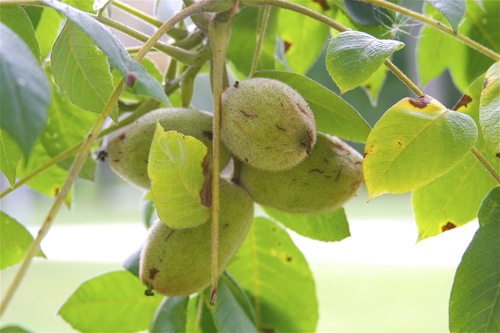
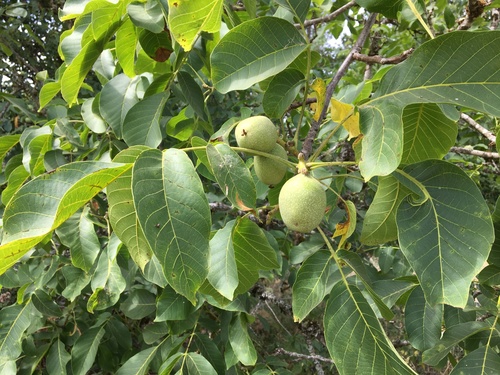
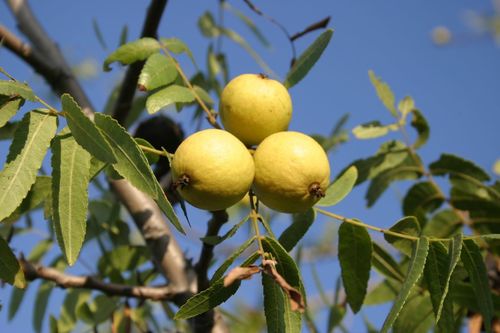
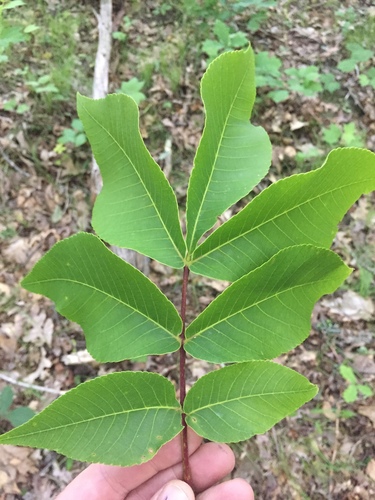
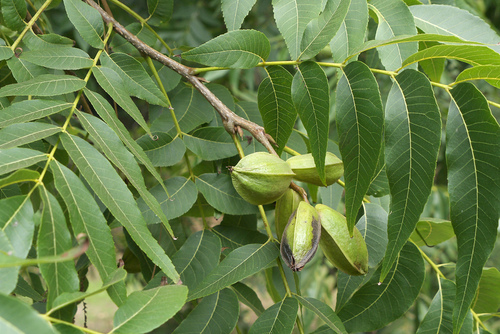
This large deciduous tree, the pecan, reaches a typical height of 20 to 40 m (66 to 131 ft), and rarely grows as tall as 44 m (144 ft). It usually has a canopy spread of 12 to 23 m (39 to 75 ft), with a trunk that can grow up to 2 m (6 ft 7 in) in diameter. A 10-year-old pecan sapling grown in ideal conditions reaches roughly 5 m (16 ft) tall. Its leaves are alternate, 30 to 45 cm (12 to 18 in) long, and pinnately compound, bearing 9 to 17 leaflets. Each individual leaflet measures 5 to 12 cm (2 to 4+1⁄2 in) long and 2 to 6 cm (1 to 2+1⁄2 in) broad. Like fruits from all other members of the hickory genus Carya, the pecan is not technically a true nut; it is classified as a drupe: a fruit with a single central pit surrounded by an outer husk. The husk develops from the exocarp tissue of the flower, while the structure commonly called the pecan nut develops from the endocarp and holds the seed. The husk is aeneous, meaning it has a brassy greenish-gold color, with an oval to oblong shape. It measures 2.6 to 6 cm (1 to 2+3⁄8 in) long and 1.5 to 3 cm (5⁄8 to 1+1⁄8 in) broad. The outer husk is 3 to 4 mm (1⁄8 to 5⁄32 in) thick, begins green, and turns brown when mature. At maturity, it splits into four sections to release the thin-shelled seed inside. Pecan trees are native to south-central United States, but have spread widely through cultivation. Native Americans may also have helped spread the species by planting it. Carya illinoinensis grows in bottomlands, suburban woodlands, disturbed areas, and along forest edges, and commonly naturalizes near locations where cultivated pecan trees grow. It grows on soils that do not experience frequent flooding, and prefers moist, well-drained, rich soils. Pecans are one of the most recently domesticated major crop species. While wild pecans were already well known as a delicacy to both Native Americans and colonial Americans, commercial pecan cultivation in the United States did not start until the 1880s. As of 2014, the United States produced an annual pecan crop of 119.8 million kilograms (264.2 million pounds), with 75% of this total production coming from Georgia, New Mexico, and Texas. Pecan trees can be grown in USDA hardiness zones roughly 5 to 9, and grow best in regions with long, hot, humid summers. Growers typically harvest pecan nuts around mid-October. The tree requires very little pruning, as it naturally develops a vase-shaped canopy; the only pruning needed is removal of diseased, broken, or dead limbs. In 2017, outside the United States, Mexico produced nearly half of the world's total pecan supply, a volume similar to that of the United States; together, the two countries accounted for 93% of global pecan production. As of 2024, South Africa is the third largest pecan producer, and exports most of its crop to China. Pecan trees need large amounts of water during the growing season, and most pecan orchards in South Africa use flood irrigation to optimize water use and mature pecan production. Generally, two or more pecan trees of different cultivars are required to successfully pollinate one another. Selecting appropriate pecan cultivars can be a complex process, based on a cultivar's Alternate Bearing Index (ABI) and its pollination period. Commercial growers prioritize the ABI, which measures how likely a cultivar is to produce a crop only in alternating years (an index of 1.0 means the cultivar is most likely to produce little to no crop every other year). Pollination period sorts all cultivars into two groups: protandrous cultivars, which shed pollen before they become receptive to pollen, and protogynous cultivars, which shed pollen after they have become receptive to pollen. State-level resources provide lists of recommended pecan varieties for specific local regions. Native pecan populations in Mexico are adapted to USDA hardiness zones 9 to 11, and very little breeding work has been done with these populations. A small number of selections from native Mexican pecan stands, such as Frutosa and Norteña, are recommended for cultivation in Mexico. Improved varieties recommended for Mexican cultivation are developed by the USDA. There is a gap in pecan breeding development for Mexico: native pecans can be cultivated as far south as the Yucatán peninsula, but USDA-developed cultivars require more chilling hours than are available in much of this region. Some regions of the United States, including parts of Florida and Puerto Rico, fall into USDA hardiness zone 10 or warmer, and have limited options for pecan cultivation. 'Western' is the only commonly available pecan variety that can produce a crop in low-chill zones. Pecan seeds are edible, with a rich, buttery flavor. They can be eaten fresh or roasted, or used in cooking, especially in sweet desserts such as pecan pie, a traditional Southern United States dish. Butter pecan is also a common flavor for cookies, cakes, and ice creams. Pecans are a key ingredient in American praline candy. Other cooking uses for pecans include making pecan oil and pecan butter. Pecan wood is used to make furniture and wood flooring, and is also used as flavoring fuel for smoking meats, giving grilled foods a sweet and nutty flavor that is stronger than the flavor from most fruit woods.