About Carya cordiformis (Wangenh.) K.Koch
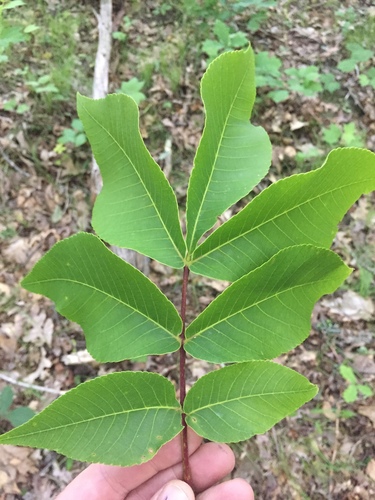
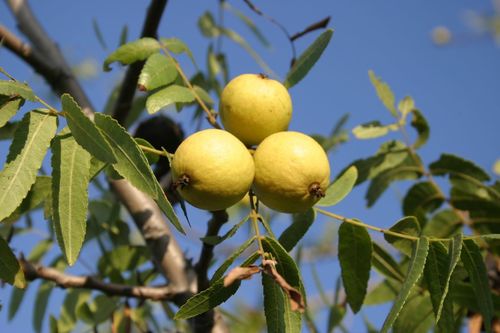
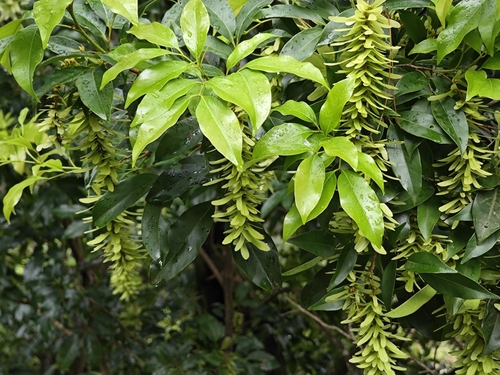
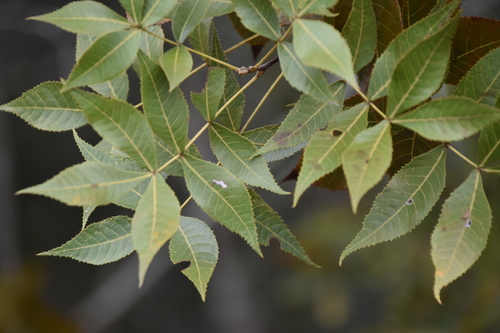
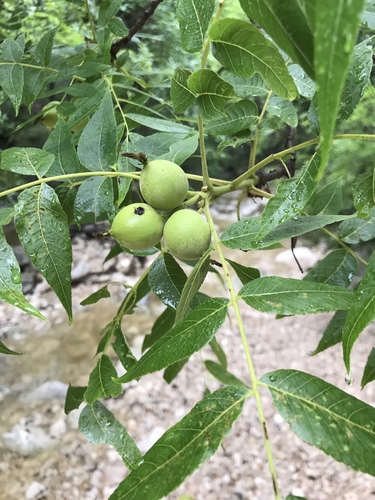
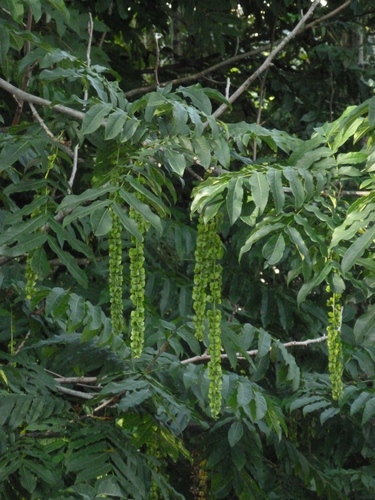
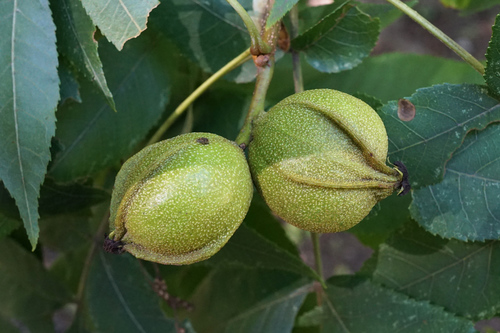
This large deciduous tree typically reaches up to 35 m (115 ft) tall, with exceptional individuals growing as tall as 47 m (154 ft). Its trunk can grow up to 1 m (3 ft 3 in) in diameter. Its leaves are 15–30 cm (6–12 in) long and pinnate, with 7–11 lanceolate leaflets. Each leaflet measures 7–13 cm (2+3⁄4–5 in) long, and the apical leaflet is only slightly larger than the others. It produces small, wind-pollinated catkin flowers in spring. Its fruit is a very bitter nut 2–3 cm (3⁄4–1+1⁄4 in) long, enclosed in a green four-valved covering that splits away when the nut matures in fall, with a hard, bony inner shell. A key identifying feature of this species is its bright sulfur-yellow winter bud. It is closely related to pecan, and is classified alongside pecan in the same section of the genus Carya: Carya sect. Apocarya, sharing similar leaf shape with pecan. Unlike pecan, however, it does not produce edible nuts. It can be most easily distinguished from pecan by its smaller number of leaflets: many of its leaves have only 7 leaflets, while pecan rarely has fewer than 9 leaflets and most often has 11–13 leaflets per leaf. Known hybrids between this species and pecan are named Carya × brownii. A recognized hybrid between this species and shagbark hickory (C. ovata) is called Laney's hickory (Carya ×laneyi). Bitternut hickory grows in moist mountain valleys along streambanks and in swamps. While it is most often found on wet bottom lands, it also grows on dry sites and grows well on poor soils that are low in nutrients. This species is not listed as a titled species in the Society of American Foresters forest cover types because it does not grow in large enough numbers. Its range covers most of eastern United States and southern Quebec, Canada, extending from southwestern New Hampshire, Vermont, Maine, and southern Quebec west to southern Ontario, central Michigan, and northern Minnesota, south to eastern Texas, and east to northwestern Florida and Georgia. It is most common across the area from southern New England west to Iowa, and from southern Michigan south to Kentucky. It is likely the most abundant and most uniformly distributed of all hickories, and is most commonly found at high elevations in the Southern Appalachian Mountains. Bitternut hickory is used for lumber and pulpwood. Commercial stands of this species are mostly located north of commercial stands of other pecan hickories. It is typically cut and sold mixed together with "true" hickories. Because its wood is hard and durable, it is used to make furniture, paneling, dowels, tool handles, and ladders. Like other hickories, its wood is used for smoking meat, and was used by Native Americans to make bows. Its seeds are eaten by rabbits, and both its seeds and bark are eaten by other wildlife. The tannins that give bitternut hickory nuts their bitter flavor are not fat soluble, so edible oil can be extracted from the nuts by pressing and separating the tannin-containing pulp from the oil. Reportedly, bitternut hickory nuts can have an oil content as high as 80%, and the oil is reputed to have a mild, pleasant flavor similar to pecan oil.