About Carya aquatica (F.Michx.) Nutt.
Carya aquatica, commonly called bitter pecan or water hickory, is a large tree in the Juglandaceae (walnut) family that can grow over 30 meters (98 ft) tall. It is a dominant plant species in clay flats and backwater areas near streams and rivers across the American South, and is a major component of wetland forests in the southeastern United States, after selective cutting of more commercially desirable tree species for lumber. It is recognized as important for cleansing drainage water: during flooding, the trees slow water flow, allowing sediments to settle out of the water column. This species tolerates wet soils but grows best on well-draining soils near rivers and other waterways. Its native range covers the Atlantic and Gulf Coastal Plains from southeastern Virginia to southern Florida and Alabama, west into eastern Texas, and extends north along the Mississippi Valley to southern Illinois.
Water hickory reproduces aggressively both by seed and vegetative sprouts from roots and cut tree stumps. It regenerates readily from seeds, which germinate and establish on disturbed soil or understory duff. Understory seedlings require release from canopy competition to fully develop. Most existing water hickory stands, especially those on imperfectly drained flats, established after preferential logging removed more valuable tree species. On poorly drained sites with lower competition, water hickory fills in openings created by windthrow, natural mortality, and logging.
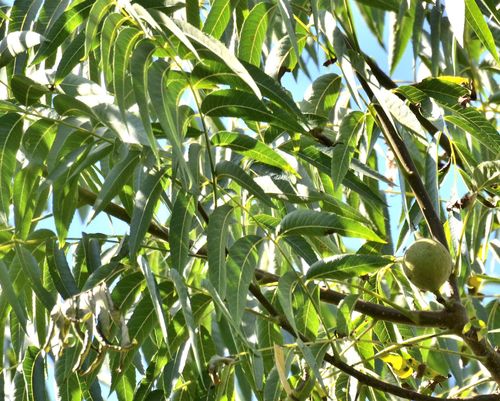
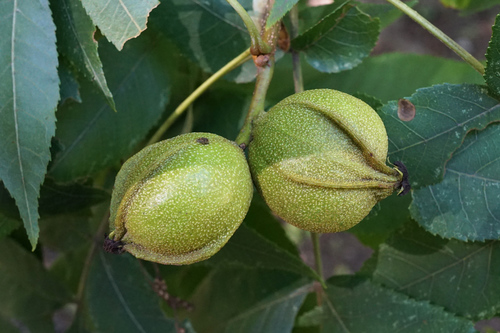
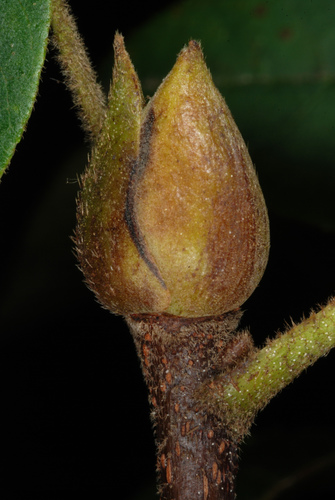
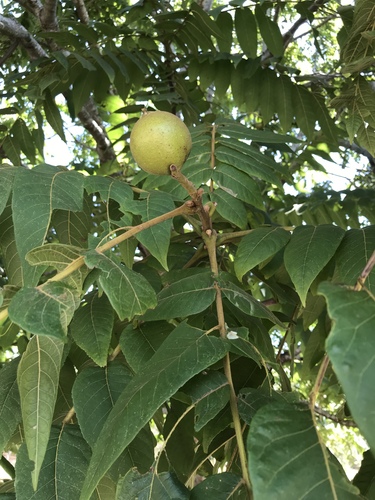
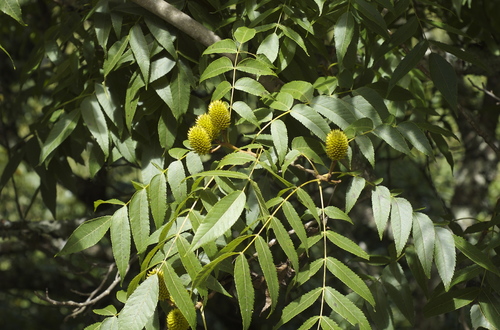
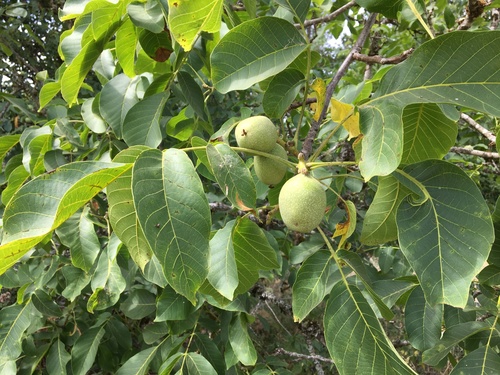
Water hickory is monoecious: male and female flowers develop alongside new leaves during April and May. Male flowers grow as stalked catkins on current or previous year’s branches, while female flowers form on short spikes or stalks. Its fruit develops inside a thin husk, producing thin-shelled, flattened nuts with a bitter seed. Nuts fall between October and December of the same year.
Seed production begins when trees are roughly 20 years old, or around 20 cm (7.9 in) diameter at breast height (d.b.h.). Optimum seed-bearing occurs between 40 and 75 years of age, or once trees reach 51 cm (20 in) d.b.h. Most years produce heavy seed crops, and a healthy tree can bear up to 70 liters (2 bushels) of seeds. There are approximately 440 cleaned seeds per kilogram (200 seeds per pound). Seeds are dispersed by water and animals, with floodwaters being particularly important for carrying seeds to new growing areas.
After falling in autumn, seeds remain dormant until germination between late April and early June, and rarely stay viable until the second spring. Germination is hypogeal. Up to nearly 80 percent of a seed crop can germinate, leading to the common formation of thickets and clumps of water hickory. The species can survive in the understory for at least 15 years due to its moderate shade tolerance, but full sunlight is required for seedlings to grow into mature trees. Its relatively slow height growth means water hickory needs nearly free from competition to reach the overstory. Thanks to its extended dormant season, water hickory seedlings survive late-spring floods better than most competing species.
Stumps less than 61 cm (24 in) in diameter and severed roots readily produce sprouts. In their first one to two years, sprouts grow three to four times faster than seedlings. Even on poorly drained clay soil, first-year sprouts can reach 1.5 m (4.9 ft) tall, and sprouts have been recorded at 4.6 m (15 ft) tall when 5 years old.
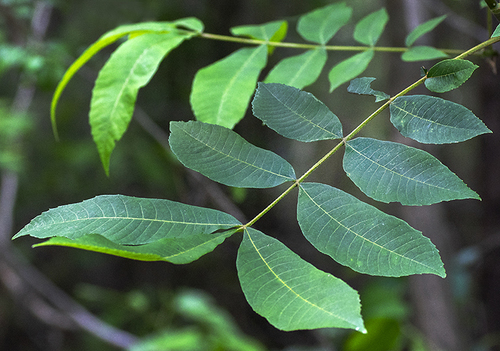
On high-quality sites, mature water hickory can reach 33.5 m (110 ft) tall and 91 cm (36 in) in diameter, with around 16 m (52 ft) of merchantable trunk. It grows a tall straight trunk topped with slender to moderately stout ascending branches. Diameter growth is slow for a southern tree species, at only 2 to 8 mm (0.079 to 0.315 in) per year. At 50 years old, dominant trees average 35 cm (14 in) d.b.h. on good sites and just 25 cm (9.8 in) on poor sites. Site index at a base age of 50 years ranges between 20 and 29 m (66 and 95 ft). Slow growth is typical when water hickory competes with oaks, sugarberry, gum, and other species on good sites. Rare pure stands on good sites have a maximum mean annual production of 10.5 m³/ha (150 ft³/acre). Maximum mean annual production on medium and poor sites is an estimated 7.0 m³/ha (100 ft³/acre) and 3.5 m³/ha (50 ft³/acre), respectively. A typical average site yields around 210 m³/ha (3,000 ft³/acre) at maturity, with low yields most common due to slow growth and poor site quality.
Like other hickories, water hickory grows a taproot during the seedling stage. The wet, clayey soils it typically inhabits restrict the entire root system to fairly shallow depths. The original taproot develops into a coarse, widely spreading but shallow lateral root system. When a 30-cm (12-in) diameter tree growing on moderately well-drained clayey soil was excavated, its taproot ended abruptly, with three large lateral roots growing out at right angles, and only a few fine roots extending deeper than 50 cm (20 in).
Water hickory is classified as intermediate in shade tolerance. Because of its slow growth, low wood quality, and low commercial value, most silvicultural operations are designed to favor other species over water hickory. However, widespread high-grade logging that removes more desirable species has left water hickory more abundant and widespread than it would be naturally. The species responds well to release from competition. On better-drained sites, removing or killing all stems larger than 5 cm (2.0 in) d.b.h. will usually reduce water hickory to a minor component of future stands. While many new seedlings and sprouts may emerge, most are eventually overtopped by faster growing species. In the Overcup Oak-Water Hickory cover type, any harvest operation will typically leave water hickory as a major component of the future stand. Water control projects that prolong spring flooding tend to favor water hickory.
Water hickory is occasionally damaged by insects. Several species of borer attack the tree, with the living-hickory borer (Goes pulcher) being the most common. Borer attacks most often affect young trees up to 14 cm (5.5 in) in diameter. Tunneling weakens trunks, which can sometimes break, and logs that were previously infested have low commercial value. While this borer is widespread, damaging populations are limited to local areas. Leaf-eating insects, especially the forest tent caterpillar (Malacosoma disstria), occasionally defoliate entire trees.
Diseases are generally not a major issue for water hickory. However, butt and stem rots that enter through wounds from fire or logging are a major cause of cull trees. Heart-rot fungi spread faster through the trunks of water hickory than through associated oaks and other bottomland hardwoods. A common major defect of water hickory is "shake," which occurs especially in trees growing on waterlogged sites. Yellow-bellied sapsuckers also cause wood defects, and water hickory tends to host more eastern mistletoe (Phoradendron serotinum) than any of its associated tree species.
The bitter nuts of water hickory are used as food to a limited extent by ducks, squirrels, feral hogs, and other wildlife. Water hickory is occasionally planted or retained in natural stands to serve as a shade tree. Its wood is locally preferred for firewood, and is sometimes used to make fence posts. Low floodplains where water hickory is a dominant species are increasingly recognized for their ability to cleanse drainage water and provide refuge for many threatened plant and animal species.