About Carterocephalus palaemon (Pallas, 1771)
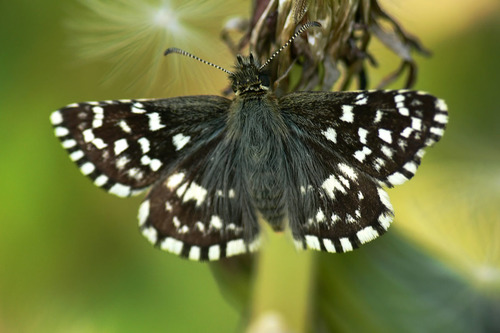
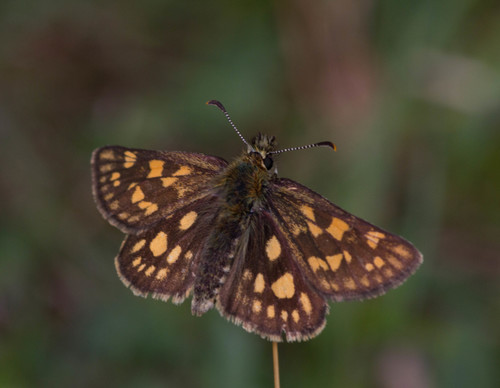
This butterfly, Carterocephalus palaemon, commonly called the chequered skipper (also known as the arctic skipper in North America), has a wingspan of 29 to 31 mm. The upperside of its wings are dark brown, with orange scales at the wing bases and golden spots, which gives the species its English common name of chequered skipper. The underside of the wings follows a similar basic pattern to the upperside, but the forewings are orange with dark spots, while the hindwings are russet with cream spots outlined in black. The two sexes are similar in appearance, though females are generally slightly larger than males. In Britain, the chequered skipper was formerly resident in both England and Scotland. Now it is only found in western Scotland, and a reintroduction programme for the species is currently underway in England. The butterfly has also reached parts of Japan, where it faces threats. In North America, where it is called the arctic skipper, it is found on northern coasts, ranges into central Alaska, and can also be seen in central California and along the coasts of Canada. Despite its North American common name, it does not live in Arctic areas. It is generally classed as a woodland butterfly, and breeds in and around damp woodland, favouring woodland clearings and paths, and shows a particular preference for blue woodland flowers. Beyond woodland, it can also be found in bogs, at stream edges, and in grassy forest openings in both Great Britain and the northern United States. In Scotland, chequered skippers can breed in open grasslands. In woodland areas, breeding sites occur at river edges and the base of slopes. While the species has a fairly limited overall geographic range, the habitats it occupies also tend to have narrow seasonal and temperature ranges. In Scotland, the presence of Molinia caerulea is very important for determining suitable habitat, while in England Bromus species are essential. In North America, chequered skippers are found around forest trails, forest edges, and open grassy areas. Males defend territories and intercept passing females from preferred perches. This territorial behavior typically occurs in areas where there are concentrations of females, larvae, or food plants. Females place their larvae in areas between woodland soils and peats. Chequered skippers establish their home ranges close to nectar sources, but they avoid positioning their territories in ways that attract other males. During flight season, males spread their home ranges farther apart from one another.