About Carsia sororiata (Hübner)
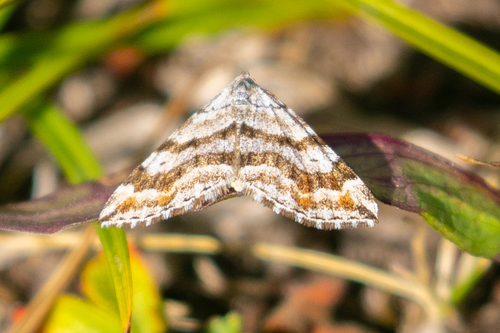
Carsia sororiata, commonly known as the Manchester treble-bar, is a moth species belonging to the family Geometridae. It was first described by Jacob Hübner in 1813. This species is distributed in northern and central Europe, the Urals, Siberia, the Far East, and northern Mongolia. In North America, its range extends from Alaska to Newfoundland, and reaches south to New Hampshire. The wingspan of Carsia sororiata measures 20 to 30 mm. The base color of the forewings ranges from slate grey and light grey to white grey. Two distinct, wide lines cross the forewing; these lines range in color from light brown and brown to black brown. The inner cross line is almost straight, while the outer cross line is bent and bears two outward-pointing spikes. The subspecies found in Central Europe, C. s. imbutata, has a brownish-yellowish to reddish-brown outer field at the points of the outer cross line. The lines on the wings are sometimes very elegantly formed. In some individual moths, the two lines connect to form a 'bridge' across the posterior half of the wing. The wing fringes alternate between light and dark sections. A reddish-brown apical extension stretches out from the wing apex. When first laid, the egg is whitish yellow, and it darkens to a deeper yellow as it develops. The micropylar rosette has 8 lobes, and the sides of the egg feature irregular reticulation that is incompletely developed in some areas. Full-grown larvae are fairly stout, with a uniform thickness along their body. The dorsal surface is a relatively deep brownish-red, marked with very fine blackish-red dorsal and subdorsal lines. A broad, bright yellow lateral stripe runs along the body, and this stripe contains prominent red spots at the folds between the middle segments. The larval venter is pale greenish yellow, with a paler central line that has dark edges. Adult moths are active and in flight from July to August. The larvae feed on multiple species of Vaccinium, including Vaccinium uliginosum, Vaccinium oxycoccos, and Vaccinium myrtillus, as well as on Rubus arcticus.