About Carpodetus serratus J.R.Forst. & G.Forst.
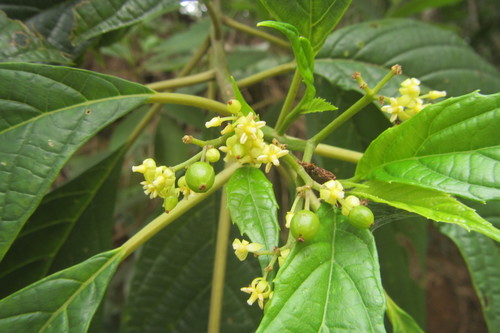
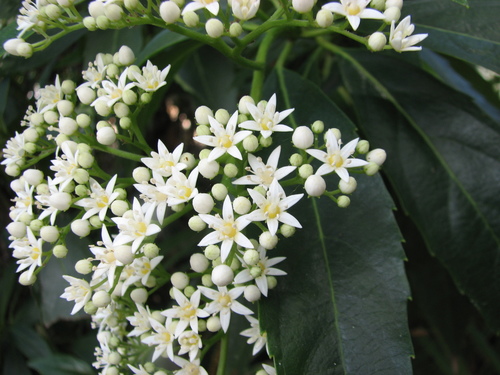
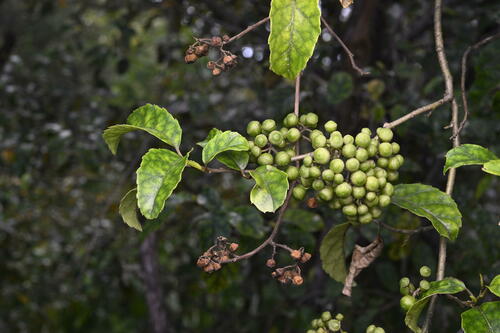
Carpodetus serratus, commonly known as putaputawētā, is a species of monoecious tree that grows up to 10 metres (30 feet) tall. It has a slender trunk reaching up to 20 cm (8 in) wide, with corky, mottled, grey-white bark that is often knobbly from insect tunnelling. Its wood is white with an open grain. Juvenile plants grow as a characteristic divaricating tangled shrub, with branchlets arranged in a zig-zag pattern. The species shows heteroblasty in both leaf and branch form. Leaves are marbled, which is referenced by its common name, and range from ovate to nearly round. They are dark green, thin, slightly leathery, and have finely toothed margins. Juvenile leaves measure 10–30 mm × 10–20 mm, while adult leaves measure 40–60 mm × 20–30 mm, with leaf stalks (petioles) around 10 mm long. Flowers grow in panicles at the tips of branchlets; these panicles can reach up to 50 × 50 mm, and individual flowers are 5–6 mm in diameter. Flowering occurs from November to March. Flowers have white, ovate petals 3–4 mm long, and a cap-shaped stigma with a dark tip. Fruits develop in 4–6 mm long capsules that turn black when mature. Fruiting typically takes place in January and February, though dried fruits can remain on the plant year-round, as they may take a full year to mature. Seeds are very small, only around 1–2 mm long. This species contains multiple chemical compounds: kaempferol, leucodelphinidin, polyphenols, quercetin, and the triterpene lupeol. It has a diploid chromosome count of 30. Carpodetus serratus is endemic to New Zealand, where it occurs across the North Island, South Island, and Stewart Island. Its northern range limit reaches either Mangōnui or Cape Reinga in the North Island, and its southern limit is Stewart Island. While it is widespread across New Zealand, it rarely grows in large populations. The genus Carpodetus was once thought to be restricted to New Zealand, but additional species have since been found in Papuasia, the Solomon Islands, and Vanuatu. A 2023 assessment under the New Zealand Threat Classification System classified this species as "Not Threatened". This tree typically grows in coastal to montane environments, reaching a maximum altitude of 1,200 metres (4,000 feet) above sea level. It is common in broadleaf forests and southern beech (Nothofagus) forests, and often grows as part of secondary forest. It also inhabits streamsides and forest margins, and grows best in areas with variable light. It is commonly found growing alongside wineberry (Aristotelia serrata). It is moderately frost-resistant, can tolerate dry soils, and prefers deep, well-drained soils. Its fruits are dispersed by frugivorous (fruit-eating) animals, most commonly birds. In 1996, researcher Burrows documented that silvereyes (Zosterops lateralis) consume the fruits of this species. Fruits are also eaten by New Zealand bellbirds (Anthornis melanura) and North Island kōkako (Callaeas wilsoni), which compete for the fruits with introduced possums. The divaricating tangled growth form of juvenile plants may have evolved to reduce leaf browsing by the extinct moa, though moa are thought to have eaten the species' fruits. Kererū (Hemiphaga novaeseelandiae) eat both the fruits and leaves of C. serratus. Tree trunks are frequently tunnelled by caterpillars of pūriri moths (Aenetus virescens). After the caterpillars abandon these tunnels, the holes are used as habitat by wētā or tunnelweb spiders (Porrhothele antipodiana). The tree also hosts caterpillars of forest semilooper moths (Declana floccosa) on its leaves, and multiple genera of gall mites have been recorded living on it. The native New Zealand mistletoe tāpia (Tupeia antarctica) grows parasitically on C. serratus. This species has a low flammability rate. As a monoecious species, individual C. serratus trees bear either hermaphroditic flowers or female flowers. The tree's white petals produce a sweet scent that is thought to attract insect pollinators. Botanist George Thomson reported in 1881 that C. serratus is entirely pollinated by insects. A 2007 study recorded both introduced and native bees of the genus Leioproctus visiting its flowers. In 1978, botanist Brenda Shore conducted hand-pollination experiments and concluded that bisexual flowers are capable of producing viable seed through self-pollination. This species has several Māori names, including kai-wētā, putaputawētā, punawētā, putāwētā, piripiriwhata, and piripiri wata. The name putaputawētā translates to "many wētā emerging", in reference to the wētā that inhabit abandoned caterpillar tunnels; other name variations reference wētā, or spleenworts of the genus Asplenium, which are called piripiri in Māori. Museum artefacts show that teka (footrests) were constructed from C. serratus wood. While the timber is not suited to large-scale sawmilling, it has been used for cabinetmaking, for axe and tool handles, and for fence nails and similar purposes. The wood is not durable when in contact with the ground, and it contains too much sap to make good firewood. This trait gave it the English nickname "bucket-of-water tree", a name it shares with kōtukutuku (Fuchsia excorticata) and rewarewa (Knightia excelsa). New Zealand botanist Leonard Cockayne considered C. serratus a strong candidate for New Zealand's national flower.