About Carpodectes nitidus Salvin, 1865
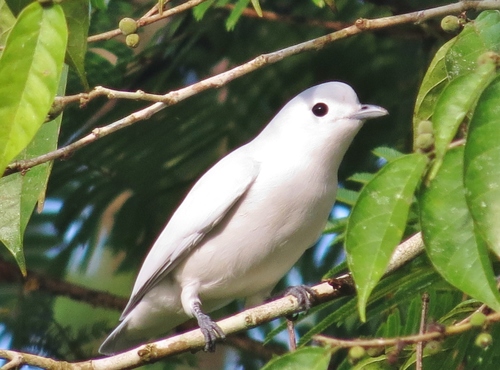
The snowy cotinga (Carpodectes nitidus Salvin, 1865) is 19.5 to 21 cm (7.7 to 8.3 in) long and has an average weight of 105 g (3.7 oz). This species is sexually dimorphic. Adult males are mostly white, with a light bluish gray crown and a very light bluish gray wash on their upperparts and wings. Their flight feathers are wide with rounded tips. Adult females have brownish gray heads and upperparts, with a darker crown. Their tails are blackish. Most of their wings are blackish, with white to grayish white edges on the coverts and inner flight feathers. Their chin is a very light gray, and the rest of their underparts are paler gray than their upperparts, fading to white on the flanks, belly, and undertail coverts. Their secondaries are much thinner than those of males. Both sexes have an orange to dark brown iris, and blackish legs and feet. Their gray bill has a wide base, a ridged culmen, and a notch on the tip of the maxilla. Immature birds of both sexes look like adult females. Subadult males have plumage that is almost fully adult, but they have dark markings on their wing feathers and a gray wash on the rump and tail. The snowy cotinga is similar to the other two species in the genus Carpodectes.
The snowy cotinga occurs on Caribbean lowlands, ranging from central Honduras south through Nicaragua and Costa Rica to western Bocas del Toro Province in extreme northwestern Panama. There are scattered records of the species further north in Honduras, and at least one confirmed sighting in extreme southern Guatemala. It inhabits the canopy of tropical humid evergreen forest and adjacent secondary forest. Its overall elevational range extends from sea level to 750 m (2,500 ft), though in Costa Rica it only rarely reaches elevations as high as 700 m (2,300 ft).