About Carpobrotus modestus S.T.Blake
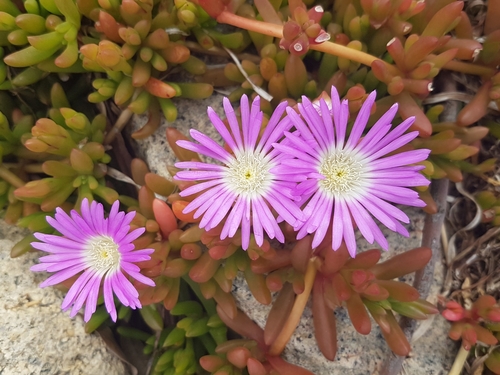
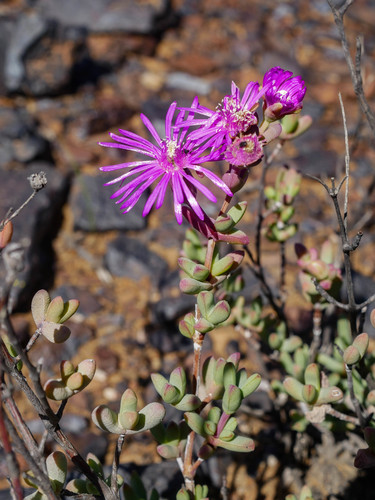
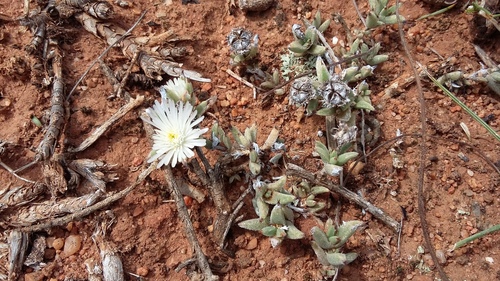
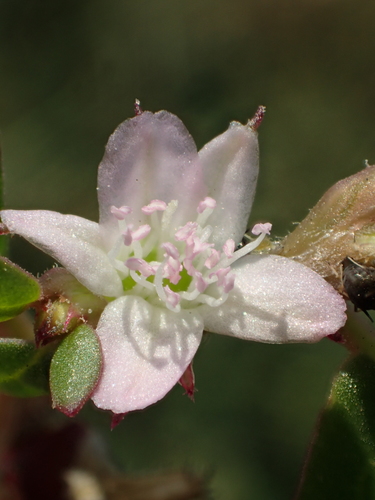
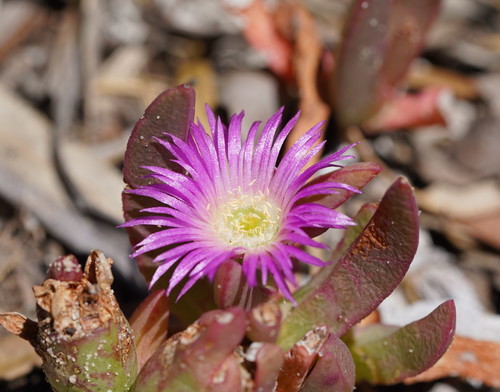
Carpobrotus modestus S.T.Blake, commonly called inland pigface, is a prostrate succulent plant. Its stems grow up to 50 centimetres (20 in) long and have a diameter between 3 and 8 millimetres (0.1–0.3 in). The leaves are 3 to 7 centimetres (1.2–2.8 in) long and 4 to 9 millimetres (0.16–0.35 in) thick, with a glaucous colour that is often tinged pink. Near the middle of the leaf, the leaf is usually slightly thicker than it is wide, with flat to slightly convex surfaces, and a smooth or finely toothed keel close to the tip. Its flowers are roughly 2 centimetres (0.8 in) in diameter and most are sessile. Each flower has five sepals, with the two longest sepals measuring 8 to 18 millimetres (0.3–0.7 in) long. Each flower also has around 45 to 60 petal-like staminodes that are 6 to 12 millimetres (0.2–0.5 in) long, purple with a white base, and 20 to 100 stamens. This species is hermaphrodite, meaning individual plants have both male and female reproductive organs. The fruit is fleshy, fig-shaped in appearance, turns purple when ripe, and is shaped as a narrow ellipsoid to obovoid. It is 1.5 to 2 centimetres (0.6–0.8 in) long, with a recurved stalk. Flowering occurs from August to November in Western Australia, and from September to February in eastern Australia. Carpobrotus modestus is distributed across Western Australia, South Australia and Victoria. It grows in heath, shrubland, and woodland, and can grow in sandy, loamy, and clay soil types, most commonly in clayey-sand. It can tolerate acidic, basic, and neutral well-drained soil. This species can tolerate harsh environmental conditions including drought, frost, and soil salinity. Carpobrotus modestus switches between two types of photosynthesis: CAM photosynthesis and C3 photosynthesis. It uses CAM photosynthesis when soil water is limited, and switches to C3 photosynthesis when water becomes available. In semi-arid shrublands, C. modestus acts as a post-fire pioneer species: it appears soon after fire, persists for several years, then disappears as the shrubland canopy closes during ecosystem regeneration. Both the fruit and leaves of C. modestus are reported to be used as food by First Nations people in Australia. Traditionally, the leaves of this species have been applied to treat stings, burns, and skin irritations in a similar way to Aloe vera. Leaf extracts from the species have also demonstrated antioxidant, antiplatelet, and anti-inflammatory activity.