About Carpobrotus dimidiatus (Haw.) L.Bolus
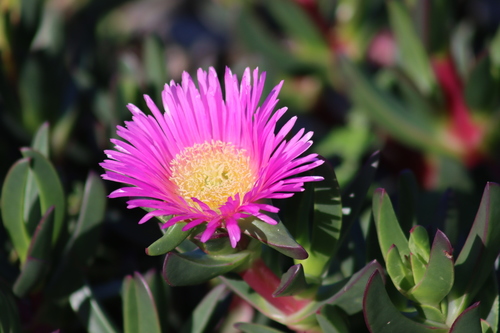
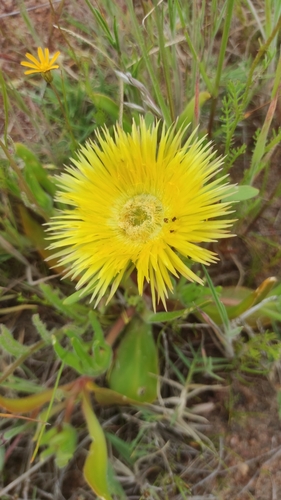
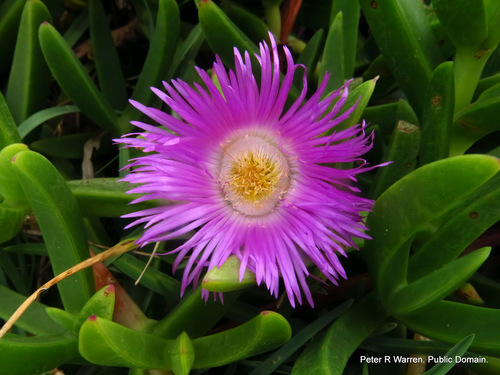
The flowers of Carpobrotus dimidiatus range in color from bright pink to mauve. The receptacle is turbiniform to barrel-shaped, similar to the receptacle of the related species C. mellei, and tapers at the base into the pedicel. The receptacle is also often strongly and distinctly double-ridged. The center of the ovary's top is slightly raised. The leaves of this species are relatively long and thin; mature leaves are straight, while very young leaves may be subacinaciform. Leaf surfaces are somewhat canaliculate, and leaves are basally connate. In cross-section, leaves form an approximate equilateral triangle, and are a dull glaucous-green color. This species' natural habitat is the coast of KwaZulu-Natal, South Africa, with its range stretching south into the Eastern Cape and north into Mozambique. In the southern and western parts of its natural range, C. dimidiatus transitions into the related species Carpobrotus deliciosus. Its fruits are edible, and are grazed by tortoises and other southern African animals.