About Carpiodes cyprinus (Lesueur, 1817)
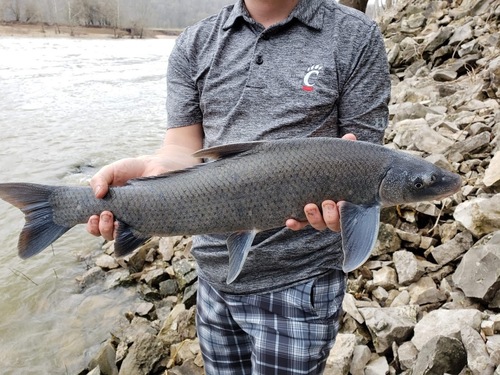
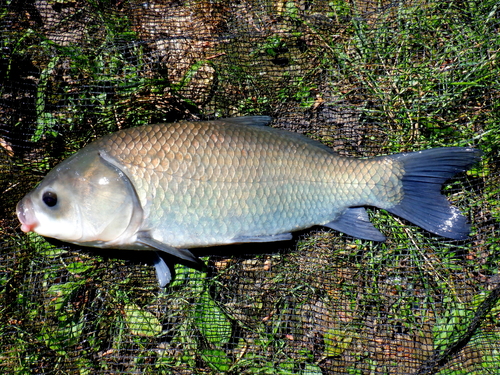
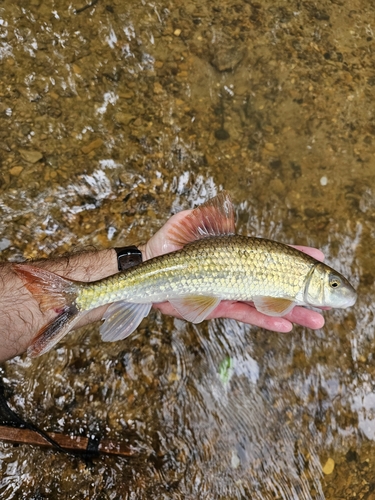
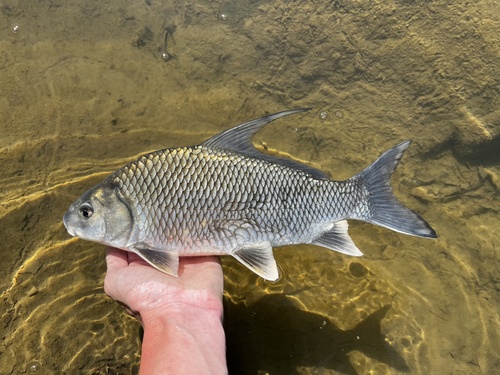
This species is scientifically named Carpiodes cyprinus (Lesueur, 1817), and is commonly known as the quillback. It is a medium-sized, deep-bodied fish distributed across North America. It has a small head, humped back, and deeply forked caudal fin. Its compressed body makes it look flattened when viewed from the side. The quillback has a subterminal mouth with no barbels, and no nipple-like protrusions on the bottom lip. It has large, reflective, silver cycloid scales that give the species its characteristic silver color. It has a white belly with yellow or orange lower fins; the tail and dorsal fin are usually gray or silver. The common name "quillback" comes from the long quill formed by the first several fin rays of the dorsal fin. Quillback are typically 15–20 inches long on average, weighing between 1 and 4 pounds, though they can grow up to 26 inches and weigh 10 pounds. The quillback has a nearly straight, hyper-sensitive lateral line made of at least 37 lateral line scales, which helps the fish locate predators and prey. The quillback is found across much of North America, ranging from Saskatchewan to Florida, and from South Dakota to Alabama. It occupies temperate freshwater habitats including many streams, lakes, channels and rivers. It prefers water that is clear, slow moving, highly productive and moderately deep. It is commonly found in the Hudson Bay, the Mississippi River basin, the Great Lakes, and drainages from the Delaware, Apalachicola, and Pearl rivers. They often make up a large portion of the biomass of warmwater rivers, but are very difficult to catch with traditional American angling methods. The quillback is closely related to the highfin carpsucker and the river carpsucker. All three species are rarely caught by anglers due to their feeding habits, but they have been caught occasionally on worms, minnows, and artificial lures. Quillbacks usually feed in schools. They are omnivores and bottom feeders that prefer lakes, rivers and streams with clear water near the bottom. Schools of quillback move slowly over sand or gravel bottoms while feeding. Their typical diet consists of aquatic insect larvae and other small organisms, and they have also been known to eat molluscs and aquatic vegetation. The quillback reproduces once yearly, typically in late spring or early summer. The timing of reproduction depends on water temperature, with ideal temperatures for reproduction between 7–18 degrees Celsius. Spawning occurs upstream of the quillback's typical habitat, and they migrate in schools to the spawning site. The female quillback produces between 15,000 and 60,000 eggs, and scatters them in shallow water over a sandy or mud bottom. Fertilization then happens externally, and the eggs are left in quiet water. Since the quillback is oviparous, the eggs are hatched outside of the fish's body. The quillback has a polygynandrous mating system, meaning two or more males have an exclusive sexual relationship with two or more females. Sex ratios may vary significantly between populations.