About Carpinus betulus L.
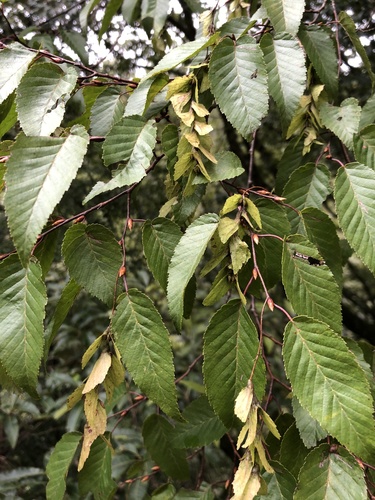
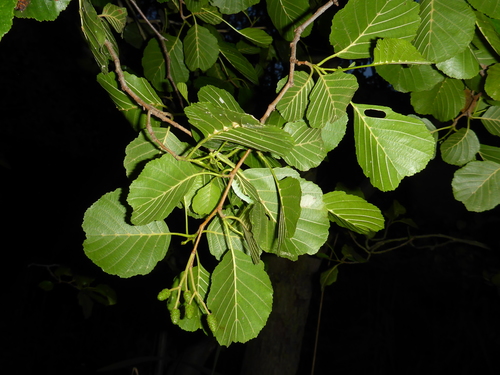
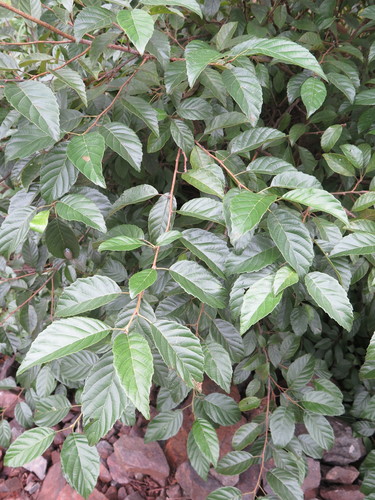
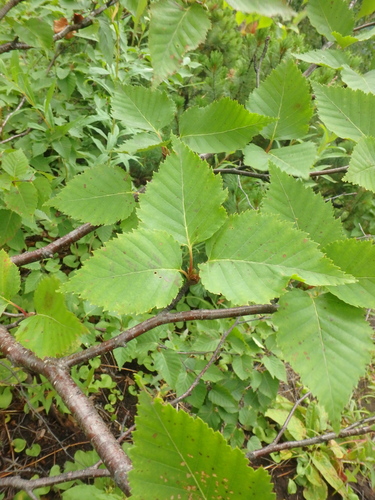
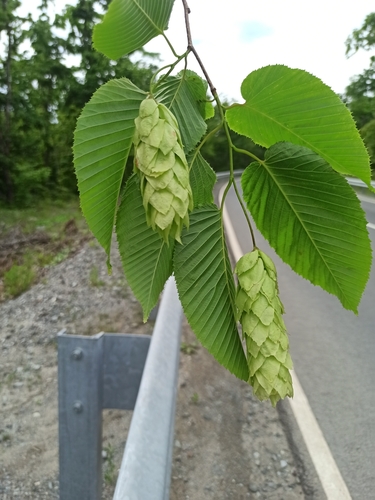
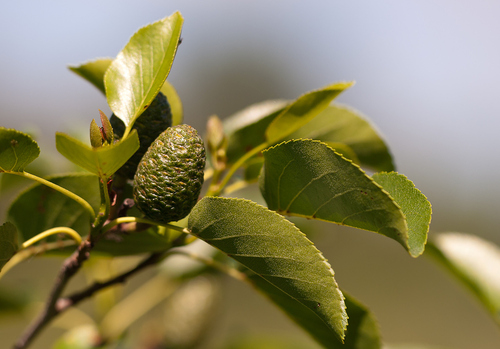
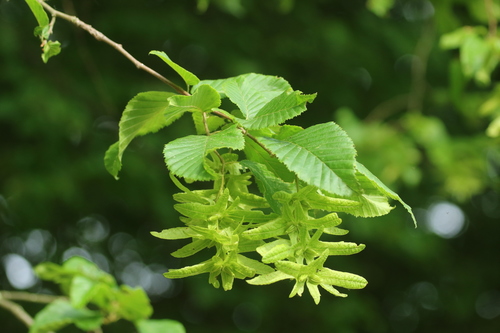
Carpinus betulus L. is a deciduous small to medium-size tree that typically grows 15–25 metres (49–82 ft) tall, rarely reaching 30 m (98 ft), and it often has a fluted, crooked trunk. Even on old individuals, the bark remains smooth and greenish-grey. Compared to beech buds, its buds are at most 10 mm (0.39 in) long and pressed tightly close to the twig. Its leaves are alternate, 4–9 cm (1.6–3.5 in) long, with prominent veins that create a distinct corrugated texture, and have a serrated margin. This species is monoecious, and its wind-pollinated male and female catkins emerge in early summer after the leaves have opened. The fruit is a small nut 7–8 mm (0.28–0.31 in) long, partially enclosed by a three-pointed leafy involucre 3–4 cm (1.2–1.6 in) long, and it matures in autumn.
Hornbeam is considered native to Western Asia and across all of Europe. It prefers a warm climate, and occurs naturally only at elevations below 1,000 metres (3,281 ft). It is a common tree species in scree forests. In England, hornbeam was frequently coppiced and pollarded in the past; these traditional management methods are still used infrequently today, mainly for non-commercial conservation purposes. As a traditionally managed woodland tree, it is especially common in the ancient woodlands of south Essex, Hertfordshire and north Kent, where it typically makes up more than half of the cover in most ancient woods and wood pastures. C. betulus is the dominant tree species in a number of notable forests, including Epping Forest in the United Kingdom and Halltorps hage in Öland, Sweden.
In England, C. betulus trees appear to prefer soils with a pH ranging from 3.6 to 4.6, but can tolerate pH levels up to 7.6. They grow on soils with moderate clay content, and avoid soils with unusually high or low clay content. C. betulus grows well in full sun or partial shade, and requires moderate soil fertility and moisture. It has a shallow, wide-spreading root system, and produces stump sprouts after being cut back. Seeds often do not germinate until the spring of the second year after sowing. Hornbeam is a prolific seeder, and shows vigorous natural regeneration.
Carpinus betulus is widely cultivated as an ornamental tree for planting in gardens and parks across north west Europe. Because it tolerates heavy cutting back and produces dense foliage, it has long been popular in landscape gardening, used mainly for tall hedges and topiary. It was the classic species used for hedges in bosquets of French formal gardens, for example at the Gardens of Versailles, as well as in their English equivalent, the garden wilderness. Several cultivars exist; the most notable are 'Fastigiata' (also called 'Pyramidalis'), a fastigiate tree when young that has become a popular urban street tree in the United Kingdom and other countries, and the similar fastigiate cultivar 'Frans Fontaine'. Both the species C. betulus and the 'Fastigiata' cultivar hold the Royal Horticultural Society's Award of Garden Merit. As early as the Roman period, and still during the Thirty Years' War, defensive hedges called Landwehr in Central Europe were planted largely from hornbeam. The young bushes were cut and broken down with axes, after which they grew together with blackberries, dog roses, and other thorny bushes to form impenetrable defensive hedges. In the 11th century, the Electorate of Mainz established a large defensive forest called the Rheingauer Gebück made of these hedges. Many place names ending in -hagen and -hain reference these landwehr defensive hedges. Hildegard of Bingen documented the use of hornbeam in traditional medicine to treat vitiligo, where heated hornbeam chips were pressed onto affected areas of skin. Hornbeam is also used as a treatment for exhaustion in Bach flower remedies. The wood of C. betulus is heavy and hard, so it is used to make tools and for building construction. It also burns hot and slowly, which makes it very suitable for use as firewood; this characteristic was the original reason for lopping, and indirectly helped preserve Epping Forest, where hornbeam was a favoured species for pollarding. The wood has a very high calorific value of around 2.3 MWh per stere (28 million BTU per cord).