About Carpenteria californica Torr.
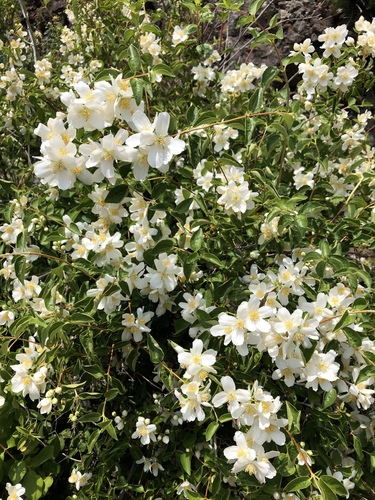
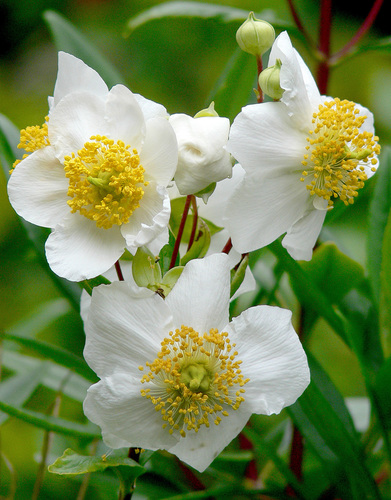
Carpenteria californica Torr., commonly known as bush anemone, grows 1–3 meters (3 ft 3 in – 9 ft 10 in) tall, with flaky bark on its older stems. Its leaves are arranged oppositely, are lanceolate in shape, 4–10 cm (2–4 in) long and 1–2.5 cm (0.4–1.0 in) broad, with a glossy green upper surface and a blue-green to whitish, downy lower surface. The sweetly-scented flowers are 3–7 cm (1–3 in) across, with five to eight pure white petals and a central cluster of yellow stamens. Flowering occurs from late spring to midsummer. The fruit is a leathery capsule 6–12 mm (1⁄4–1⁄2 in) in diameter that contains numerous seeds.
This rare species is endemic to only seven sites located in Fresno and Madera Counties, California, growing in chaparral and oak woodlands at altitudes between 340 and 1,340 m (1,115–4,396 ft), between the San Joaquin River and Kings River. It is well adapted to wildfire, and reproduces via stump sprouts after burning; natural seedlings of the species are rare.
Carpenteria californica is cultivated as an ornamental plant, valued for its lush foliage, large scented flowers, and drought tolerance. It is used in traditional gardens and wildlife gardens in both subtropical and temperate locations across the northern hemisphere. In sheltered, full-sun locations, it is hardy down to −10 °C (14 °F). It has been in cultivation since 1875, and is now much more common in gardens than in its native natural habitat. It first flowered in England in 1885, for the well-known plantswoman Gertrude Jekyll at Godalming. Named cultivars include: 'Bodnant', a cold-tolerant cultivar hardy to −15 °C (5 °F) in the British Isles; 'Elizabeth', which produces masses of smaller white flowers and has a more compact growth habit; and 'Ladham's', which bears large flowers. The cultivars 'Elizabeth' and 'Bodnant' have been awarded the Royal Horticultural Society's Award of Garden Merit.