About Carpatolechia fugitivella (Zeller, 1839)
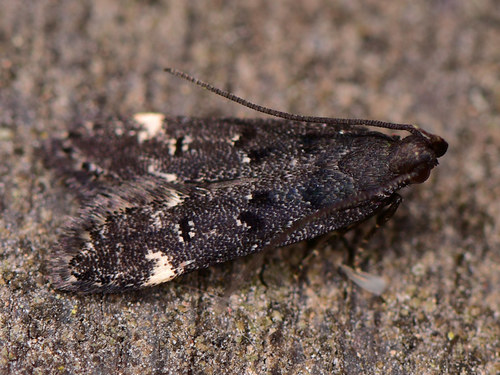
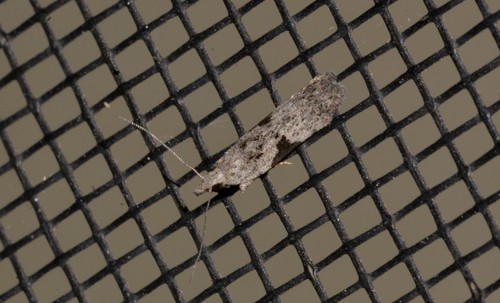
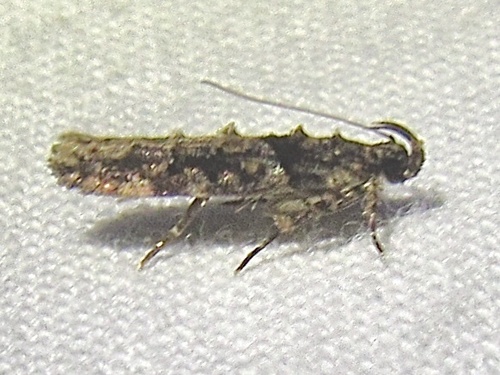
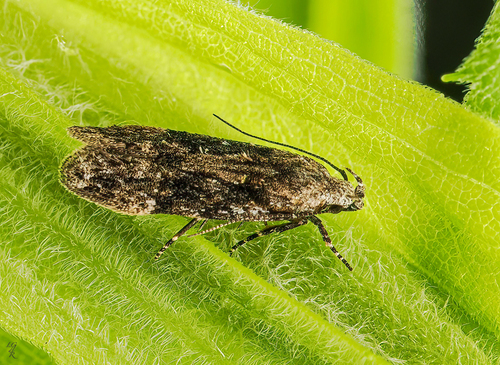
Carpatolechia fugitivella, commonly known as the elm groundling, is a species of moth in the family Gelechiidae. Its distribution covers almost all of Europe, excluding Portugal, Croatia, and Bulgaria; it is also found in Turkey, the Caucasus, Mongolia, southern Siberia, the Russian Far East, Korea, and Canada, where it has been recorded in Ontario and Quebec. It inhabits woodland, parks, gardens, and hedgerows. This moth has a wingspan of 11 to 15 mm. Its head is whitish with grey speckling, and the terminal segment of its palpi is longer than the second segment. Its forewings are grey, dusted with blackish scales, and have suffused blackish spots on the costa near the base, before the middle, and beyond the middle. A blackish streak runs along the fold, which is sometimes split into two or three separate spots. Two black dots are positioned transversely in the disc at the two-thirds mark, and a pale angulated fascia at the three-quarter mark is sometimes made visible by darker suffusion on its anterior side. The hindwings of Carpatolechia fugitivella are grey. Fully grown larvae are light green with a reddish tinge on the dorsal side, have black dots, and have a light brown head and second thoracic plate. Adult moths are active on the wing from June to September. The larvae feed on the tissues of Ulmus species, including Ulmus glabra, as well as Quercus, Corylus, Prunus avium, Pyracantha coccinea, Acer, Tilia, and Fraxinus species.