About Carlito syrichta (Linnaeus, 1758)
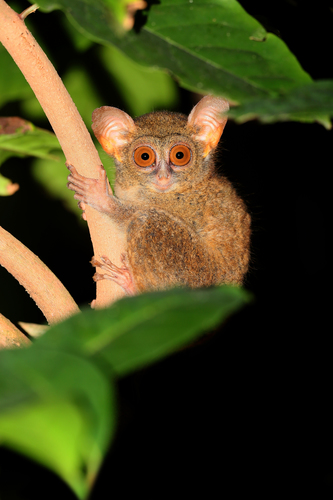
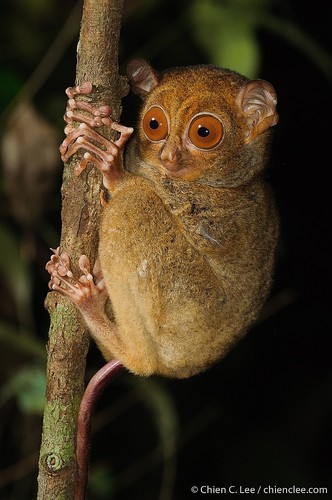
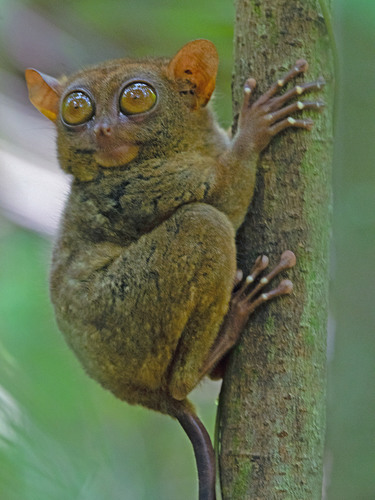
Anatomy and morphology: The Philippine tarsier (Carlito syrichta) measures 85 to 160 mm (3.35 to 6.30 in) in height, making it one of the smallest primates. Its small size makes it difficult to spot. Males have a body mass between 80–160 g (2.8–5.6 oz), and females are usually lighter. This species is somewhat heavier than other tarsiers such as the pygmy tarsier, and the average adult is about the size of an adult human fist. Female Philippine tarsiers have multiple sets of breasts, but only the set at the pectoralis is functional; the other breasts act as anchor points for newborn tarsiers. The gestation period lasts 180 days, or 6 months, after which only one offspring is born. Newborn tarsiers are born fully furred with their eyes open; their combined body and head length is about 70 mm (2.8 in), and their tail is around 115 mm (4.5 in) long. Like all tarsiers, the Philippine tarsier's eyes are fixed in its skull and cannot move within their sockets. Instead, a special neck adaptation allows its round head to be rotated 180°. Its eyes are disproportionately large, giving this species the largest eye-to-body weight ratio of any mammal. These huge eyes provide excellent night vision for this nocturnal animal. In bright light, the tarsier's eyes can constrict until the pupil appears to be only a thin spot; in low light or darkness, the pupil can dilate to fill almost the entire eye. Its large membranous ears are mobile, and appear to be almost constantly moving, allowing the tarsier to detect any movement. The Philippine tarsier has thin, rough fur that ranges in color from gray to dark brown. Its narrow tail, which is usually used for balance, is mostly hairless except for a tuft of hair at the end, and is about twice as long as its body. Its elongated "tarsus", or ankle bone, which gives tarsiers their common name, allows the Philippine tarsier to jump at least 3 m (9.8 ft) between trees. Its long digits are tipped with rounded pads that let C. syrichta cling easily to trees and grip almost any surface. The thumb is not truly opposable, but the first toe is. All digits have flattened nails, except for the second and third toes, which bear sharp claws specialized for grooming. Its dental formula is 2:1:3:3 / 1:1:3:3, with relatively small upper canines. Geographic range and habitat: As its common name suggests, the Philippine tarsier is endemic to the Philippine archipelago. Populations of C. syrichta are generally found in the southeastern part of the archipelago. Established populations occur primarily on the islands of Bohol, Samar, Leyte and Mindanao. It has also been recorded on various isolated islands within its known range, including Maripipi Island, Siargao Island, Basilan Island and Dinagat Island. The Philippine tarsier inhabits second-growth secondary forest and primary forest from sea level up to 700 m (2,300 ft). Its habitat also includes tropical rainforest with dense vegetation and trees that offer protection, such as tall grasses, bushes, and bamboo shoots. It prefers dense, low-level vegetation in secondary forests, with perching sites that average 2 m (6 ft 7 in) above the ground. Early studies found the Philippine tarsier has a home range of 1 to 2 hectares (2.5 to 4.9 acres), but more recent research shows home ranges average 6.45 ha (15.9 acres) for males and 2.45 ha (6.1 acres) for females. This range allows a population density of 16 male and 41 female tarsiers per 100 ha (250 acres). Both males and females are solitary, but will occasionally cross paths at night. They can travel up to 1.5 km (0.93 mi) across the forest, and the optimal habitat area is more than 6 ha (15 acres). Ecology: The Philippine tarsier is primarily insectivorous. Its diet consists of insects, spiders, small crustaceans, and small vertebrates such as small lizards and birds. C. syrichta preys on live insects, particularly crickets and grasshoppers. After seizing its prey, the tarsier carries it to its mouth using both hands. Reproduction: The Philippine tarsier's gestation period lasts about six months, while the female's estrous cycle lasts 25–28 days. The mating season runs from April to May. Males deposit a mating plug in the female's vagina after intercourse. Females give birth to one offspring per gestation. The infant is born with hair and its eyes open. Females carry their infants in their mouths. A newborn can already cling to branches, and less than a month after birth, it can start leaping. Newborns are breastfed until 60 days after birth. Philippine tarsiers become sexually mature and able to reproduce after two years of age.