About Carlina salicifolia (L.fil.) Cav.
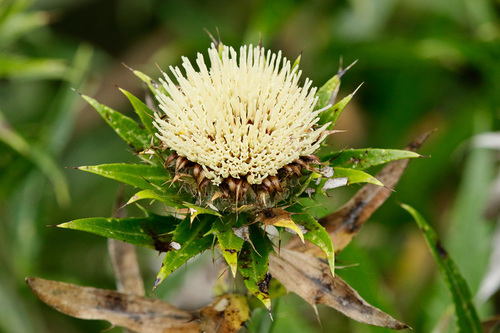
Carlina salicifolia (L.fil.) Cav. is a low shrubby perennial that reaches up to 1 m in height. Its stems are branched, covered in white tomentum on their upper sections, and marked with prominent leaf scars. Leaves are alternate, entire, and deciduous, though they remain attached to the plant long after withering. They are crowded towards the ends of branches, measuring 6–10 cm long by 6–15 mm wide. They are lanceolate and coriaceous, green and glabrescent on the upper surface, and densely white tomentose on the lower surface. They are nearly stalkless, with a few ciliate spines at the base. Capitula are 15–30 mm in diameter, excluding the outer bracts. They are discoid to hemispherical, borne on short peduncles, and grow either solitary or arranged in corymbs. The outer involucral bracts are large and leafy, varying in length, and shaped lanceolate to ovate. The innermost outer bracts are scarious, shiny, stiff, and spread out when dry. The inner involucral bracts are shorter than the outer ones, scarious, recurved, spiny at the apex, and colored blackish or purplish brown. The receptacle is flat, with persistent scales divided into linear segments. Bristles are sometimes also present, and are often tipped with red. All florets are creamy yellow, hermaphrodite, and have a tubular 5-lobed corolla; ray florets are entirely absent. Achenes are oblong and measure 3 mm long. The pappus consists of one row of plumose, dense, appressed, caduceus, shiny brown hairs that are 2- to 3-branched and united at the base into clusters. Flowering occurs from May to August. This species grows across most of the island of Madeira, occurring on cliffs and rocky slopes. It can also be found on Porto Santo and the Desertas. It is native to all of the Canary Islands, where it is common on cliffs in upper xerophytic and forest zones at elevations between 200–1600 m. It is very rare on Lanzarote, where it only occurs in the Famara mountain range, and on Fuerteventura, where it is restricted to the Jandia area that covers the island’s southwestern mountainous region.