About Carlina corymbosa L.
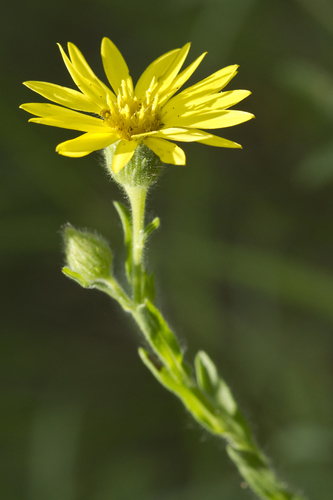
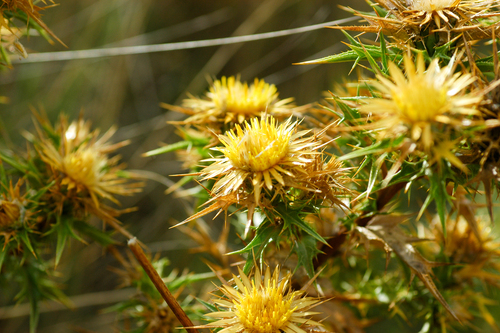
Carlina corymbosa L. grows to an average height of 10 to 90 centimeters (4 to 35 inches). It is a hemicryptophyte, with rhizomatous roots and overwintering buds located just below the soil surface, and has a scapose growth form, meaning its almost leafless stalk grows directly from the ground. Its stem is green to whitish, thick, and erect. Leaves are alternate, either stalkless or clasping the stem, lobed, and have spines along the margins. The terminal yellow flower heads are 2.0 to 3.5 centimeters (0.8 to 1.4 inches) in diameter, surrounded by thorny bracts. The outer bracts resemble the plant’s leaves, while the inner bracts that surround the disk florets are membranous, stiff, and golden in color. Flowering occurs from June through August. The flowers are hermaphroditic and pollinated by insects, most commonly bees, wasps, and butterflies, which is a pollination method called entomogamy. Fruits are achenes 2.5 millimeters (0.1 inch) long, each bearing a feathery yellow pappus. Seeds are dispersed by wind, a dispersal method called anemochory. This species is native to the Mediterranean region, and occurs in Albania, the Balearic Islands, Bulgaria, Corsica, Crete, France, Greece, Spain, Italy, former Yugoslavia, Sardinia, Sicily, and Turkey. It grows in sunny, dry locations, including sandy or rocky ground, grassland soils, roadsides, and fallow land, at altitudes ranging from 0 to 1,200 meters (0 to 3,937 feet) above sea level.