About Carissa spinarum L.
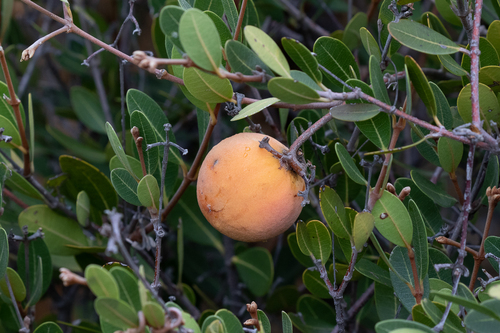
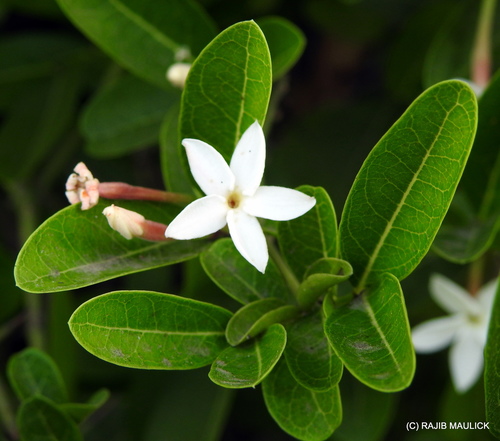
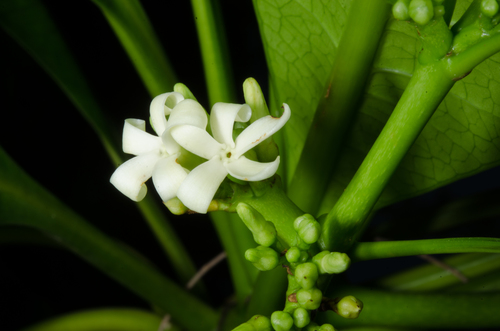
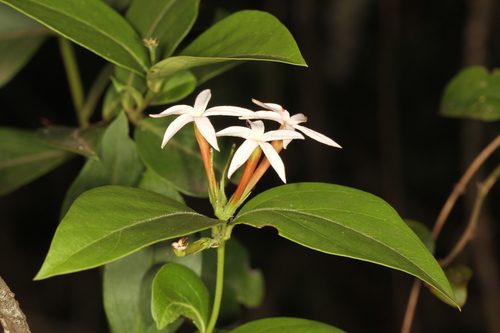
Carissa spinarum, commonly known as conkerberry or bush plum, is a large shrub in the dogbane family (Apocynaceae). It is widely distributed across tropical regions of Africa, Southern Asia, Australia, and various islands of the Indian Ocean. It is most prominent in Australia, where it is also called currant bush; more ambiguous common names include native currant or even black currant. However, this species is not closely related to true plums (genus Prunus) or true currants (genus Ribes), which belong to entirely separate eudicot lineages. In India, it is called wild karanda or wild karavanda, named after the closely related species karanda (Carissa carandas). Carissa spinarum is often referenced under its many now-obsolete synonyms. This plant grows as a multi-stemmed shrub, reaching 0.5 to 3 meters (1.6 to 9.8 feet) in height. Its leaves are glossy green, arranged oppositely, and shaped from narrow ovate to lanceolate, measuring 1–5 centimeters (0.4–2.0 inches) long. Its branches bear thorns 1–3 centimeters (0.4–1.2 inches) long. It produces white, star-shaped flowers around 1 centimeter (0.4 inches) across. After flowering, it develops ovate green berries 1–2 centimeters (0.4–0.8 inches) long that turn black or dark purple when fully ripe. In terms of ecology, Carissa spinarum is most commonly found in semiarid coastal regions growing on fine-textured soils such as clays and clay-loams. In more arid regions, the plant is typically confined to areas with higher moisture, such as at the base of hills or in floodout areas. Despite this preference, it has high ecological tolerance and can survive in a wide range of habitats. For example, in Australia it is often found growing alongside Eucalyptus brownii, poplar box (Eucalyptus populnea), gidgee (Acacia cambagei), or brigalow (Acacia harpophylla). It grows in coastal rainforest, gallery forest, and vine thickets in regions that receive more than 900 millimeters (35 inches) of annual rainfall, as well as in softwood scrubs and open eucalypt savannas that receive less than 700 millimeters (28 inches) of annual rainfall. The ripe conkerberry fruit is edible, and only fully ripe fruits are safe to eat. Ripe fruits have a sweet flavor, but the milky sap of the entire plant and unripe fruit are poisonous, which is typical for members of the Apocynaceae family. The fruit is a popular traditional bush tucker food for Australian Aboriginal people living in Central Australia. In Arrernte language the fruit is called merne arrankweye, in Anmatyerr it is called anwekety, and in Pintupi it is called nganango. The fruits are also a common food source for the Australian bustard, emu, and many other bird species across the plant's range. Its leaves serve as food for butterflies such as the Australian crow (Euploea core) and for some moths including certain hawkmoths. In northern Australia, Carissa spinarum is frequently a weed in grazing land. It chokes out native grasses, reduces the area available for livestock to feed, interferes with stock handling, and provides shelter for vermin. The plant can reproduce quickly via layering, is difficult to control with mechanical methods, and expensive to manage using herbicides. On the other hand, it has been used in projects to restore habitat for small birds in disturbed dry rainforest in Queensland, Australia. The Maasai people of Kenya use parts of this plant medicinally to treat joint and muscle pain. Extracts made from the plant's fruit have demonstrated both antioxidant and antidiabetic properties.