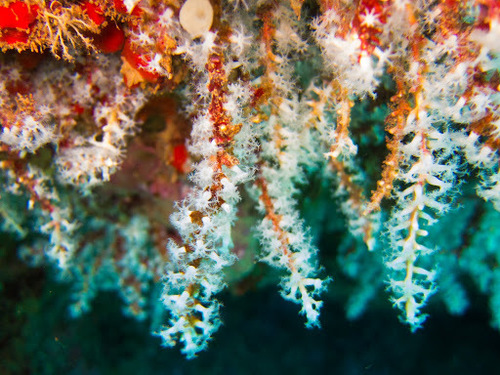
About Carijoa riisei (Duchassaing & Michelotti, 1860)
Carijoa riisei is a colonial soft coral with a tangled, bushy growth form. It has hollow branches that may reach 30 cm (12 in) in length, growing from a creeping stolon. Branches develop by budding off the stolon, and feature eight longitudinal furrows and a prominent polyp at their tip. The calyces that hold the polyps are tubular, widely spaced across the branches, 3 to 5 mm (1⁄8 to 3⁄16 in) long, and 1.5 mm (1⁄16 in) wide. Polyps are able to retract into the branches. Originally, Carijoa riisei was thought to be native to the tropical and semi-tropical western Atlantic Ocean, including the Caribbean Sea and the Gulf of Mexico, with a range stretching from South Carolina to Brazil. It is now considered to be invasive across its entire range in the western Atlantic Ocean. This species has a global distribution and is widely found in association with high-traffic shipping ports. It was first detected in Hawaii in 1972, when it appeared in Pearl Harbor, and has since spread to all other islands in the Hawaiian archipelago. It has also been detected on many other Indo-Pacific islands, as well as along the coasts of Australia and Asia. In Ecuador, the first report of Carijoa riisei came in 2010 from Machalilla National Park, followed by detections in 2011 at Galera San Francisco Marine Reserve in Esmeraldas Province, in 2012 at El Islote Los Ahorcados in Manabí Province and at El Pelado Marine Reserve, and in 2013 at a small number of additional coastal locations and one offshore site. As of 2020, 22 known colonies of C. riisei exist along the coast of Ecuador; the largest of these is located in Jama, Manabí Province. Several uncolonized suitable habitat areas remain along Ecuador’s coast, which have not been colonized by chance. C. riisei generally smothers other corals as it grows, but does not do so to another Indo-Pacific invasive species, Tubastraea coccinea. Carijoa riisei is a shade-loving species that grows on hard surfaces away from direct sunlight; common growing sites include caves, overhangs, ledges, and areas under piers. It is a common hull fouling organism that can grow on metal, wood, concrete, plastic, and rope. It grows best in turbid water with moderate to strong currents or wave action.

