About Cariblatta lutea (Saussure & Zehntner, 1893)
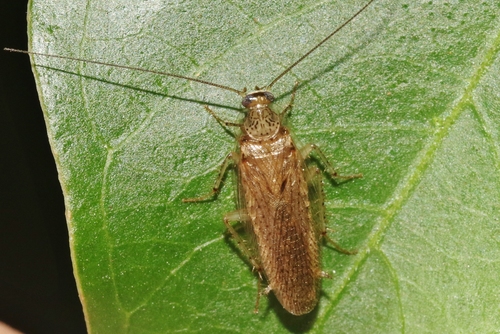
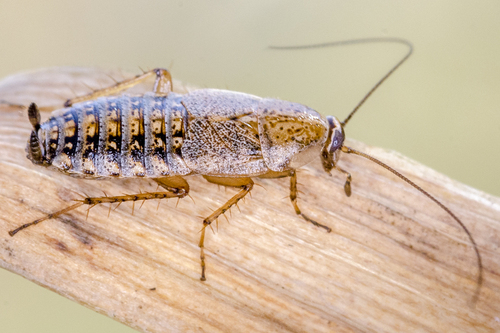
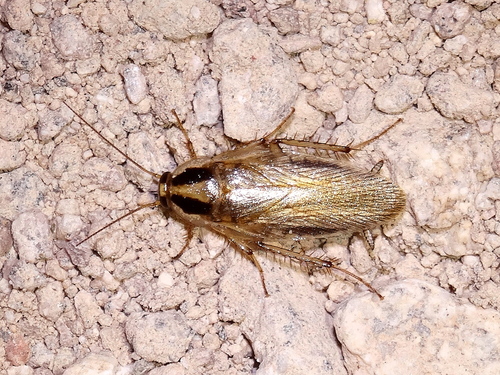
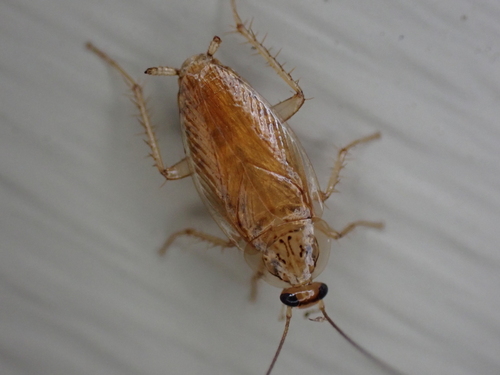
This species, Cariblatta lutea, includes two subspecies: Cariblatta lutea lutea and Cariblatta lutea minima. The nominate subspecies Cariblatta lutea lutea has a pale brownish-yellow body, a pale brown head with a band between the eyes, and usually has dark brown spots on the face. The disc of its pronotum (the head shield) is typically marked with several small brownish spots, and the sides of the pronotum are transparent. The tegmina, the leathery forewings, usually do not reach all the way to the apex of the abdomen. Male tegmina are distinctly shorter than female tegmina, and female tegmina have rounded tips. In males, the section of the subgenital plate between the styles is three times as long as it is broad. In females, the subgenital plate is large, boat-shaped, and has a rounded apex. Females of this subspecies tend to be larger than males and have much shorter wings. Female body length ranges from 7.0–9.5 mm (0.28–0.37 in), while male body length ranges from 5.8–8.1 mm (0.23–0.32 in). Female pronotum length ranges from 2.2–2.6 mm (0.087–0.10 in), compared to 1.8–2.1 mm (0.071–0.083 in) for male pronotum length. Cariblatta lutea minima is on average smaller and has shorter tegmina than Cariblatta lutea lutea. Males of the C. l. minima subspecies also have shorter inner rudimentary wings and a much narrower subgenital plate than males of C. l. lutea. In C. l. minima, males are slightly smaller than females. Male body length ranges from 5.4–7.7 mm (0.21–0.30 in), and male pronotum length ranges from 1.8–2.1 mm (0.071–0.083 in). Female body length ranges from 5.8–8.0 mm (0.23–0.31 in), and female pronotum length ranges from 2.0–2.3 mm (0.079–0.091 in). Cariblatta lutea lutea is distributed across the coastal plains of the southeastern United States, including the states of Alabama, Florida, Georgia, Louisiana, Mississippi, North Carolina, South Carolina, Texas, and Virginia, and is also found in Cuba. Cariblatta lutea minima is only documented in Cuba and several counties in Florida. In the southeastern US, Cariblatta lutea lutea lives in leaf, grass, and pine needle litter within forests. In Florida, it is common across a wide variety of plant communities, and has also been found in gopher tortoise burrows, disturbed areas, and near houses. Cariblatta lutea minima is found in hardwood hammocks in southern peninsular Florida and the Florida Keys, in open pinelands in Dade County, and in a variety of scrub, flatwoods, and hammock plant communities in northeastern Florida. It has also been collected in Spartina marshes, sawgrass marshes, and in grasses growing behind beaches.