About Cariama cristata (Linnaeus, 1766)
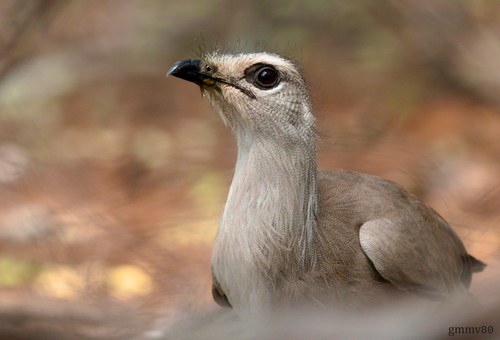
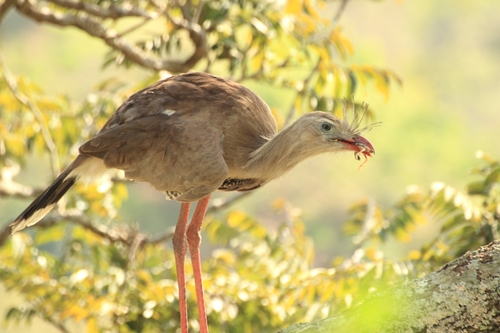
The red-legged seriema, scientifically named Cariama cristata (Linnaeus, 1766), measures 75 to 90 centimetres (30 to 35 in) in length and weighs 1.5 to 2.2 kilograms (3.3 to 4.9 lb). It has long legs, necks, and tails, with males slightly larger than females. Its plumage is greyish-brown, finely barred and vermiculated with dark brown and black; the head, neck, and breast are pale brown, and the belly is white. Its long, broad outer tail has a subterminal black band and a white tip. It has a reddish beak, very long salmon-coloured legs, yellow eyes, and soft feathers growing from the base of its bill that form a distinctive fan-shaped crest. It shares many characteristics with the black-legged seriema (Chunga burmeisteri), the only other living member of its family Cariamidae, and further discussion of these shared traits can be found in the Cariamidae article.
The red-legged seriema is distributed across most of central and eastern Brazil, Paraguay, eastern and southeastern Bolivia, Uruguay, and northeastern Argentina. It occurs at elevations up to 2,000 m (6,600 feet). It prefers grassland habitat above all other types. While it often lives in lush meadows near rivers, it does not readily enter wetlands or crop fields. It commonly occupies semi-open, fairly dry areas including thorny scrub, semi-arid woodland regions, savannas, ranchlands, and hilly grasslands near wooded areas. This species is very common in the Caatinga, Cerrado and Chaco regions.
Red-legged seriemas are wary, territorial, diurnal birds. They are generally sedentary, though there are reports of temperature-related migrations. They are typically seen alone or in pairs, and occasionally in groups of up to four individuals that are apparently family groups. They usually walk on the ground and can easily run faster than a human in their native habitat. They will outrun a car on foot at speeds up to 25 km/h (15 mph) before taking flight. Territorial defense may involve aggressive confrontations between individuals, which start with full vocal duets, followed by short runs and flights toward intruders, alternated with attacks using claws and beak. In one recorded conflict between two birds, the individuals jumped at each other feet-first, keeping their balance by flapping their wings. This species typically builds its nest on low trees or bushes, so adults can reach the nest from the ground via short hops or flutters rather than flight. Red-legged seriemas have an unusual method of hunting vertebrate prey: they pick prey up with their beak and repeatedly throw it against the ground until it is stunned or dead.
Red-legged seriemas are monogamous. In the wild, the breeding season aligns with rainy months: it falls between February and July in northeastern Brazil, September to January in central Brazil, and November to December in Argentina. During the breeding season, the male acts more intimidating to assert himself over the female, spreads his wings laterally, moves them forward, and displays the contrasting arrangement of his flight feathers—a pattern similar to that seen in certain birds of prey, such as the African secretarybird (Sagittarius serpentarius). This display is often followed by the male strutting in front of the female, with his head raised and crest lifted. The male also gives food from his regular diet to the female. Both birds call, which reinforces their pair bond and establishes the pair's territory. Copulation occurs on the ground. Females typically lay 2–3 white eggs with soft spotting. Incubation is performed by both sexes, and lasts 24–30 days. The chicks are covered in long, light brown feathers and are fed by both parents; newly hatched chicks weigh around 40–60 g (1.4–2.1 oz). Chicks are able to leave the nest at around 14 days of age. At this stage, chicks can produce a faint call similar to adult vocalizations to attract their parents' attention. They gain full adult plumage at 4–5 months of age.